Exploring the Meaning of Pepoithesis in Greek
πεποίθησις means “confidence” and appears six times in Scripture: 2 Corinthians 1:15; 3:4; 8:22; 10:2; Ephesians 3:12; Philippians 3:4.
Core Meaning
πεποίθησις is defined as “confidence.” Its six New Testament occurrences show the term in varied contexts.
Learn More →Pauline Contexts
It appears repeatedly in 2 Corinthians (1:15; 3:4; 8:22; 10:2). It also occurs in Ephesians 3:12 and Philippians 3:4.
Learn More →Usage Snapshots
In Ephesians 3:12, it is linked with boldness and access “in confidence through our faith in him.” In Philippians 3:4, it is used of “confidence…in the flesh.”
Learn More →Pepoithesis means “confidence.” It appears in a cluster of Pauline passages, most densely in 2 Corinthians, where it is applied to travel plans, ministry posture, relationships in the churches, and the contrast between confidence “through Christ” and confidence “in the flesh.”
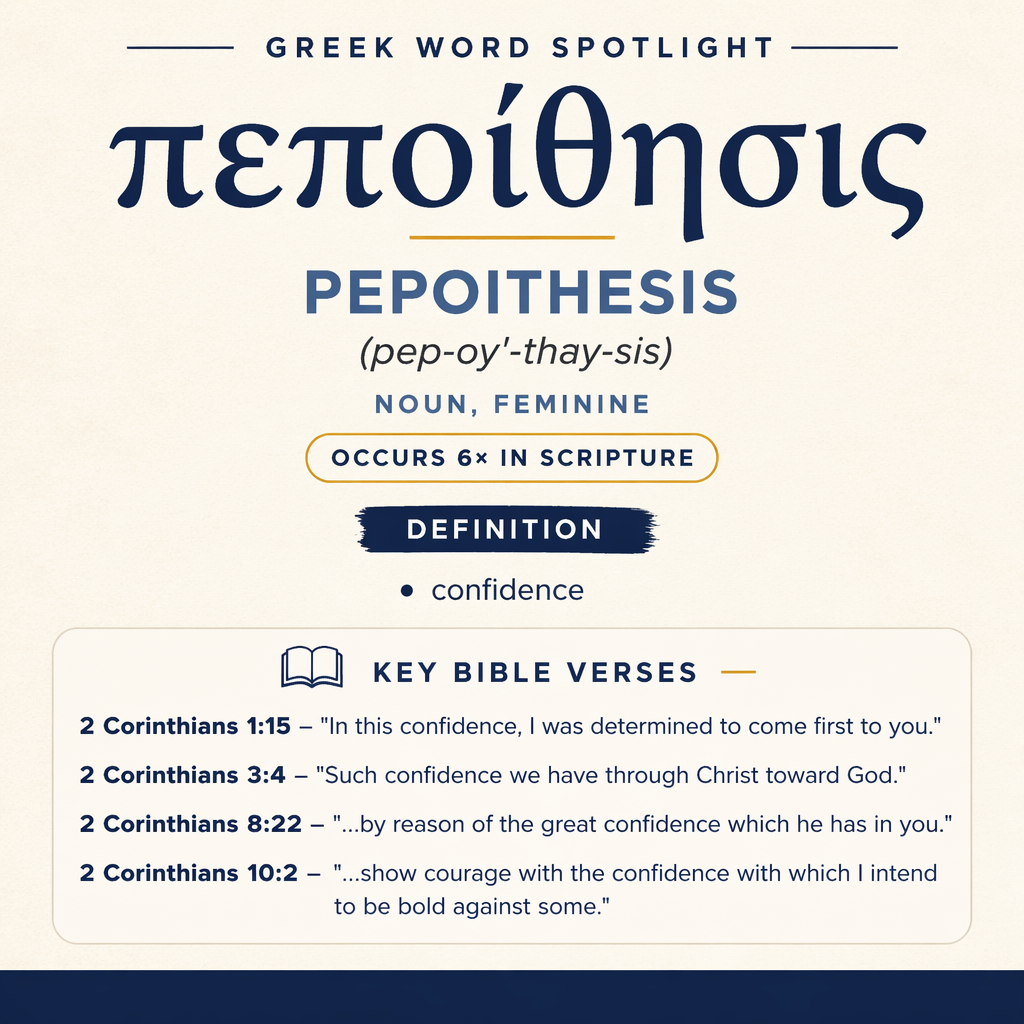
Occurrences
“In this confidence, I was determined to come first to you, that you might have a second benefit,” (2 Corinthians 1:15)
Here pepoithesis frames an intended course of action: “I was determined to come first to you.” Confidence is the stated footing for a concrete decision about presence and timing. The verse places confidence not as a private feeling but as the stance from which a resolve (“determined”) is formed, directed toward the Corinthians’ good (“that you might have a second benefit”). Pepoithesis thus supplies the tone of assurance behind a plan that aims to bless the recipients.

“Such confidence we have through Christ toward God,” (2 Corinthians 3:4)
In this line, pepoithesis is explicitly located: it is “through Christ” and oriented “toward God.” The prepositional phrases define the pathway and direction of confidence. The verse’s compact structure makes confidence relational: it is not merely possessed (“we have”) but mediated (“through Christ”) and directed (“toward God”). Pepoithesis thereby marks a settled assurance that is compatible with speaking and acting in God’s presence, grounded in the Christ-mediated relationship indicated in the wording.
“We have sent with them our brother, whom we have many times proved earnest in many things, but now much more earnest, by reason of the great confidence which he has in you.” (2 Corinthians 8:22)
In this sending report, pepoithesis becomes a motive force that intensifies earnestness. The brother’s character has been “proved” over time, and his present zeal is heightened “by reason of the great confidence which he has in you.” Confidence here is interpersonal and community-directed: it is “in you,” the recipients, and it produces practical results—greater earnestness and readiness for the mission associated with “sent with them.” Pepoithesis is thus portrayed as a confidence that can be placed in a church and that energizes faithful service rather than replacing it.
“Yes, I beg you that I may not, when present, show courage with the confidence with which I intend to be bold against some, who consider us to be walking according to the flesh.” (2 Corinthians 10:2)
Here pepoithesis is closely paired with public demeanor: “show courage,” “intend to be bold.” Confidence is the inner posture that would underwrite a confrontational boldness “against some.” At the same time, the sentence reveals that Paul prefers not to have to enact this confidence “when present”; he “beg[s]” that circumstances will not require it. Pepoithesis in this verse therefore carries a sharpened edge: it can stand behind firmness and even severity, yet it is invoked in the context of a plea to avoid that face-to-face display. The mention of opponents “who consider us to be walking according to the flesh” sets up a contested evaluation of Paul’s conduct, and confidence is part of how he would respond to that challenge.
“In him we have boldness and access in confidence through our faith in him.” (Ephesians 3:12)
This occurrence places pepoithesis alongside “boldness and access,” describing the manner in which approach is made. Confidence qualifies “access”: it is access “in confidence,” not hesitating or tentative. The verse also specifies the sphere and means: “In him” and “through our faith in him.” Pepoithesis therefore functions as the settled assurance that accompanies approach, linking confident access with faith’s reliance. In this sentence, confidence is not isolated; it is coordinated with boldness (freedom of speech or posture) and access (entry or approach), describing a full-bodied way of coming near “in him.”
“though I myself might have confidence even in the flesh. If any other man thinks that he has confidence in the flesh, I yet more:” (Philippians 3:4)
In Philippians, pepoithesis is placed in a contrastive frame by the repeated phrase “in the flesh.” Paul presents a hypothetical basis for confidence: “I myself might have confidence even in the flesh.” He then amplifies the comparison: if anyone else “thinks that he has confidence in the flesh,” Paul claims an even stronger claim by that measure (“I yet more”). Pepoithesis here is a measurable, comparable posture—something one can “think” one has, something that can be claimed competitively. The verse’s rhetoric treats confidence as capable of being grounded in a particular sphere (“the flesh”), and it sets up a critique by first conceding that, on those terms, Paul could surpass others.

Sense and Usage
Across these passages, pepoithesis consistently denotes a settled assurance that supports action, speech, and stance. In 2 Corinthians 1:15 it is the footing for a concrete intention (“determined to come first”), showing that confidence can underwrite pastoral planning and relational commitments. In 2 Corinthians 8:22, confidence is not static; it actively motivates and strengthens diligence (“much more earnest”), illustrating how confidence in a community can produce energetic service rather than complacency.
Several occurrences define confidence by its direction and sphere. In 2 Corinthians 3:4, confidence has a vertical orientation (“toward God”) and a mediating channel (“through Christ”), locating assurance in a relationship shaped by Christ and directed Godward. Ephesians 3:12 similarly anchors confidence “in him” and links it to “faith,” but the emphasis there is experiential posture: confidence is the mode in which “access” is possessed, paired with “boldness.” Together these verses show pepoithesis as confidence that functions in proximity to God—language of approach, orientation, and mediated relationship—rather than as a generalized self-trust.
At the same time, pepoithesis can stand behind firmness in contested situations. In 2 Corinthians 10:2 confidence is closely related to intended boldness against critics. Yet the verse’s tone is controlled: Paul asks that he not need to display that confident courage “when present.” Confidence here is not presented as aggressiveness for its own sake; it is the kind of assurance that could be expressed sharply if required by the situation, and it is invoked precisely to avoid having to use it.
Philippians 3:4 places pepoithesis into a different argumentative setting: the question is not whether one can be confident, but where that confidence is located (“in the flesh”) and how it is evaluated. The verse depicts confidence as something people can “think” they possess and can compare with others. The repetition of the phrase “confidence in the flesh” highlights that pepoithesis can be attached to a particular grounding or realm. In the immediate wording, Paul’s strategy is to acknowledge the possibility of such confidence and to assert that, by those standards, he could exceed competitors; pepoithesis is the category that allows the comparison to be made at all.
When the occurrences are read together, pepoithesis is shown operating on multiple relational axes: toward a church (“in you,” 2 Corinthians 8:22), toward God (“toward God,” 2 Corinthians 3:4), and within an individual’s self-assessment vis-à-vis others (“If any other man thinks…,” Philippians 3:4). The word’s force is not limited to internal feeling; it regularly appears at moments of decision, sending, access, and confrontation. Confidence is portrayed as something one can have, intend to act with, and exercise in ways that affect others—either by strengthening cooperative ministry or by enabling decisive response to criticism.
Imagery and Posture
The passages attach pepoithesis to bodily and relational posture: coming “first” to a community (2 Corinthians 1:15), being “sent” with others in proven earnestness (2 Corinthians 8:22), standing present with courage and boldness if necessary (2 Corinthians 10:2), and having “boldness and access” in a confident approach (Ephesians 3:12). Even where confidence is contested (“in the flesh,” Philippians 3:4), it is depicted as something that shapes one’s stance in comparison and argument. Pepoithesis, in these texts, is confidence that shows itself in how one moves toward others and toward God.
Sources: Lexical data from Strong’s Exhaustive Concordance and the Translators Brief Lexicon of Extended Strongs for Greek (STEPBible, CC BY). Occurrence data from the Translators Amalgamated Greek New Testament (STEPBible, CC BY). Scripture quotations from the World English Bible (public domain).