
Exploring the Meaning of Pardalis in Greek
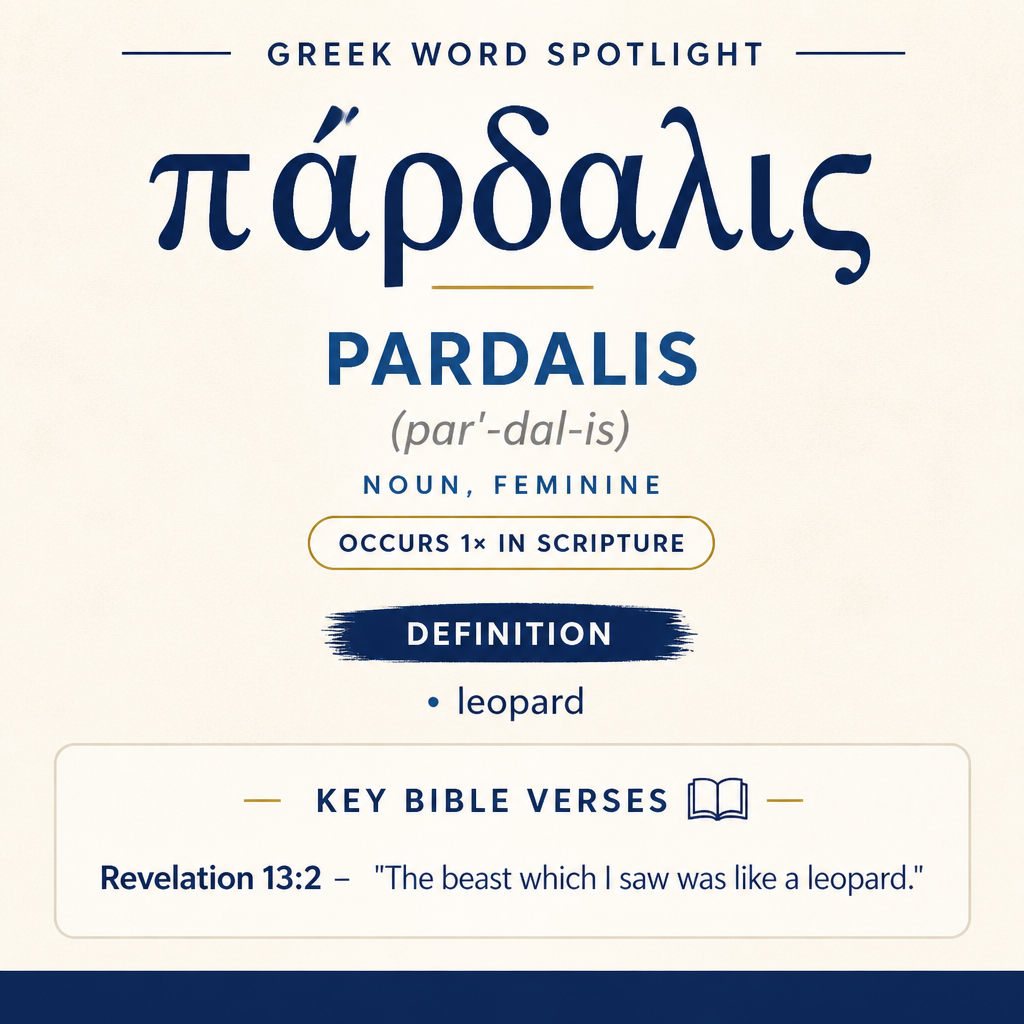
πάρδαλις means “leopard” and appears once in Scripture, in Revelation 13:2.
Biblical Usage
It occurs one time in Scripture. The only occurrence is in Revelation 13:2.
Learn More →Context in Verse
In Revelation 13:2, the beast John saw was like a leopard. The verse also compares its feet to a bear and its mouth to a lion.
Learn More →πάρδαλις refers to a “leopard” and appears in the New Testament in a single verse describing the appearance of “the beast” in Revelation. In that scene the word functions as part of a sequence of animal comparisons used to depict the creature’s likeness and features.
Occurrences
“The beast which I saw was like a leopard, and his feet were like those of a bear, and his mouth like the mouth of a lion. The dragon gave him his power, his throne, and great authority.” (Revelation 13:2)
Here πάρδαλις supplies the first and controlling comparison in the description: “The beast which I saw was like a leopard.” The verse then adds further likenesses (“feet…like those of a bear,” “mouth like the mouth of a lion”), so “leopard” introduces a composite portrait in which one creature is portrayed through multiple animal resemblances. Within the sentence, the leopard comparison speaks to the beast’s overall appearance (“was like a leopard”), while the later comparisons narrow to specific body parts (“feet,” “mouth”). As a result, “leopard” frames the initial visual impression before the text specifies additional details.
The comparison is embedded in a larger statement about delegated rule: “The dragon gave him his power, his throne, and great authority.” The verse moves from what the beast looks like to what the beast receives. In that transition, the leopard-likeness belongs to the beast’s observed form (“which I saw”), while the subsequent clause explains the source of its power and authority. πάρδαλις therefore participates in the vision’s portrayal by furnishing a concrete animal image that stands alongside the verse’s political-sounding terms (“power,” “throne,” “authority”), keeping the description anchored in vivid, bodily imagery even as the narrative speaks of rule and empowerment.

Sense and Usage
In Revelation 13:2 the sense “leopard” functions as an image-term rather than as a zoological reference for its own sake. The word is used in a simile (“like a leopard”), so it does not identify the beast as a leopard but presents leopard-likeness as a way of seeing it. That mode of usage highlights perception and resemblance: the narrator reports what the beast is “like” in appearance, placing the reader in the position of picturing the creature through a familiar animal category.
The verse’s structure gives πάρδαλις a particular rhetorical weight. Because the beast is first compared to a leopard and only afterward are individual features compared to other animals, “leopard” governs the primary likeness and sets the tone for the rest of the description. The bear and lion comparisons then refine the picture by assigning different animal resemblances to different parts. This makes “leopard” the broadest comparison in the line, a single likeness that covers the whole beast before the imagery becomes anatomically specific.
The immediate context also shows how the leopard image works alongside notions of dominion. The verse pairs an animal portrait with the granting of “power,” “throne,” and “great authority.” Within that pairing, πάρδαλις contributes a concrete, visual designation in a sentence that also carries abstract and institutional vocabulary. The effect is that the beast’s authority is presented in the same breath as its striking appearance: the vision does not separate what the beast is like to behold from what it is enabled to do or possess. The leopard comparison, as part of the observed likenesses, belongs to the narrative’s way of rendering the beast as a visually graspable figure within a scene of bestowed authority.
Imagery
Revelation 13:2 places πάρδαλις within a cluster of animal images—leopard, bear, lion—so “leopard” contributes to a deliberately layered picture rather than a single, isolated metaphor. The beast is described through resemblance, and the stacked comparisons build an impression of a creature whose appearance is best communicated by borrowing multiple animal forms. In that imaginative environment, πάρδαλις is a key component of the verse’s visual language: it is the first likeness named, and it helps establish the overall animal-like character of the beast as it is seen.
Sources: Lexical data from Strong’s Exhaustive Concordance and the Translators Brief Lexicon of Extended Strongs for Greek (STEPBible, CC BY). Occurrence data from the Translators Amalgamated Greek New Testament (STEPBible, CC BY). Scripture quotations from the World English Bible (public domain).





