Exploring the Meaning of Parakathizo in Greek
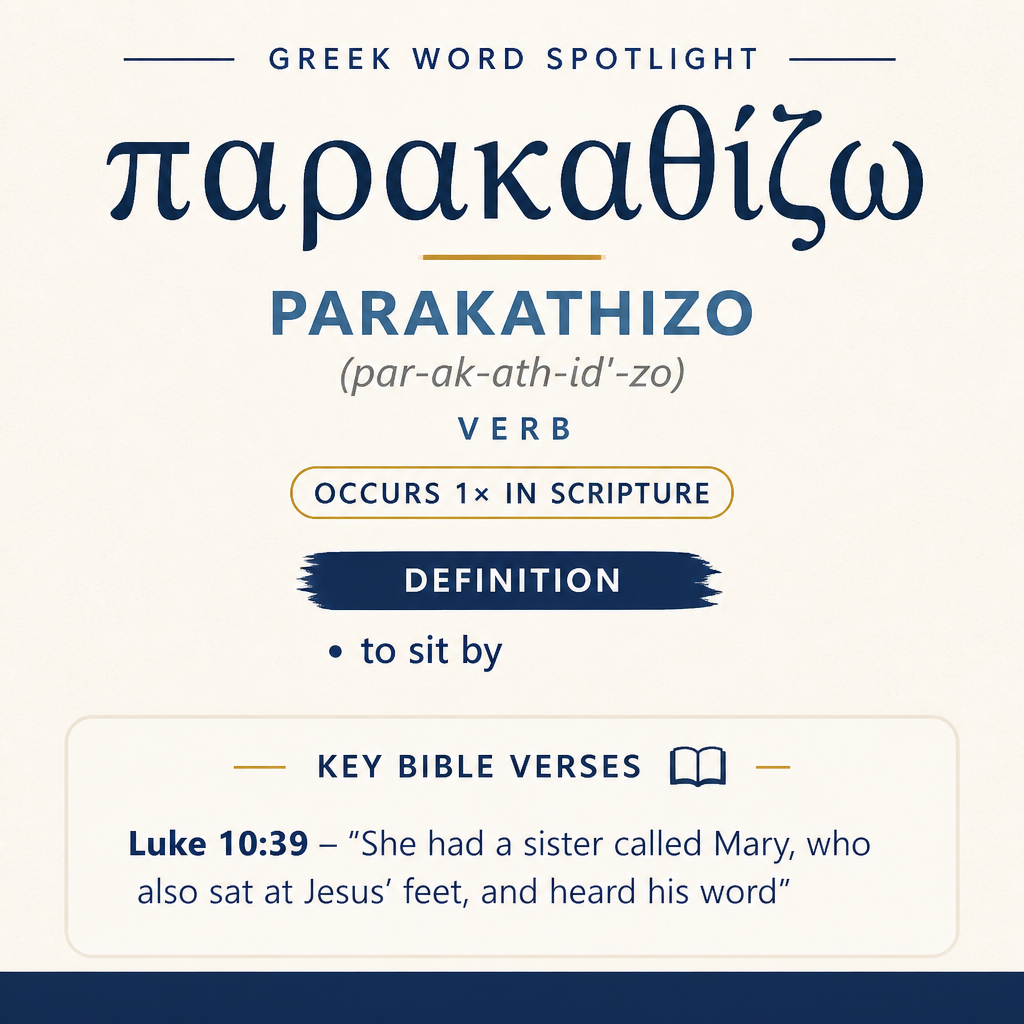
παρακαθίζω means “to sit by” and appears once in Scripture, in Luke 10:39.
παρακαθίζω means “to sit by,” and it is attested in the Gospel scene where Mary positions herself beside Jesus in attentive hearing (Luke 10:39). The verb contributes a concrete, bodily posture that frames the act of listening.
Root and Related Words
παρακαθίζω is formed from para (παρά), “from/with/beside” (Strong’s G3844), and kathizo (καθίζω), “to seat” (Strong’s G2523). The combination of these elements yields a verb built around sitting with or beside someone as an intentional placement.

Occurrences
“She had a sister called Mary, who also sat at Jesus’ feet, and heard his word.” (Luke 10:39)
In Luke 10:39, παρακαθίζω describes Mary’s action in relation to Jesus: she “sat at Jesus’ feet” and “heard his word.” The verb ties Mary’s listening to a deliberate physical nearness. Her hearing is not presented as incidental or at a distance; it is anchored in her choice to be seated beside him, within the space of his presence and instruction.
The wording also binds posture and attention into a single scene. Mary’s sitting is not merely a change of position; it is the setting in which her hearing occurs. The verse pairs the spatial detail (“at Jesus’ feet”) with the auditory focus (“heard his word”), so the act of sitting by functions as the enacted preface to receiving what is spoken. In narrative terms, the verb gives the reader a visible arrangement of the room: Jesus as the one speaking, Mary as the one who has taken the place nearest him, oriented toward his words.
Sense and Usage
The core sense “to sit by” is spatial and relational: it expresses sitting as an action defined by proximity to another person. In Luke 10:39 that proximity is specified with vivid concreteness—Mary is placed “at Jesus’ feet.” The verb therefore serves to locate the listener, not only as a character who hears, but as one who positions herself beside the speaker in a way that makes her listening a settled, sustained activity rather than a passing moment.
Because the verse links this sitting with hearing, the posture carries narrative weight. The scene depicts listening that happens from a chosen place of nearness. “To sit by” does not add new content to “heard his word,” but it shapes how that hearing is portrayed: as attentive presence, embodied in sitting close. The verb thus functions as a compact way of expressing that Mary’s engagement with Jesus’ speech is grounded in her physical closeness and her readiness to remain there.
Even within this single attestation, the verb’s components help explain its force. The presence of para (παρά), with its sense “from/with/beside,” draws the act of sitting into the sphere of companionship and adjacency. The element kathizo (καθίζω), “to seat,” supplies the basic action of taking a seated position. Together, they yield a verb suited to scenes where the important point is not simply sitting, but sitting beside someone—taking a place close enough that relationship, attention, and access are implied by the posture itself.
Imagery
The imagery of Luke 10:39 is quiet and focused: a seated figure near Jesus, oriented toward his speech. παρακαθίζω carries the picture of settled closeness—sitting by in a way that makes space for hearing. In this scene, the verb invites the reader to picture not movement or activity, but a deliberate stillness placed alongside Jesus, where words can be received.
Sources: Lexical data from Strong’s Exhaustive Concordance and the Translators Brief Lexicon of Extended Strongs for Greek (STEPBible, CC BY). Occurrence data from the Translators Amalgamated Greek New Testament (STEPBible, CC BY). Scripture quotations from the World English Bible (public domain).