
Exploring the Meaning of Parabates in Greek
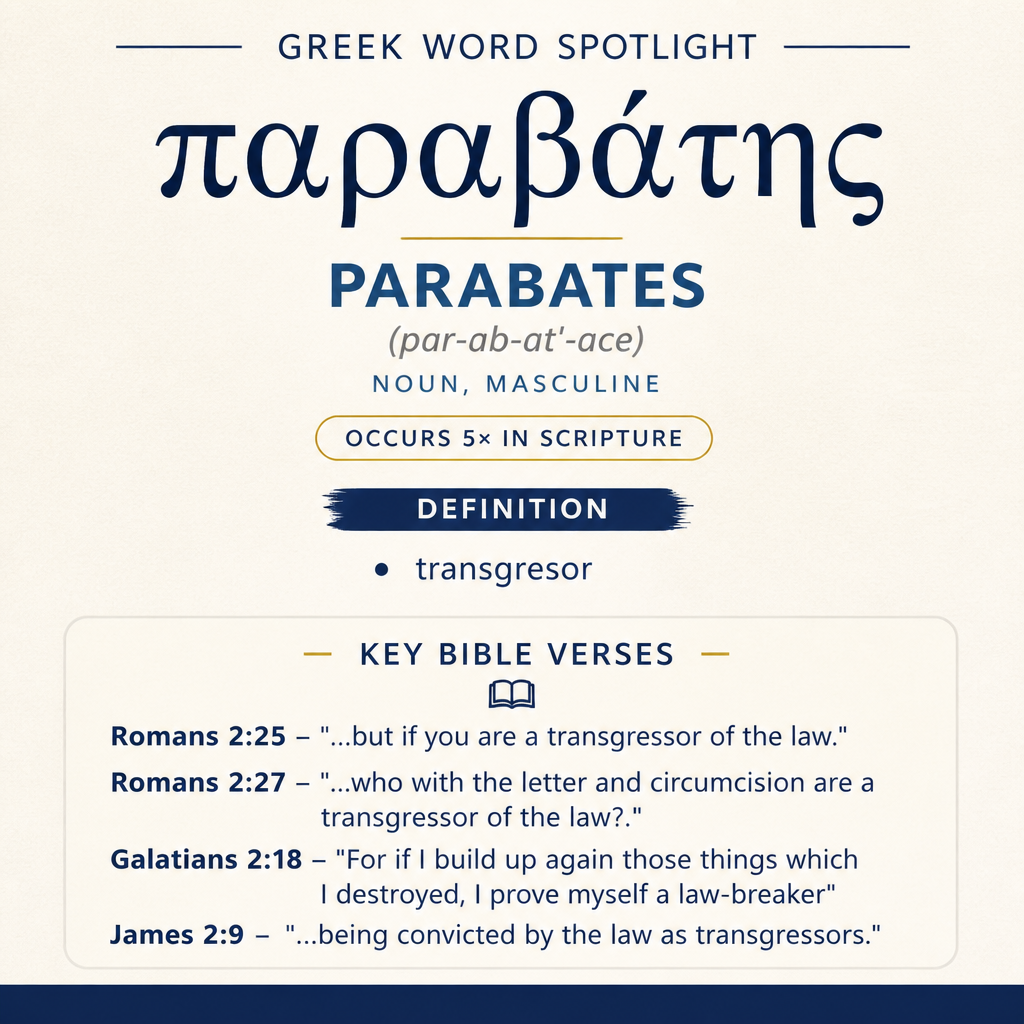
παραβάτης means “transgressor” and appears five times in Scripture: Romans 2:25, Romans 2:27, Galatians 2:18, James 2:9, and James 2:11.
Biblical Usage
It occurs five times in Scripture. These uses appear in Romans 2, Galatians 2, and James 2.
Learn More →Verse Contexts
Romans 2 links it with being a transgressor of the law, and Galatians 2:18 with being a law-breaker. James 2 uses it for those convicted by the law as transgressors.
Learn More →παραβάτης (Parabates) means “transgresor” and appears in Romans, Galatians, and James in discussions of law, obedience, and being judged in relation to the law. In these contexts, the word marks a person’s standing when conduct does not match the law being appealed to.
Root and Related Words
παραβάτης (Parabates) derives from the verb παραβαίνω (parabainō), “to transgress” (Strong’s G3845). The noun form personalizes the action: it speaks about the kind of person one is shown to be in relation to the law being invoked in the argument.

Occurrences
“For circumcision indeed profits, if you are a doer of the law, but if you are a transgressor of the law, your circumcision has become uncircumcision.” (Romans 2:25)
Here παραβάτης functions as the decisive contrast to being “a doer of the law.” The sentence is built on conditional logic (“if… but if…”): circumcision has profit only in the case of law-doing, but the moment a person is a “transgressor of the law,” the outward marker is rhetorically emptied—“has become uncircumcision.” The word therefore carries weight not as a minor lapse but as a category that reverses the assumed advantage of having circumcision. It identifies a status in which the law’s demands have been violated, so that the external sign no longer supports the claim it is supposed to represent.

“Won’t the uncircumcision which is by nature, if it fulfills the law, judge you, who with the letter and circumcision are a transgressor of the law?” (Romans 2:27)
In this second Romans occurrence, παραβάτης again appears in a sharp comparison, now between “the uncircumcision which is by nature” and the person “with the letter and circumcision.” The force of the word is judicial: the one who “fulfills the law” is pictured as judging the one who possesses “the letter and circumcision” yet is still called “a transgressor of the law.” The word thus exposes a mismatch between possession of the law (“the letter”) and the reality of disobedience. The rhetorical question presses an irony: the one presumed to be outside by an external marker (“uncircumcision”) is envisioned as the evaluator of the one presumed to be inside, precisely because being a “transgressor” negates the privilege implied by having the law’s written form and the covenant sign.
“For if I build up again those things which I destroyed, I prove myself a law-breaker.” (Galatians 2:18)
Galatians places παραβάτης in a first-person admission shaped as a logical consequence: “if I build up again… I prove myself….” The word “law-breaker” frames the action of rebuilding what had been destroyed as self-incriminating; it is not merely inconsistent behavior but a demonstration that the actor is, by his own actions, a “law-breaker.” The term’s contribution is to describe the verdict that follows from a particular pattern of reversal—tearing down and then reconstructing. Within the sentence, παραβάτης stands at the end as the conclusion, the label the speaker would be forced to accept if he acted in that way.
“But if you show partiality, you commit sin, being convicted by the law as transgressors.” (James 2:9)
James uses παραβάτης in a community-ethical setting: showing partiality is described as committing sin, and the law is portrayed as doing the convicting—“being convicted by the law as transgressors.” The word belongs to a courtroom-like picture: partiality is not treated as a socially unfortunate habit but as conduct that results in conviction by the law. The plural “transgressors” broadens the charge to any who practice the behavior; it depicts a group rendered guilty by the law’s own standards. Here παραβάτης is closely tied to the law’s evaluative function: it is the law that names the offenders and establishes their culpability.
“For he who said, “Do not commit adultery,” also said, “Do not commit murder.” Now if you do not commit adultery, but murder, you have become a transgressor of the law.” (James 2:11)
In James 2:11, παραβάτης is the outcome of breaking any command of the one lawgiver: the same speaker issued “Do not commit adultery” and “Do not commit murder.” The example is intentionally stark. Even if one command is kept (“you do not commit adultery”), committing another (“but murder”) leads to the conclusion, “you have become a transgressor of the law.” The phrase “have become” presents the label as a resulting state: one act of disobedience is sufficient to place the person in the category of “transgressor” with respect to the law as a whole. The word therefore crystallizes James’s point about the unity of the law in relation to obedience and violation.
Sense and Usage
Across these five passages, παραβάτης is consistently used for a person set in opposition to the law’s demand, and it is repeatedly linked to the phrase “of the law,” making the law the explicit reference point for the label. The word does not function as a neutral description of a mistake; it is a moral-juridical designation that carries the idea of being answerable to the law’s judgment. In Romans 2, it undermines confidence in external religious markers: circumcision “profits” only under the condition of law-doing, but the condition of being a “transgressor of the law” turns the supposed advantage into its opposite. The usage there gives παραβάτης a polemical edge: it strips away a claim to standing that rests on possession of “the letter” or a covenant sign, because the label is decided by conduct in relation to the law.
In Galatians 2:18 the term shifts into a personal, argumentative self-test: a certain kind of reversal (“build up again those things which I destroyed”) would demonstrate and “prove” the actor to be a “law-breaker.” The noun becomes a verdict drawn from one’s own actions. It is not the action alone that is in view, but what the action establishes about the person; παραβάτης names the identity a person shows himself to have by the logic of what he does.
James uses παραβάτης to press the implications of apparently selective obedience. In 2:9, the law is depicted as the convicting agent: partiality leads to being “convicted by the law as transgressors.” In 2:11, the unity of the lawgiver’s commands means that violating one command places a person under the same label. Together these uses show how the term can apply not only to conspicuous crimes like “murder” but also to social conduct such as “show partiality,” because the defining issue is the law’s standard and the law’s verdict. The word therefore serves in James as a leveling designation: it prevents a person from claiming innocence on the basis of keeping one command while failing another, and it frames partiality as a genuine law-problem with real culpability.
Imagery and Rhetoric
The passages give παραβάτης a courtroom resonance without turning it into a mere metaphor. Romans 2:27 asks whether the one who “fulfills the law” will “judge you,” and James 2:9 states that the law itself convicts, so the word often sits close to verdict language. Even where explicit judging is not mentioned (Romans 2:25; Galatians 2:18; James 2:11), the term operates like a concluded finding: circumcision “has become uncircumcision,” a course of action “prove[s]” the speaker a law-breaker, and a single act can mean “you have become a transgressor of the law.” In these arguments, παραβάτης is less a passing insult than a settled designation that seals the moral logic of the sentence.
Sources: Lexical data from Strong’s Exhaustive Concordance and the Translators Brief Lexicon of Extended Strongs for Greek (STEPBible, CC BY). Occurrence data from the Translators Amalgamated Greek New Testament (STEPBible, CC BY). Scripture quotations from the World English Bible (public domain).





