
Exploring the Meaning of Paidiske in Greek
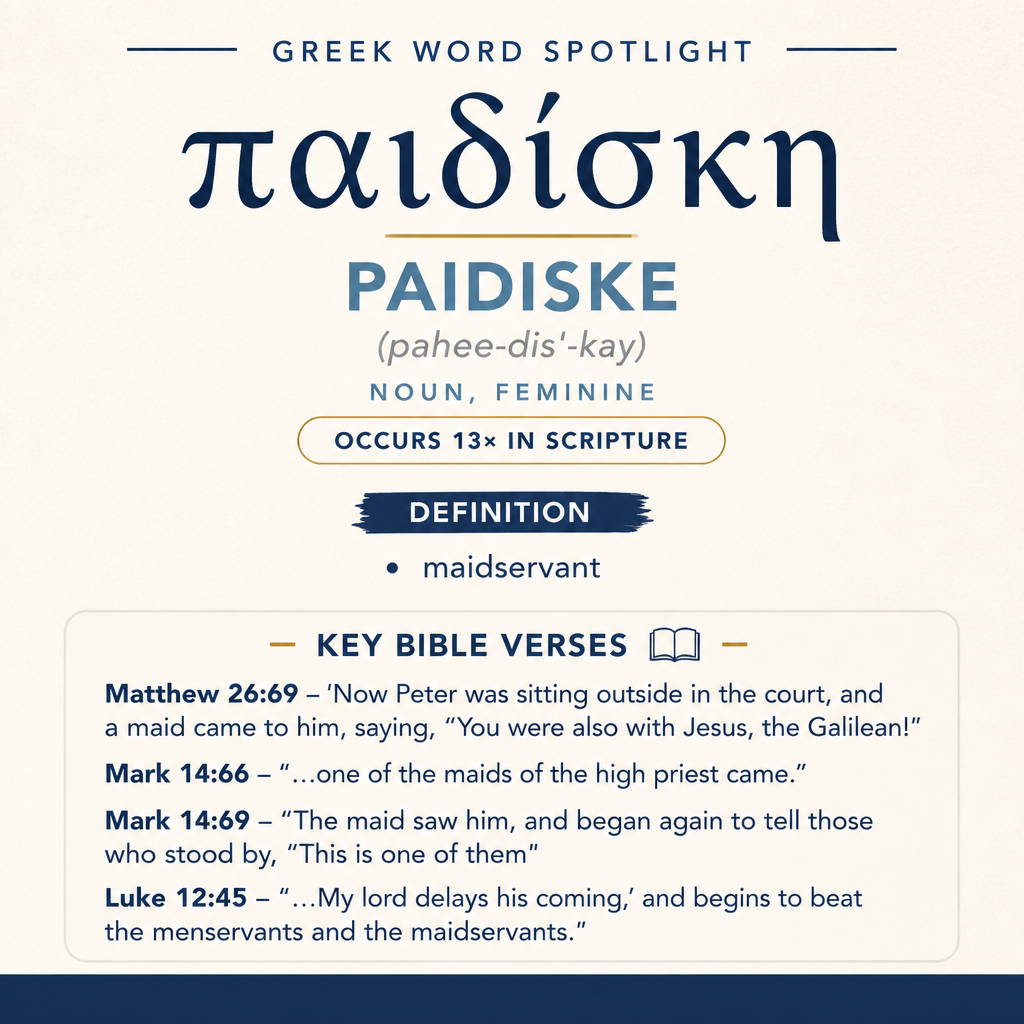
παιδίσκη means “maidservant” and appears 13 times in Scripture, including key scenes in the Gospels and Acts.
Core Meaning
παιδίσκη is defined as “maidservant.” In several passages it refers to a servant girl involved in ordinary household duties.
Learn More →Gospel Scenes
In Matthew 26:69, Mark 14:66–69, Luke 22:56, and John 18:17, a maidservant questions Peter about Jesus. These occurrences place the word in the context of Peter’s denials.
Learn More →Acts Examples
In Acts 12:13, a servant girl named Rhoda answers when Peter knocks at the gate. In Acts 16:16, it refers to a girl with a spirit of divination who brought her masters much gain.
Learn More →Paidiskē means “maidservant.” In the New Testament it appears in narrative scenes involving household service (including a doorkeeper and a named servant girl), in Jesus’ parable language about household authority, and in Paul’s contrast between “the servant” and “the free woman.”
Occurrences
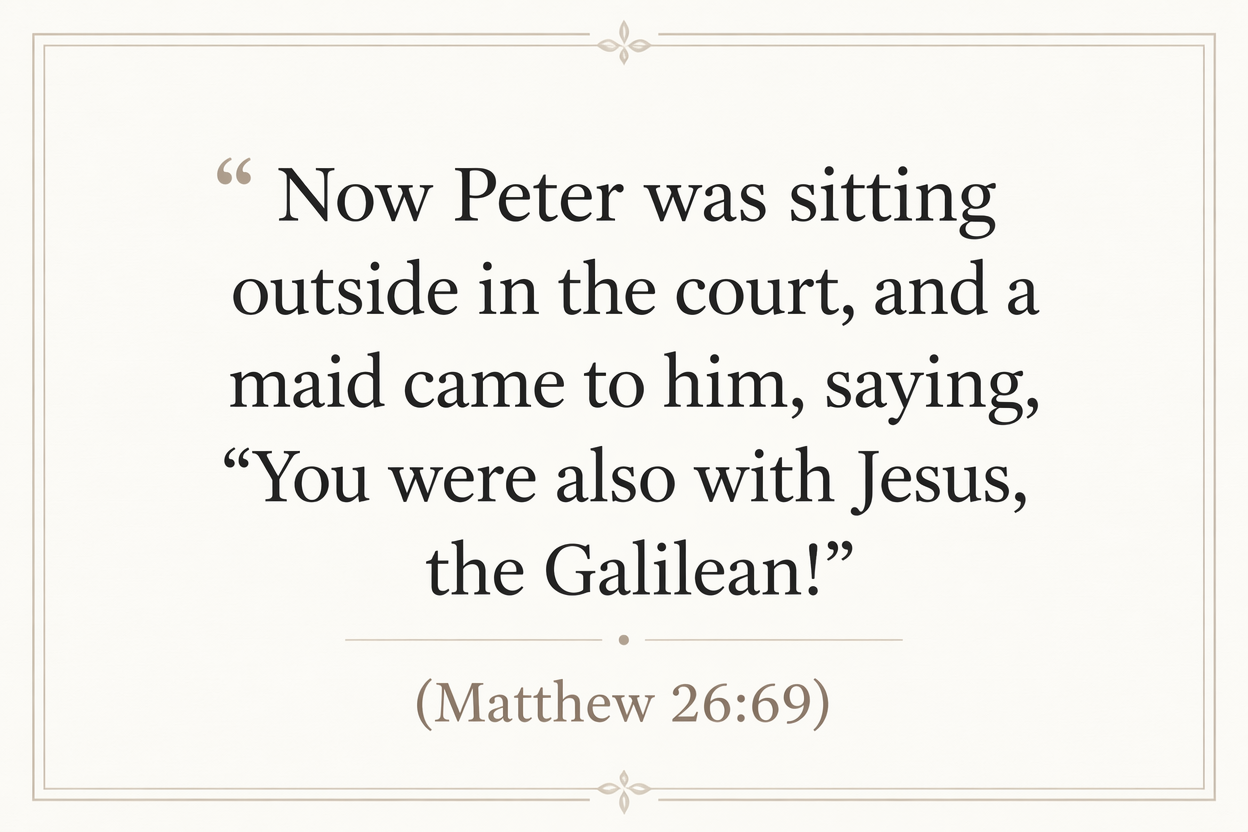
“Now Peter was sitting outside in the court, and a maid came to him, saying, “You were also with Jesus, the Galilean!”” (Matthew 26:69)
Paidiskē introduces a household servant as the one who confronts Peter in a public space (“outside in the court”). The maidservant’s speech presses an identification—association with “Jesus, the Galilean!”—so the word helps frame the accusation as coming from someone of low household rank but close enough to observe and speak freely in the courtyard setting.
“As Peter was in the courtyard below, one of the maids of the high priest came,” (Mark 14:66)
Here the maidservant is explicitly connected to the high priest’s household (“of the high priest”). Paidiskē locates her within the domestic staff of a powerful home, and her arrival sets up the ensuing recognition and public talk that unfolds around Peter in the courtyard.
“The maid saw him, and began again to tell those who stood by, “This is one of them.”” (Mark 14:69)
Paidiskē identifies the speaker as the same kind of servant figure, now functioning as a witness who draws bystanders into the moment (“tell those who stood by”). The maidservant’s role is not managerial or judicial; the word marks her as a household subordinate whose observation nevertheless influences the crowd’s perception of Peter (“This is one of them.”).
“But if that servant says in his heart, ‘My lord delays his coming,’ and begins to beat the menservants and the maidservants, and to eat and drink, and to be drunken,” (Luke 12:45)
In Jesus’ parable, paidiskē appears in the plural alongside “menservants,” describing vulnerable members of a household subject to mistreatment. The presence of both male and female servants paints a full domestic staff; the maidservants are those who can be harmed when a servant abuses authority (“begins to beat…”). The word here contributes to the social picture: the misconduct is displayed by violence toward dependents who cannot easily resist.
“A certain servant girl saw him as he sat in the light, and looking intently at him, said, “This man also was with him.”” (Luke 22:56)
Paidiskē again marks a servant girl as the initiating observer. Luke’s wording stresses her careful attention (“looking intently”), and the maidservant’s perception becomes the trigger for a public claim about allegiance (“was with him”). The word therefore functions within a scene where an ordinary household worker becomes the first voice to press an uncomfortable identification.
“Then the maid who kept the door said to Peter, “Are you also one of this man’s disciples?” He said, “I am not.”” (John 18:17)
Paidiskē here describes a maidservant assigned a specific duty: she “kept the door.” The word anchors her within the household’s service structure, and her position at the entrance makes her a gatekeeper in practice, able to question arrivals. Her brief exchange with Peter shows how a maidservant’s ordinary role can bring her into a decisive moment of recognition and denial.
“When Peter knocked at the door of the gate, a servant girl named Rhoda came to answer.” (Acts 12:13)
Paidiskē identifies Rhoda as a servant girl, and the narrative makes her role concrete: she “came to answer” the knock at the gate. The naming (“Rhoda”) individualizes the maidservant, showing that a domestic worker can be both recognizable and narratively significant. The word contributes to the household realism of the scene: a gate, a knock, and a servant girl responding as part of her work.
“As we were going to prayer, a certain girl having a spirit of divination met us, who brought her masters much gain by fortune telling.” (Acts 16:16)
Paidiskē describes a girl whose situation is defined by possession and profit: she “brought her masters much gain.” The word signals her status as someone under others’ control within a household or ownership setting (“her masters”), and it sharpens the ethical tension by placing exploitation in view: a maidservant-like figure is treated as a source of income through “fortune telling.”
“For it is written that Abraham had two sons, one by the servant, and one by the free woman.” (Galatians 4:22)
In Paul’s argument, paidiskē is used in a compressed, relational sense: “the servant” is defined over against “the free woman.” The word contributes a social category that structures a contrast between two mothers, and therefore between two lines of descent (“two sons”). The maidservant’s status is part of how the distinction is drawn and remembered in the argument.
“However, the son by the servant was born according to the flesh, but the son by the free woman was born through promise.” (Galatians 4:23)
Paidiskē continues the same contrast, now tied to two ways of speaking about birth: “according to the flesh” versus “through promise.” The word “servant” functions as a label that keeps the comparison clear and stable across sentences. It is not merely describing labor; it is marking a mother’s social standing as part of the framework Paul uses to differentiate the sons.
“However what does the Scripture say? “Throw out the servant and her son, for the son of the servant will not inherit with the son of the free woman.”” (Galatians 4:30)
Paidiskē here appears within a cited command that speaks directly about expulsion (“Throw out the servant and her son”) and inheritance (“will not inherit”). The maidservant is paired with “her son,” and the word helps state the boundary being enforced: inheritance is denied “with the son of the free woman.” In this usage, the social label “servant” carries legal and household consequences within the quotation’s logic.
“So then, brothers, we are not children of a servant, but of the free woman.” (Galatians 4:31)
Paidiskē concludes the sequence as a familial identity marker: “children of a servant” contrasts with “of the free woman.” The word serves Paul’s rhetorical purpose by anchoring a collective self-description in terms of maternal status. It is used as a clear, socially loaded category that the audience is meant to accept as decisive for the contrast being made.

Sense and Usage
Across these passages, paidiskē consistently identifies a female servant within a household or under masters. In the Gospels’ courtyard scenes (Matthew 26:69; Mark 14:66, 14:69; Luke 22:56; John 18:17), the maidservant is close enough to see, recognize, and speak. The word’s force there is social and situational: a household worker—someone whose presence is ordinary in such places—becomes an unexpected agent of exposure. Even when she is assigned a routine task (“kept the door,” John 18:17), that task places her at a point where she can challenge identity and belonging.
In Luke 12:45, paidiskē appears in the plural within a household hierarchy. The maidservants are those who can be beaten by an abusive servant; the word therefore helps picture the household as a place where authority can be exercised either rightly or violently. The mention of maidservants alongside menservants broadens the scene to include the full range of dependents affected by the servant’s self-indulgence (“to eat and drink, and to be drunken”).
In Acts, paidiskē ranges from ordinary domestic duty to economic exploitation. Rhoda (Acts 12:13) embodies a straightforward household role at the gate, her service rendered in a simple, physical action of answering a knock. By contrast, the girl in Acts 16:16 is defined by how her masters profit from her; the word “girl” in that setting is inseparable from the statement that she “brought her masters much gain.” Paidiskē thus fits both the mundane texture of a home and the harsher reality of being controlled for others’ advantage.
In Galatians 4:22–31, paidiskē functions as a key term in a sustained contrast. Here the word is not used to describe a scene of labor or household tasks, but to identify a woman’s standing (“the servant”) over against “the free woman.” Within the quoted and argued material, that standing is tied to lineage, exclusion, and inheritance (“Throw out the servant and her son… will not inherit,” Galatians 4:30). Paidiskē therefore carries its sense into an abstracted, relational register: it becomes a label that organizes a theological and communal argument through the social distinction it names.
Imagery
Paidiskē often places a servant girl at thresholds and in watchful spaces: a courtyard where a maid speaks up (Matthew 26:69), a lower courtyard where a high priest’s maid arrives (Mark 14:66), and a doorway where a maid keeps the entrance (John 18:17). The word’s scenes repeatedly show how people of low household status can still shape events through what they see, say, and do—whether calling out recognition in the light (Luke 22:56) or answering a gate at night (Acts 12:13).
Sources: Lexical data from Strong’s Exhaustive Concordance and the Translators Brief Lexicon of Extended Strongs for Greek (STEPBible, CC BY). Occurrence data from the Translators Amalgamated Greek New Testament (STEPBible, CC BY). Scripture quotations from the World English Bible (public domain).





