
Exploring the Meaning of Ous in Greek
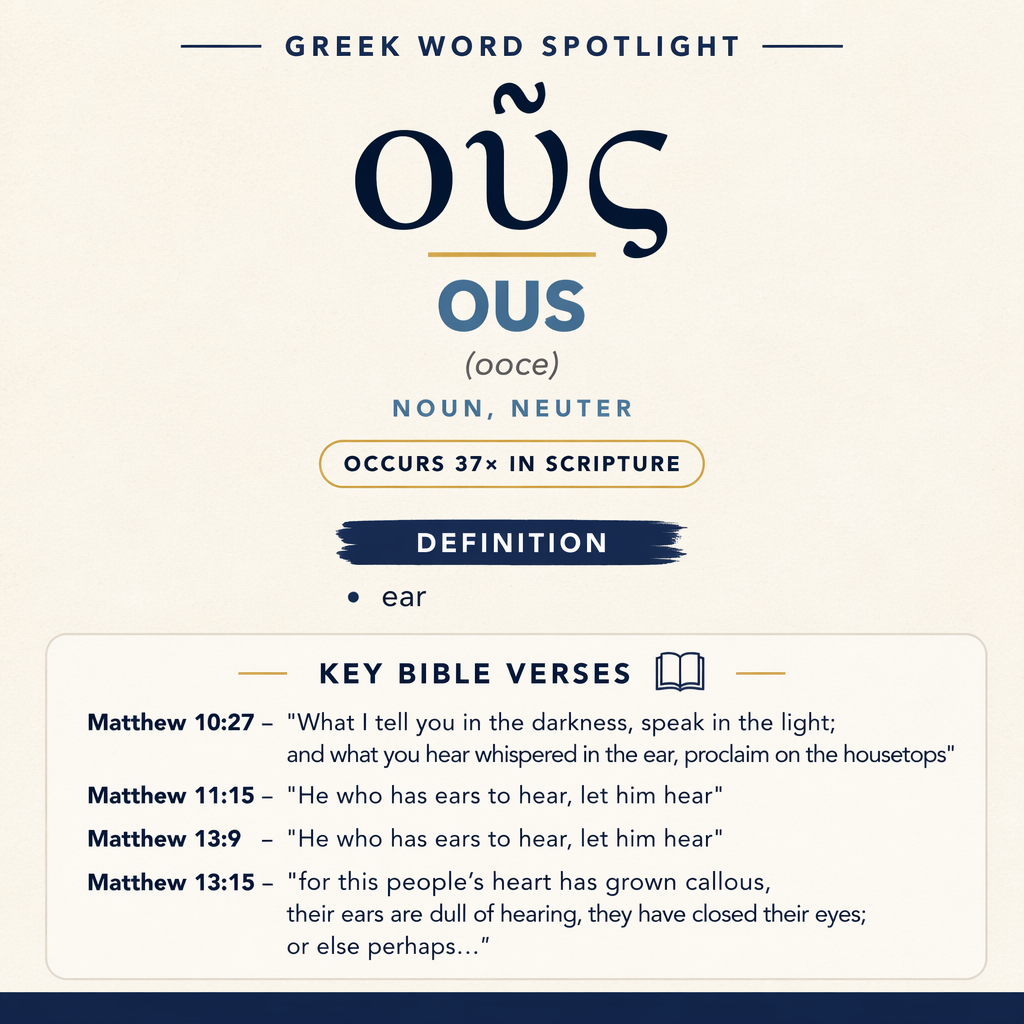
οὖς means “ear” in Greek and appears 37 times in Scripture, including Matthew 10–13 and Mark 4.
Gospel Appearances
It occurs in Matthew 10:27 and repeatedly in Matthew 11–13 and Mark 4:9, 23.
Learn More →Hearing Emphasis
In several verses it appears in the call, “He who has ears to hear, let him hear.”
Learn More →οὖς refers to the “ear,” appearing in sayings about hearing and in scenes where hearing is physically or figuratively in view. In these passages it can be the literal bodily organ, or the place where a message is received and the test of whether one truly hears.
Occurrences
Matthew 10:27: “What I tell you in the darkness, speak in the light; and what you hear whispered in the ear, proclaim on the housetops.”
Here the ear is the intimate point of reception: a message comes quietly, “whispered in the ear.” The verse contrasts private hearing with public proclamation—what is received in a near, personal way is to be carried outward “on the housetops.” The ear marks the first stage of transmission: hearing precedes speaking.

Matthew 11:15: “He who has ears to hear, let him hear.”
The ear is invoked as the capacity for hearing, but the wording presses beyond mere possession (“has ears”) to the act and responsiveness of hearing (“let him hear”). The ear becomes the emblem of readiness to receive what is being spoken.
Matthew 13:9: “He who has ears to hear, let him hear.”
Repeated in the setting of teaching, the ear again functions as the gateway for reception. The phrase does not add new content about the ear itself; it heightens the moment by demanding active hearing rather than passive exposure to sound.
Matthew 13:15: “for this people’s heart has grown callous, their ears are dull of hearing, they have closed their eyes; or else perhaps they might perceive with their eyes, hear with their ears, understand with their heart, and would turn again; and I would heal them.’”
This verse places “ears” alongside “eyes” and “heart,” linking hearing with perception and understanding. The ear is described as capable of becoming “dull of hearing,” suggesting a condition in which the organ remains present but its function—hearing—fails at the level of receptivity. The clause “hear with their ears” treats the ear as the proper instrument of hearing, yet the larger sentence shows that hearing is bound up with a person’s inner response (“understand with their heart” and “turn again”).
Matthew 13:16: ““But blessed are your eyes, for they see; and your ears, for they hear.”
Here ears are paired with eyes in a direct affirmation: the blessing is tied to functioning senses—“they see” and “they hear.” The ear is not merely anatomical; it represents successful reception of what is being taught, as opposed to the dulled hearing just described.
Matthew 13:43: “Then the righteous will shine like the sun in the Kingdom of their Father. He who has ears to hear, let him hear.”
The call to hearing is attached to an announcement about the future: the ear is summoned to receive and take in a weighty statement. As in the earlier refrains, the phrase makes the ear a boundary marker between those who merely listen and those who actually hear what is being declared.
Mark 4:9: “He said, “Whoever has ears to hear, let him hear.”
Mark’s form matches the Matthean refrain and uses “ears” to address the audience as responsible hearers. The ear stands for the capacity that should be employed; “let him hear” calls for engagement with the spoken word.
Mark 4:23: “If any man has ears to hear, let him hear.”
The conditional “If” sharpens the challenge: anyone who claims the basic equipment for hearing is summoned to use it rightly. The ear remains the focal point, the organ through which the teaching is to be received.
Mark 7:16: “If anyone has ears to hear, let him hear!”
With an exclamation, the saying functions as an urgent appeal. The ear again is the site of reception; the form suggests that the issue is not whether sound reaches the ear, but whether the person truly hears.
Mark 7:33: “He took him aside from the multitude, privately, and put his fingers into his ears, and he spat, and touched his tongue.”
This is a concrete, bodily use. The ears are physical and can be touched: “put his fingers into his ears.” The action is careful and personal (“aside… privately”), and the ears are treated as the immediate locus of the man’s impairment and its remedy, alongside the tongue. In the narrative, the ear is not a metaphor; it is a body part addressed directly.
Mark 8:18: “Having eyes, don’t you see? Having ears, don’t you hear? Don’t you remember?”
Ears are placed in parallel with eyes and linked with memory: failure to hear is connected to failure to remember. The question “Having ears, don’t you hear?” distinguishes possession from performance; ears exist, yet hearing does not occur. The ear serves as a measure of responsiveness—what should be heard is missed, and that missed hearing has consequences for understanding and recall.
Luke 1:44: “For behold, when the voice of your greeting came into my ears, the baby leaped in my womb for joy!”
Here the ear is the point where sound arrives: the “voice… came into my ears.” The expression is vivid and spatial, portraying the greeting as entering the hearer’s ears and producing an immediate bodily and emotional effect (“the baby leaped… for joy”). The ear functions as the doorway through which an external voice becomes an experienced reality.

Sense and Usage
Across these verses, οὖς consistently names the ear as the organ of hearing, but the texts explore what hearing entails. In several sayings (“He who has ears to hear, let him hear”), ears stand for the ordinary human capacity to receive speech, yet the repeated call implies a deeper demand: hearing is an action, not an automatic result of having ears. The ear becomes shorthand for a person’s readiness to take in teaching, especially when the same statement can be heard by many but only received by some.
Matthew 13:15–16 develops this further by contrasting ears that are “dull of hearing” with ears that “hear.” The ear is treated as a faculty that can be impeded, whether by a condition described as dullness or by the larger inward posture that accompanies closed eyes and a calloused heart. This does not redefine the ear; it shows that the ear’s proper function is bound up with perception and response. Hearing with the ear is portrayed as part of a chain that can lead to understanding and turning, or can be blocked.
Mark 8:18 similarly insists on the difference between having ears and actually hearing, and it links hearing with remembering. In this framing, ears are not only for receiving sounds in the moment; they are tied to retention and comprehension. Hearing is presented as something that should register deeply enough to shape what one remembers.
Alongside these exhortations, two passages anchor the word in straightforward physicality. Mark 7:33 depicts ears as tangible and accessible to touch, emphasizing the bodily reality of hearing. Luke 1:44 portrays sound entering the ears and producing an effect, showing the ear as the meeting point between an external voice and an internal reaction. Matthew 10:27 then uses the ear’s intimacy: what is “whispered in the ear” is a privately received message that must become public speech. In each case, the ear is the consistent locus where speech becomes heard, whether in quiet proximity, in bodily healing, or in the call for attentive reception.
Imagery
Within these scenes, the ear carries a recurring image of nearness and access. A whisper “in the ear” (Matthew 10:27) evokes closeness; a voice “came into my ears” (Luke 1:44) depicts entry and impact; fingers placed “into his ears” (Mark 7:33) shows direct contact with the organ itself. Against that concrete imagery stands the searching refrain, “He who has ears to hear, let him hear,” which treats the ear as the threshold where spoken truth either passes by or is truly received.
Sources: Lexical data from Strong’s Exhaustive Concordance and the Translators Brief Lexicon of Extended Strongs for Greek (STEPBible, CC BY). Occurrence data from the Translators Amalgamated Greek New Testament (STEPBible, CC BY). Scripture quotations from the World English Bible (public domain).





