
Exploring the Meaning of Ouai in Greek
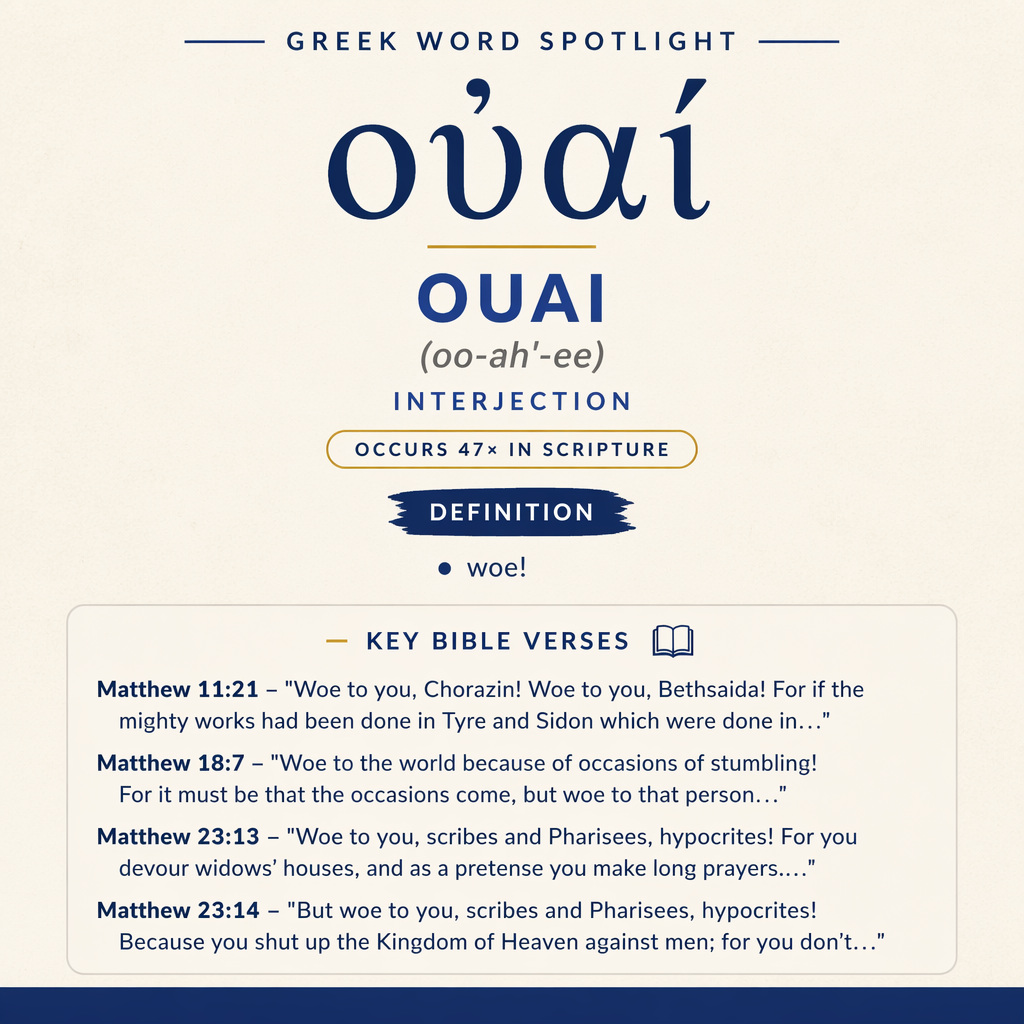
οὐαί means “woe!” and appears 47 times in Scripture, including in Matthew 11:21, 18:7, and multiple times in Matthew 23.
Matthew Examples
It appears in warnings such as Matthew 11:21 and Matthew 18:7, and repeatedly in Matthew 23:13–16, 23, 25.
Learn More →οὐαί expresses an exclamation of “woe!” in scenes of warning and denunciation. In the passages below it punctuates direct address, marking statements of severe peril, culpability, or calamity tied to concrete actions and coming circumstances.
Occurrences
“Woe to you, Chorazin! Woe to you, Bethsaida! For if the mighty works had been done in Tyre and Sidon which were done in you, they would have repented long ago in sackcloth and ashes.” (Matthew 11:21)
Here οὐαί frames a double direct address (“Chorazin… Bethsaida”) and turns the saying into a solemn pronouncement. The following explanation (“For if… they would have repented…”) ties the “woe” to an accountable response to “mighty works,” portraying the exclamation as a moral alarm over missed repentance.
“Woe to the world because of occasions of stumbling! For it must be that the occasions come, but woe to that person through whom the occasion comes!” (Matthew 18:7)
οὐαί is used twice with two different targets. First, it is directed broadly (“the world”) because stumbling occasions bring harm; then it narrows sharply (“that person through whom the occasion comes”), concentrating responsibility on the agent who becomes the channel of stumbling. The interjection thus intensifies both the general tragedy and the personal accountability within the same sentence.
“Woe to you, scribes and Pharisees, hypocrites! For you devour widows’ houses, and as a pretense you make long prayers. Therefore you will receive greater condemnation.” (Matthew 23:13)
οὐαί introduces a direct rebuke addressed to “scribes and Pharisees” and labels them “hypocrites,” setting a courtroom-like tone. The “woe” is immediately grounded in the acts named (“devour widows’ houses,” “as a pretense… long prayers”) and culminates in a stated outcome (“greater condemnation”), so the exclamation functions as the gateway into a charge-and-verdict pattern.
“But woe to you, scribes and Pharisees, hypocrites! Because you shut up the Kingdom of Heaven against men; for you don’t enter in yourselves, neither do you allow those who are entering in to enter.” (Matthew 23:14)
With “But woe to you,” οὐαί marks another accusatory turn, this time focused on obstruction. The description is relational and communal: they block “the Kingdom of Heaven against men,” harming both themselves (“you don’t enter in yourselves”) and others (“neither do you allow…”). The “woe” presses the seriousness of preventing entry and restricting those who are “entering in.”
“Woe to you, scribes and Pharisees, hypocrites! For you travel around by sea and land to make one proselyte; and when he becomes one, you make him twice as much a son of Gehenna as yourselves.” (Matthew 23:15)
Here οὐαί stands at the head of a critique of zeal misdirected. The line highlights the extent of their effort (“by sea and land”) and then contrasts that energy with a disastrous result (“twice as much a son of Gehenna as yourselves”). The “woe” casts the whole mission as bringing ruin rather than good.
“Woe to you, you blind guides, who say, ‘Whoever swears by the temple, it is nothing; but whoever swears by the gold of the temple, he is obligated.’” (Matthew 23:16)
οὐαί introduces a condemnation of misguided leadership (“blind guides”). The content that follows quotes their teaching about oaths, and the “woe” signals that this instruction is not merely mistaken but dangerous in its guidance. By attaching the exclamation to their speech (“who say…”), the passage presents their words themselves as part of the peril.
“Woe to you, scribes and Pharisees, hypocrites! For you tithe mint, dill, and cumin, and have left undone the weightier matters of the law: justice, mercy, and faith. But you ought to have done these, and not to have left the other undone.” (Matthew 23:23)
In this saying, οὐαί targets a moral imbalance: meticulous attention to small items (“mint, dill, and cumin”) alongside neglect of “the weightier matters… justice, mercy, and faith.” The “woe” heightens the contrast and makes the omission culpable, not a minor oversight. It also sits beside an explicit correction (“you ought to have done these”), underscoring that the lament is paired with a clear standard.
“Woe to you, scribes and Pharisees, hypocrites! For you clean the outside of the cup and of the platter, but within they are full of extortion and unrighteousness.” (Matthew 23:25)
οὐαί here introduces an image of external cleanliness hiding internal corruption. The “woe” forces attention inward (“within”) where “extortion and unrighteousness” reside, and it exposes the inadequacy of outward maintenance. The interjection thus punctures appearances and presents the internal state as the true ground of the warning.
“Woe to you, scribes and Pharisees, hypocrites! For you are like whitened tombs, which outwardly appear beautiful, but inwardly are full of dead men’s bones, and of all uncleanness.” (Matthew 23:27)
With οὐαί the denunciation moves into a stark comparison (“like whitened tombs”). The exclamation sharpens the shock of the contrast: beauty “outwardly” versus impurity “inwardly.” By pairing “woe” with this imagery, the passage makes the hidden interior (“dead men’s bones… uncleanness”) the decisive reality behind the outward appearance.
“Woe to you, scribes and Pharisees, hypocrites! For you build the tombs of the prophets, and decorate the tombs of the righteous,” (Matthew 23:29)
Here οὐαί introduces criticism tied to commemorative actions (“build… decorate”). The “woe” signals that these visible acts, though honoring “prophets” and “the righteous,” stand in a context of hypocrisy established by the repeated address. The interjection makes the building and decorating themselves part of a larger indictment rather than a neutral deed.
But woe to those who are with child and to nursing mothers in those days! (Matthew 24:19)
οὐαί is aimed not at wrongdoing but at vulnerability in an urgent time (“in those days”). The exclamation marks impending hardship for “those who are with child” and “nursing mothers,” focusing on the burden of circumstance. Its force is pastoral in the sense that it calls attention to intensified distress, not to a listed offense.
The Son of Man goes, even as it is written of him, but woe to that man through whom the Son of Man is betrayed! It would be better for that man if he had not been born.” (Matthew 26:24)
In this climactic warning, οὐαί falls on “that man through whom… is betrayed,” isolating the betrayer as the object of dread. The “woe” stands alongside a statement of grave consequence (“It would be better for that man if he had not been born”), giving the interjection its heaviest personal weight in these excerpts. It marks betrayal not merely as an act within events, but as an action carrying fearful ruin for the perpetrator.

Sense and Usage
Across these occurrences, οὐαί functions as a sharp spoken marker that introduces or seals a pronouncement of disaster, peril, or condemning evaluation. It is regularly paired with direct address (“Woe to you…”) and so serves as an audible summons: the speaker names the target and then states the reason, often with “For…” or “Because…,” making the “woe” the threshold into explicit grounds for the warning. In Matthew 23 especially, the repeated pattern builds a sustained cadence of denunciation: each οὐαί launches a fresh angle on hypocrisy—harm done to the vulnerable (“widows’ houses”), obstruction (“shut up the Kingdom of Heaven against men”), misdirected effort (“make one proselyte”), distorted guidance (“blind guides”), moral imbalance (“left undone… justice, mercy, and faith”), and inward corruption under outward polish (“outside… within”).
οὐαί is flexible enough to address both collective and individual objects. It can be directed at towns (“Chorazin… Bethsaida”), at a broad sphere (“the world”), and at a singular responsible agent (“that person…,” “that man…”). It can also be directed at a group defined by role (“scribes and Pharisees”) or at people in a vulnerable condition (“those who are with child… nursing mothers”). In each case, the interjection heightens the seriousness of what follows, whether the emphasis is culpability (as with devouring houses, shutting others out, or betrayal) or the heavy burden of impending hardship (as with pregnancy and nursing “in those days”).
The word’s placement at the front of clauses gives it rhetorical force: it does not argue at length by itself but signals that what comes next carries weight and consequence. When followed by explicit outcomes (“greater condemnation,” “better… if he had not been born”), οὐαί stands as the initial alarm that matches the severity of the declared end.
Imagery and Tone
In these passages οὐαί often stands beside concrete images that make the warning felt: sackcloth and ashes for repentance (Matthew 11:21), stumbling occasions that trip others (Matthew 18:7), cups and platters whose insides contradict their outsides (Matthew 23:25), and whitened tombs beautiful on the surface yet filled with death within (Matthew 23:27). Even when the language is not figurative, the tone remains urgent and weighty, as in the plain hardship named for “those who are with child… nursing mothers” (Matthew 24:19) and the personal doom attached to betrayal (Matthew 26:24). οὐαί is the spoken flare that sets these scenes in a register of warning and lament over impending ruin.
Sources: Lexical data from Strong’s Exhaustive Concordance and the Translators Brief Lexicon of Extended Strongs for Greek (STEPBible, CC BY). Occurrence data from the Translators Amalgamated Greek New Testament (STEPBible, CC BY). Scripture quotations from the World English Bible (public domain).





