
Exploring the Meaning of Oua in Greek
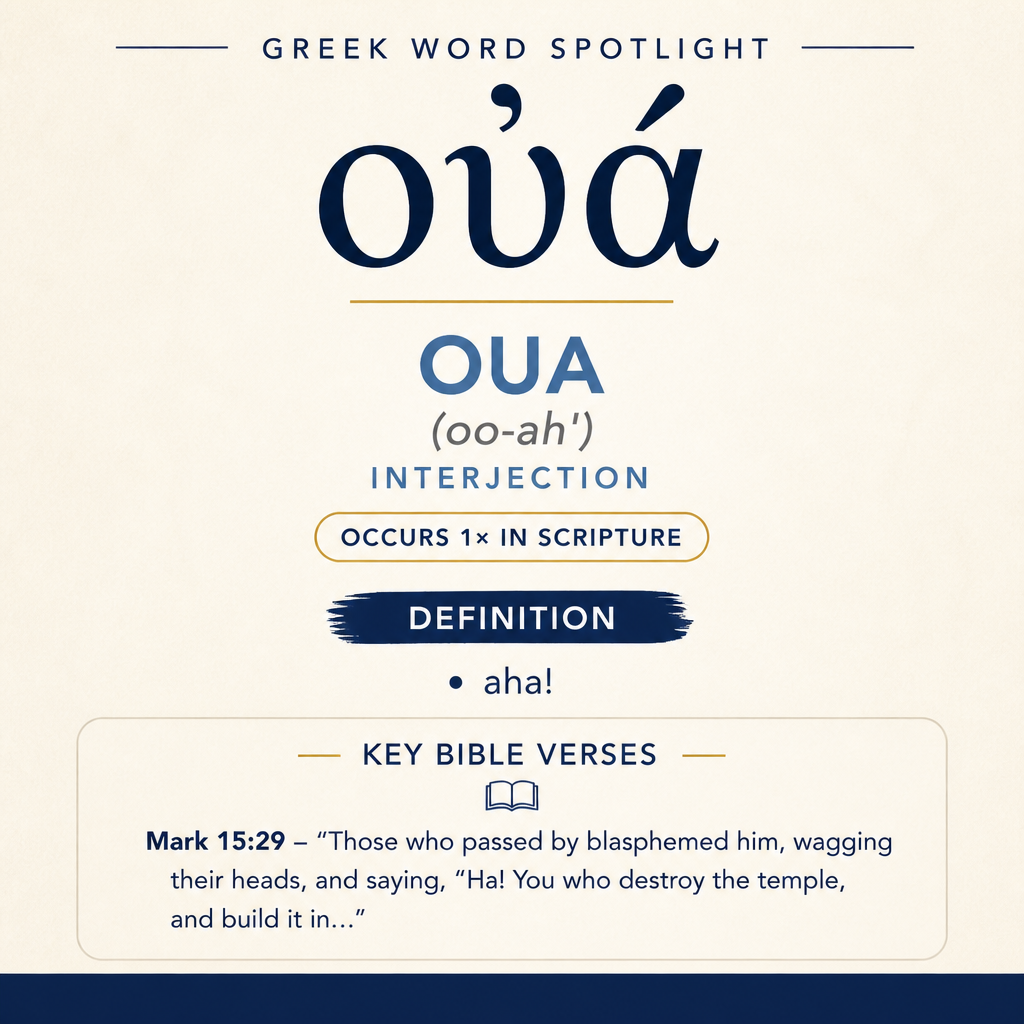
οὐά means “aha!” and appears once in Scripture, in Mark 15:29.
Mark 15:29 Usage
In Mark 15:29, passersby speak it while blaspheming Jesus and wagging their heads.
Learn More →οὐά expresses an exclamatory “aha!” and is used once in the New Testament, in the mockery surrounding Jesus’ crucifixion. In that single scene it functions as a short, sharp verbal jab that frames what follows as derision rather than sincere address.
Occurrences
“Those who passed by blasphemed him, wagging their heads, and saying, “Ha! You who destroy the temple, and build it in three days,” (Mark 15:29)
In Mark 15:29, οὐά is rendered “Ha!” and stands at the head of the bystanders’ taunt. The verse presents a coordinated cluster of contempt: they “passed by,” they “blasphemed him,” they were “wagging their heads,” and they were “saying” words meant to sting. Within that sequence, the interjection is not a mere filler syllable; it cues the reader to hear the sentence as ridicule from the first breath. It is the sound of scorn, introducing the accusation-like address, “You who destroy the temple, and build it in three days,” and it belongs to the action of blaspheming described in the same line.
The punctuation and placement show how οὐά works: it comes before any propositional content, before the content about the temple and the three days. That makes it a tonal marker. The words that follow could be quoted in other settings as a claim to power or a statement to be investigated; here, prefaced by οὐά and surrounded by head-wagging, it becomes a sneer. The interjection compresses a whole posture into a single utterance: the speakers do not approach to ask, plead, or argue; they begin by scoffing.
The narrative also places the interjection on the lips of anonymous “those who passed by.” The taunt is portrayed as public and mobile—spoken by people in transit, not by a single interlocutor who lingers for conversation. That setting suits an interjection: it is brief, easily thrown out, and does not require engagement. In the verse’s depiction, the speakers throw the “Ha!” and the ensuing line as they go, their disdain reinforced by gesture (“wagging their heads”). οὐά thus belongs to the immediacy of crowd speech: quick, performative, and directed at shaming.

Sense and Usage
As an interjection glossed “aha!,” οὐά conveys a burst of derisive recognition—an exclamation that signals the speaker’s sense of having caught someone out, exposed an absurdity, or gained a moment of superiority. In Mark 15:29 that effect is sharpened by the surrounding verbs and actions. The bystanders are not portrayed as neutral observers who happen to remark; they “blasphemed him.” The interjection, therefore, is part of a speech-act of contempt, functioning less to communicate information than to communicate attitude: “We see through you,” “We are unimpressed,” “We take pleasure in this.”
Because οὐά is extremely short, it does not carry the content of the taunt; it frames the content. Its meaning operates at the level of discourse, not description. It signals to the listener how to process the sentence that follows. In the quoted line, the interjection stands before a vocative-like address (“You who…”). The effect is to turn that address into a jeer. The interjection provides the audible equivalent of the head-wagging mentioned in the same verse: a bodily gesture and a vocal burst combine to create a unified display of scorn. The verse’s syntax links gesture and speech (“wagging their heads, and saying”), and οὐά is the first audible unit of what they say.
The gloss “aha!” also suits the way mockery often mimics discovery. The speaker acts as though a hidden truth has suddenly become obvious, even when the “discovery” is manufactured for ridicule. In Mark 15:29, οὐά introduces a recited claim about destroying and rebuilding the temple in three days. Whatever the origin of that line, in this scene it is not handled as a claim that deserves careful listening; it is handled as a point of ridicule. The interjection is the sound of someone pretending to have a clever angle—an exclamation that says, in effect, “So this is the one,” and then uses that set-up to belittle.
Interjections like οὐά are also socially contagious: they are easily repeated and understood without explanation. The narrative depicts multiple passersby, and the plural description (“Those who passed by… saying”) allows the interjection to be heard as the kind of thing one person starts and others can readily echo. In this way, οὐά is suited to communal mockery. It takes almost no time to say, yet it establishes a shared stance among the speakers: the stance that the person addressed is an object of ridicule.
At the same time, the interjection’s brevity gives it a particular sharpness. A longer insult requires content and can be argued with; a clipped “Ha!” cannot easily be answered on its own terms. It is designed to end conversation before it begins, to signal that the speaker has already judged the matter. In Mark 15:29 that rhetorical shutting-down matches the setting of public humiliation: the passersby do not ask questions; they “blasphemed” and moved on. οὐά thus functions as the sonic spearpoint of the insult—small but piercing, a momentary burst that turns the rest of the line into a weapon.
Finally, the interjection is inseparable from the physical imagery Mark provides. “Wagging their heads” is an embodied sign of contempt, and οὐά is its spoken counterpart. The combined effect is ridicule that is both seen and heard. The verse therefore uses a minimal word to maximum rhetorical effect: it opens the bystanders’ utterance with an exclamation that makes their intention unmistakable before any specific accusation is articulated.
Implied Imagery
In Mark 15:29, οὐά carries the imagery of passing mockers who do not stop to help but stop long enough to jeer. It evokes a scene where contempt is expressed with a quick sound and a dismissive motion—heads wagging as the crowd throws out “Ha!” and continues on. The interjection concentrates the atmosphere of public scorn into a single syllable at the front of their speech, giving the reader an audible cue to the hostility that fills the moment.
Sources: Lexical data from Strong’s Exhaustive Concordance and the Translators Brief Lexicon of Extended Strongs for Greek (STEPBible, CC BY). Occurrence data from the Translators Amalgamated Greek New Testament (STEPBible, CC BY). Scripture quotations from the World English Bible (public domain).





