
Exploring the Meaning of Osphus in Greek
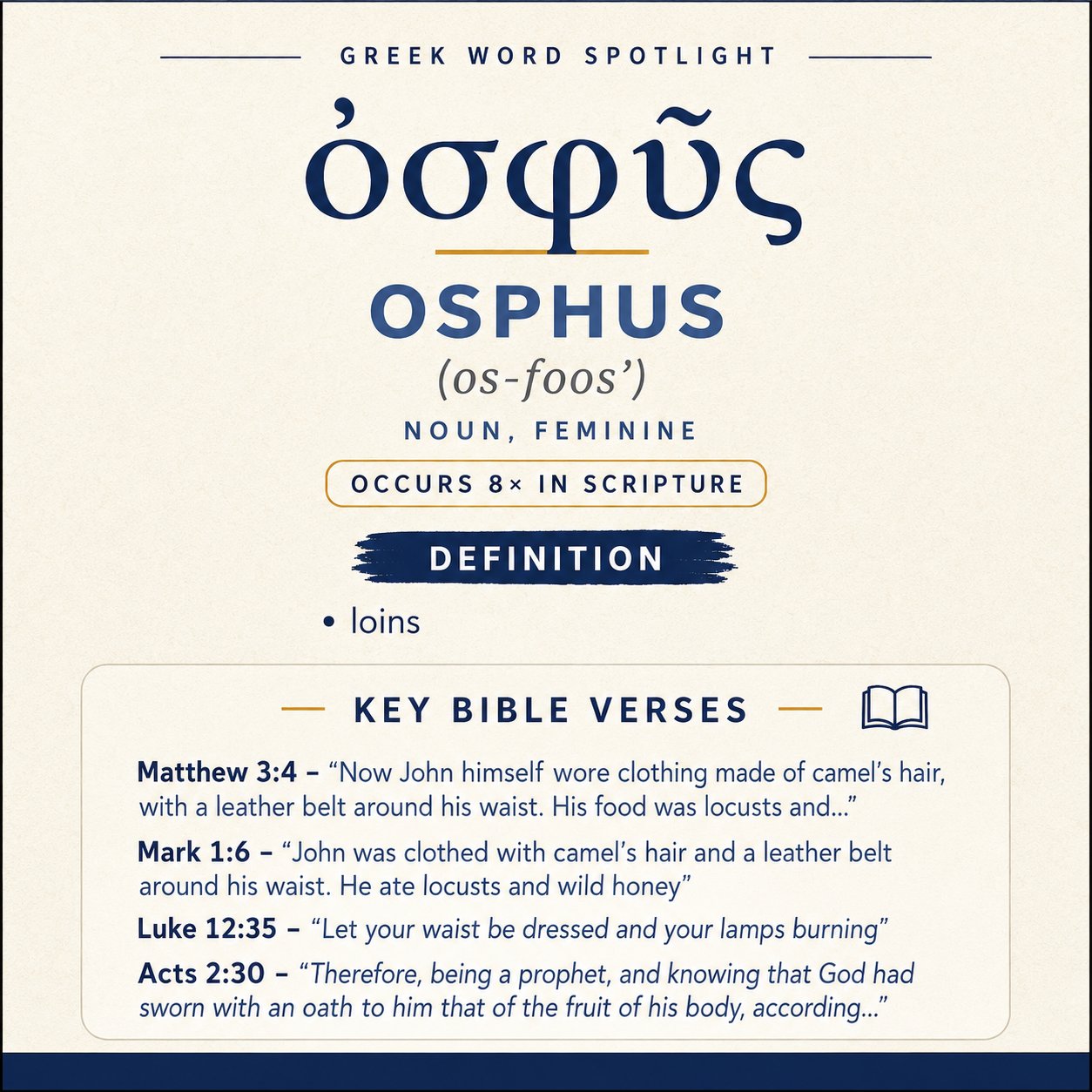
ὀσφῦς means “loins” and appears 8 times in Scripture, including Matthew 3:4, Luke 12:35, and Ephesians 6:14.
Gospel Contexts
In Matthew 3:4 and Mark 1:6, it describes John’s leather belt around his waist. In Luke 12:35 it appears in the command, “Let your waist be dressed.”
Learn More →Broader Usage
It appears in Acts 2:30 in the phrase “of the fruit of his body.” It also occurs in Hebrews 7:5, Hebrews 7:10, Ephesians 6:14, and 1 Peter 1:13.
Learn More →ὀσφῦς means “loins” and appears in narrative description, instruction, and argumentation across the Gospels, Acts, the epistles, and Hebrews. In these passages it can be pictured concretely at the waist, and it also supports statements about bodily descent and readiness for action.
Occurrences
“Now John himself wore clothing made of camel’s hair, with a leather belt around his waist. His food was locusts and wild honey.” (Matthew 3:4)
Here ὀσφῦς is the bodily location where John’s belt is fastened. The sentence is a compact portrait of his manner of life: rough clothing, a belt at the waist, and simple food. The reference to the loins anchors the description in an ordinary human detail—how the garment is held in place—and helps the reader visualize John’s attire as something worn for movement and daily life in the open air.
“John was clothed with camel’s hair and a leather belt around his waist. He ate locusts and wild honey.” (Mark 1:6)
Mark’s wording closely parallels Matthew’s, again placing the belt “around his waist.” ὀσφῦς functions as the anatomical point of contact between belt and body. In the scene it reinforces the same earthy realism: John is not presented in courtly clothing but in a practical outfit secured at the loins, paired with a diet that matches the simplicity of his dress.
““Let your waist be dressed and your lamps burning.” (Luke 12:35)
In this instruction, ὀσφῦς shifts from description to command. The loins are the place that is to be “dressed,” an expression that frames readiness as something bodily and visible. The pairing with “your lamps burning” ties preparedness at the waist to alertness in the environment: the body is made ready at the loins, and the surroundings are kept ready by light. The loins are thus the hinge-point for a posture of immediate response.
“Therefore, being a prophet, and knowing that God had sworn with an oath to him that of the fruit of his body, according to the flesh, he would raise up the Christ to sit on his throne,” (Acts 2:30)
In Peter’s speech, ὀσφῦς contributes to a statement about physical lineage. The phrase “of the fruit of his body, according to the flesh” uses bodily language to speak of descent in concrete terms. The loins, as part of the “body” invoked here, supply an embodied way of expressing continuity from ancestor to offspring within the sphere “according to the flesh,” which in the sentence is contrasted with the act of God who “would raise up the Christ.”
“Stand therefore, having the utility belt of truth buckled around your waist, and having put on the breastplate of righteousness,” (Ephesians 6:14)
Here ὀσφῦς appears in a call to “Stand,” with equipment described as being worn. The “utility belt of truth” is “buckled around your waist,” locating the belt at the loins as the point where readiness is secured. The loins provide the bodily center where something is fastened firmly, and the verse sets that fastening alongside another worn item, “the breastplate of righteousness.” The waist is the place where the belt is tightened; the image depends on ὀσφῦς as the practical site of fastening for standing firm.
“They indeed of the sons of Levi who receive the priest’s office have a commandment to take tithes of the people according to the law, that is, of their brothers, though these have come out of the body of Abraham,” (Hebrews 7:5)
This verse uses bodily origin to frame kinship and legal obligation: the people who are tithed are “their brothers,” and that brotherhood is grounded in the fact that “these have come out of the body of Abraham.” ὀσφῦς belongs to that register of descent-language, making the argument vivid by rooting social and legal relations in embodied ancestry. The loins, implied within “the body of Abraham,” serve the writer’s point that shared physical origin underlies the relationship between those who tithe and those who receive tithes.
“for he was yet in the body of his father when Melchizedek met him.” (Hebrews 7:10)
In this continuation, ὀσφῦς again supports a claim about descent, now expressed with temporal force: someone “was yet in the body of his father” at the time of a meeting. The bodily phrasing treats ancestry not as abstraction but as a concrete line of origin that can be spoken of with before-and-after language. The loins, as a bodily locus for the idea of being “in the body” of one’s father, strengthens the author’s reasoning by keeping the argument tethered to physical lineage.
“Therefore prepare your minds for action. Be sober, and set your hope fully on the grace that will be brought to you at the revelation of Jesus Christ—” (1 Peter 1:13)
Although the verse foregrounds the “minds,” ὀσφῦς stands behind the exhortation’s imagery of readiness. “Prepare your minds for action” echoes the same kind of get-ready posture seen when the waist is made ready for movement. The loins supply the bodily metaphor that supports the call to a disciplined stance: sobriety, focused hope, and readiness are presented as a kind of preparation analogous to making the waist ready for purposeful activity.

Sense and Usage
Across these eight contexts, ὀσφῦς consistently operates as a concrete body-term whose placement at the waist makes it especially useful for two kinds of discourse: (1) the physical securing of clothing and gear, and (2) speech about bodily descent. In Matthew and Mark, the loins are the ordinary, visible location where a “leather belt” sits; the word helps create a tactile snapshot of John’s clothing. Luke and Ephesians rely on the same bodily location but harness it for readiness: the waist is where something is tightened, dressed, or buckled so the person can stand and act without impediment.
Acts and Hebrews draw on bodily language in a different direction. When lineage is discussed as “fruit” arising “of the body” and “according to the flesh,” ὀσφῦς supports a mode of speaking in which ancestry is not merely a legal category but an embodied continuity. Hebrews uses this embodied continuity to talk about who “have come out of the body of Abraham,” and even to describe someone as being “yet in the body of his father” at a key moment. In such reasoning, the loins contribute to the conceptual apparatus that binds family relations, historical sequence, and covenantal or legal implications to the physical reality of descent.
These two uses are not unrelated. In both, ὀσφῦς points to what is central and connective: the waist as the place where garments are gathered and secured, and the body as the point of origin through which kinship is traced. The word’s concreteness allows the writers to move easily between the visible (a belt at the waist) and the inferential (descent “according to the flesh”) without leaving the realm of bodily reality.
Imagery
The passages create a cluster of waist-centered images: a leather belt around John’s loins (Matthew 3:4; Mark 1:6), a waist made ready alongside a burning lamp (Luke 12:35), and a belt buckled for standing (Ephesians 6:14). Alongside these, Acts 2:30 and Hebrews 7:5, 7:10 use the language of the body and flesh to speak of offspring and ancestry, making descent feel tangible rather than merely genealogical. 1 Peter 1:13 turns the same readiness impulse toward the inner life—“prepare your minds for action”—so that the bodily image associated with the loins supports a broader call to alert, steady preparedness.
Sources: Lexical data from Strong’s Exhaustive Concordance and the Translators Brief Lexicon of Extended Strongs for Greek (STEPBible, CC BY). Occurrence data from the Translators Amalgamated Greek New Testament (STEPBible, CC BY). Scripture quotations from the World English Bible (public domain).





