
Exploring the Meaning of Hoios in Greek
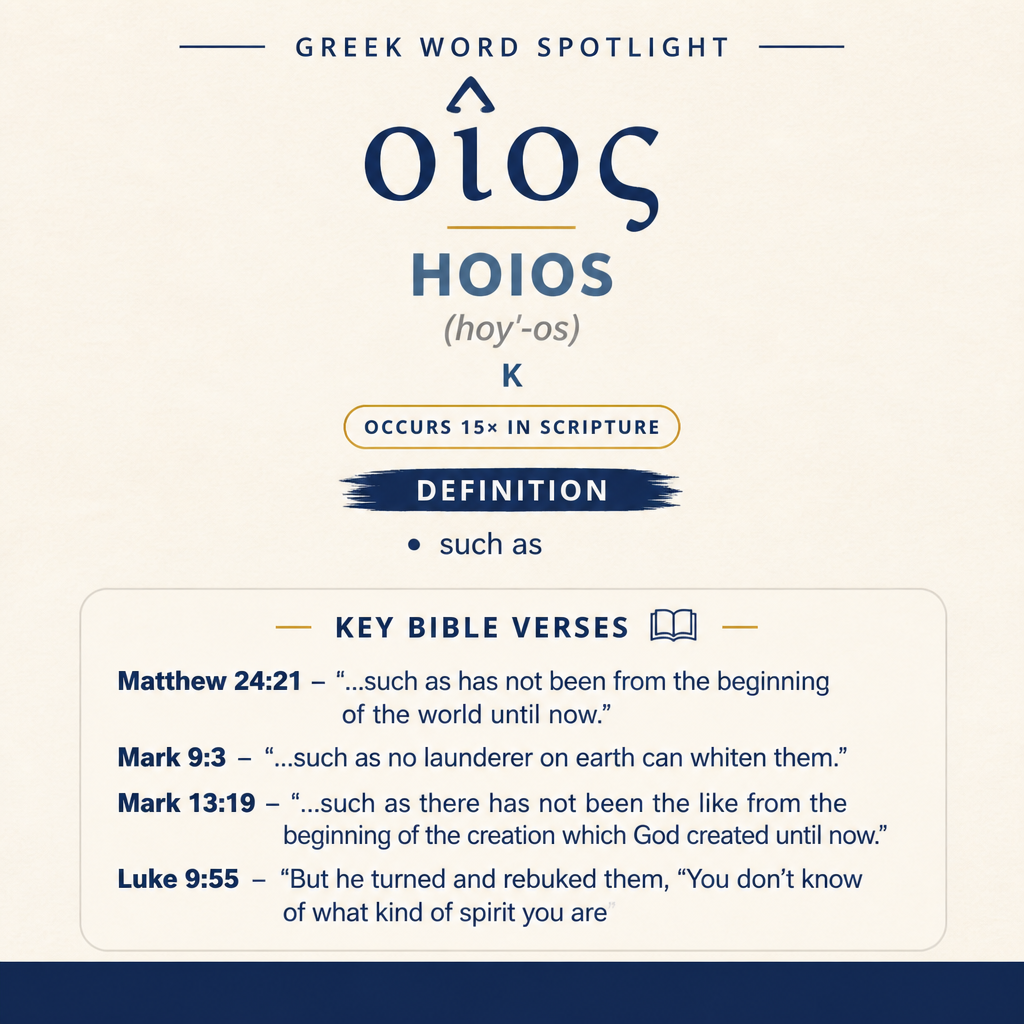
οἷος means “such as” and appears 15 times in Scripture, including Matthew 24:21, Mark 9:3, Luke 9:55, Romans 9:6, and 1 Corinthians 15:48.
Core Meaning
οἷος is defined as “such as.” It introduces comparisons and descriptions of what something is like.
Learn More →Gospel Examples
In Matthew 24:21 and Mark 13:19 it describes suffering or oppression “such as” has not been before. In Mark 9:3 it describes whiteness “such as” no launderer can produce.
Learn More →Letter Usage
In 1 Corinthians 15:48 it marks a parallel: “As is… such are…” between the earthly and the heavenly. In 2 Corinthians 10:11 it connects words in letters with deeds in person.
Learn More →οἷος expresses the idea of “such as,” marking resemblance, kind, or correspondence. Across its New Testament appearances, it helps compare events, describe qualities, and measure people or actions against an implied standard.
Occurrences
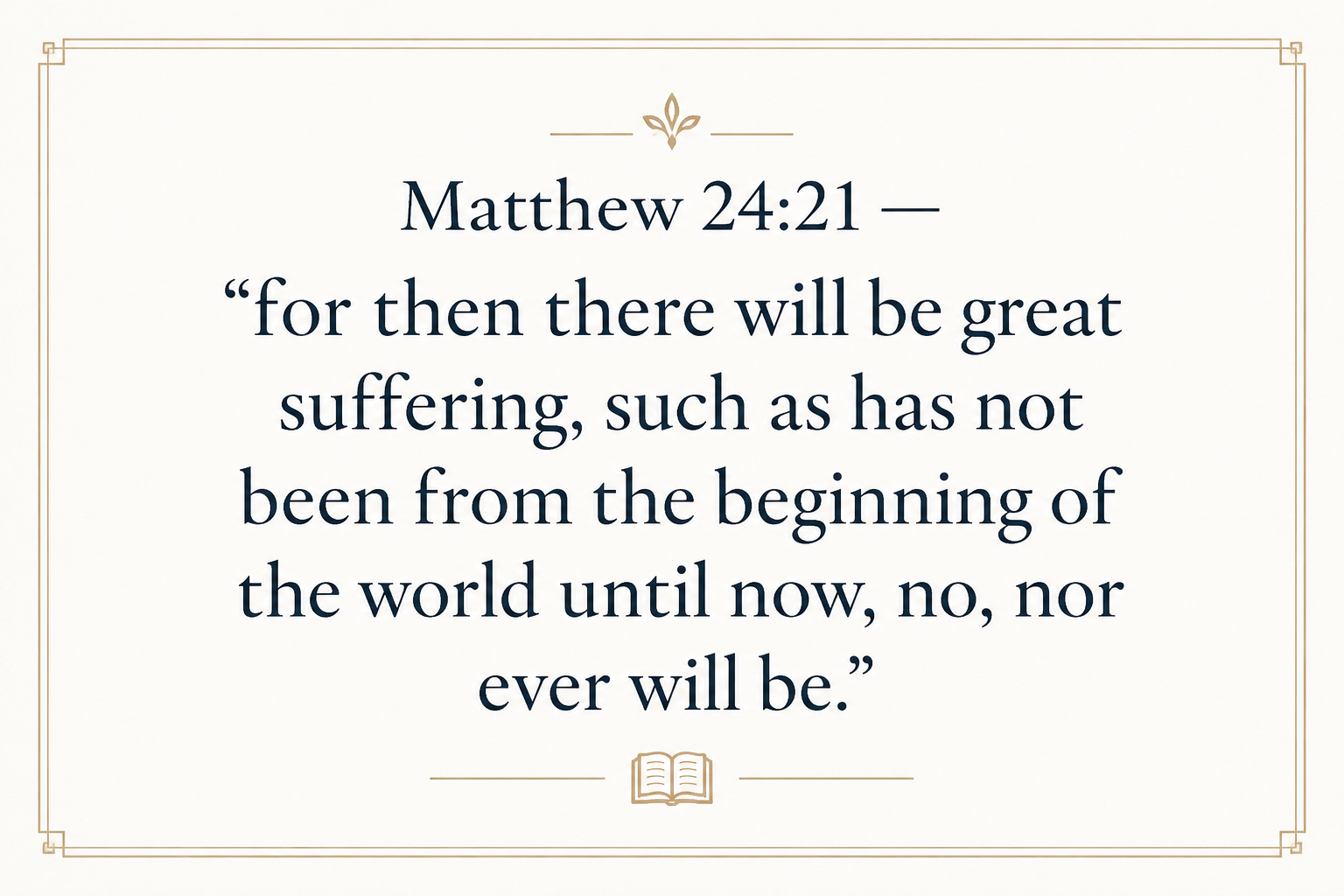
Matthew 24:21 — “for then there will be great suffering, such as has not been from the beginning of the world until now, no, nor ever will be.”
Here οἷος frames suffering by comparison: the coming distress is characterized as unlike anything earlier or later. The wording “such as has not been” uses comparison to stress singularity—an intensity measured against “the beginning of the world until now” and even against the future (“nor ever will be”).
Mark 9:3 — “His clothing became glistening, exceedingly white, like snow, such as no launderer on earth can whiten them.”
In this description, οἷος reinforces the impossibility of achieving the described whiteness by ordinary means. The clothing is not merely white; it is of a kind (“such as”) that surpasses what “no launderer on earth” can produce, so the comparison sets an upper boundary for human capability and places the observed whiteness beyond it.
Mark 13:19 — “For in those days there will be oppression, such as there has not been the like from the beginning of the creation which God created until now, and never will be.”
As in Matthew’s saying about suffering, οἷος measures “oppression” by a broad historical comparison. The phrase “such as there has not been” casts the oppression as unprecedented, and the time span (“from the beginning of the creation…until now”) functions as the scale against which the oppression’s kind is evaluated.
Luke 9:55 — “But he turned and rebuked them, “You don’t know of what kind of spirit you are.”
In this rebuke, οἷος targets identity and disposition: the issue is “what kind” of spirit characterizes the disciples’ stance in that moment. The word does not name the spirit directly; instead it presses the question of quality or sort, urging recognition of the character behind their impulse.
Romans 9:6 — “But it is not as though the word of God has come to nothing. For they are not all Israel that are of Israel.”
Within this tightly reasoned sentence, οἷος works in a contrastive statement: “not as though” introduces a comparison that is denied. Paul rejects an interpretation that would treat the situation as equivalent to “the word of God” failing, and he follows with a distinction (“not all Israel…”) that clarifies why that comparison should not be made.
1 Corinthians 15:48 — “As is the one made of dust, such are those who are also made of dust; and as is the heavenly, such are they also that are heavenly.”
Here οἷος appears in a balanced set of correspondences: the nature of “the one made of dust” is mirrored in those “made of dust,” and the nature of “the heavenly” is mirrored in those “that are heavenly.” The word enables a structured analogy—“as is…such are…”—so that kind determines kind: what someone is aligned with shapes what they are like.
2 Corinthians 10:11 — “Let such a person consider this, that what we are in word by letters when we are absent, such are we also in deed when we are present.”
οἷος serves two functions in this verse. First, “such a person” points to a certain sort of critic—someone drawing conclusions from letters and absence. Second, Paul asserts correspondence between communication and conduct: “what we are in word…when we are absent, such are we also in deed when we are present.” The comparison insists that written words are of a piece with embodied action.
2 Corinthians 12:20 — “For I am afraid that by any means, when I come, I might find you not the way I want to, and that I might be found by you as you don’t desire, that by any means there would be strife, jealousy, outbursts of anger, factions, slander, whisperings, proud thoughts, or riots,”
In this personal warning, οἷος shapes mutual expectations: Paul fears he may find them “not the way” he wants, and that he may be found “as you don’t desire.” The word sets up a comparison between hoped-for presence and feared reality, where the “kind” of encounter anticipated includes a list of communal breakdowns (strife through riots).
Philippians 1:30 — “having the same conflict which you saw in me and now hear is in me.”
Here οἷος anchors sameness by linking two perceptions of Paul’s struggle: what the Philippians “saw” and what they “now hear” are characterized as “the same conflict.” The word connects past observation and present report, presenting the conflict as of one kind across time and circumstance.
1 Thessalonians 1:5 — “and that our Good News came to you not in word only, but also in power, and in the Holy Spirit, and with much assurance. You know what kind of men we showed ourselves to be among you for your sake.”
In this reminder of the missionaries’ conduct, οἷος identifies the recognizable quality of their lives: “what kind of men we showed ourselves to be.” The statement ties message-delivery (“not in word only”) to embodied character “among you,” presenting their manner as a visible, knowable sort that served the Thessalonians’ good.
2 Timothy 3:11 — “persecutions, and sufferings: those things that happened to me at Antioch, Iconium, and Lystra. I endured those persecutions. The Lord delivered me out of them all.”
In this recollection, οἷος gathers concrete hardships into a definable category: “persecutions, and sufferings” are then specified as “those things that happened to me” in named places. The word contributes a sense of “such things” as recognizable instances within the broader label—events of a certain kind that can be pointed to and remembered.
Revelation 16:18 — “There were lightnings, sounds, and thunders; and there was a great earthquake, such as has not happened since there were men on the earth, so great an earthquake, and so mighty.”
οἷος intensifies the scene by asserting unmatched magnitude. The earthquake is defined by comparison to all human experience (“since there were men on the earth”), and the description presses the point with two reinforcing measures: “so great… and so mighty.” The comparison is not decorative; it marks the quake as of an extraordinary kind.

Sense and Usage
Across these passages, οἷος regularly operates as a comparison-marker that classifies something by kind and places it in relation to a known standard. Sometimes the standard is explicit and broad—history from “the beginning” (Matthew 24:21; Mark 13:19), human craft (“no launderer on earth,” Mark 9:3), or human memory (“since there were men on the earth,” Revelation 16:18). In these, the effect is to define an experience by its unmatched character: the suffering, oppression, and earthquake are presented as unprecedented, and the whiteness as beyond normal production.
At other times, οἷος identifies a quality that should be recognized in persons. In Luke 9:55 the focus is inward: “what kind of spirit you are” frames a moral or dispositional diagnosis without naming it outright. In 1 Thessalonians 1:5 the focus is outward and communal: the Thessalonians “know what kind of men” the missionaries proved to be among them. In 2 Corinthians 10:11 and 12:20, the word helps manage relational judgments—both the labeling of “such a person” and the assertion that Paul’s deeds match his words, as well as the fear of being found in an unwanted manner.
οἷος can also be used to build logical and rhetorical structure. Romans 9:6 denies a comparison (“not as though”), clearing away an inference that would interpret events as the collapse of God’s word; the denial sets the stage for a distinction within “Israel.” In 1 Corinthians 15:48, the word supports a paired analogy (“As is… such are…”) that maps one kind onto another in two directions—dust to dust, heavenly to heavenly—so that resemblance and belonging are expressed through matched categories. Philippians 1:30 similarly uses the idea of sameness of kind (“the same conflict”) to link what was seen and what is heard, knitting together experience and report.
Imagery
Several scenes sharpen “such as” through extremes that invite comparison: unmatched suffering and oppression spanning all time (Matthew 24:21; Mark 13:19), cloth whiteness beyond any earthly laundering (Mark 9:3), and an earthquake measured against all human history (Revelation 16:18). Alongside these, the word also presses comparison into personal life—asking what sort of spirit is at work (Luke 9:55), what sort of people the messengers proved to be (1 Thessalonians 1:5), and whether presence will match letters and hopes (2 Corinthians 10:11; 12:20). In each setting, οἷος makes the reader weigh resemblance: what something is like, what it corresponds to, and what kind it truly is.
Sources: Lexical data from Strong’s Exhaustive Concordance and the Translators Brief Lexicon of Extended Strongs for Greek (STEPBible, CC BY). Occurrence data from the Translators Amalgamated Greek New Testament (STEPBible, CC BY). Scripture quotations from the World English Bible (public domain).





