
Exploring the Meaning of Nun in Greek
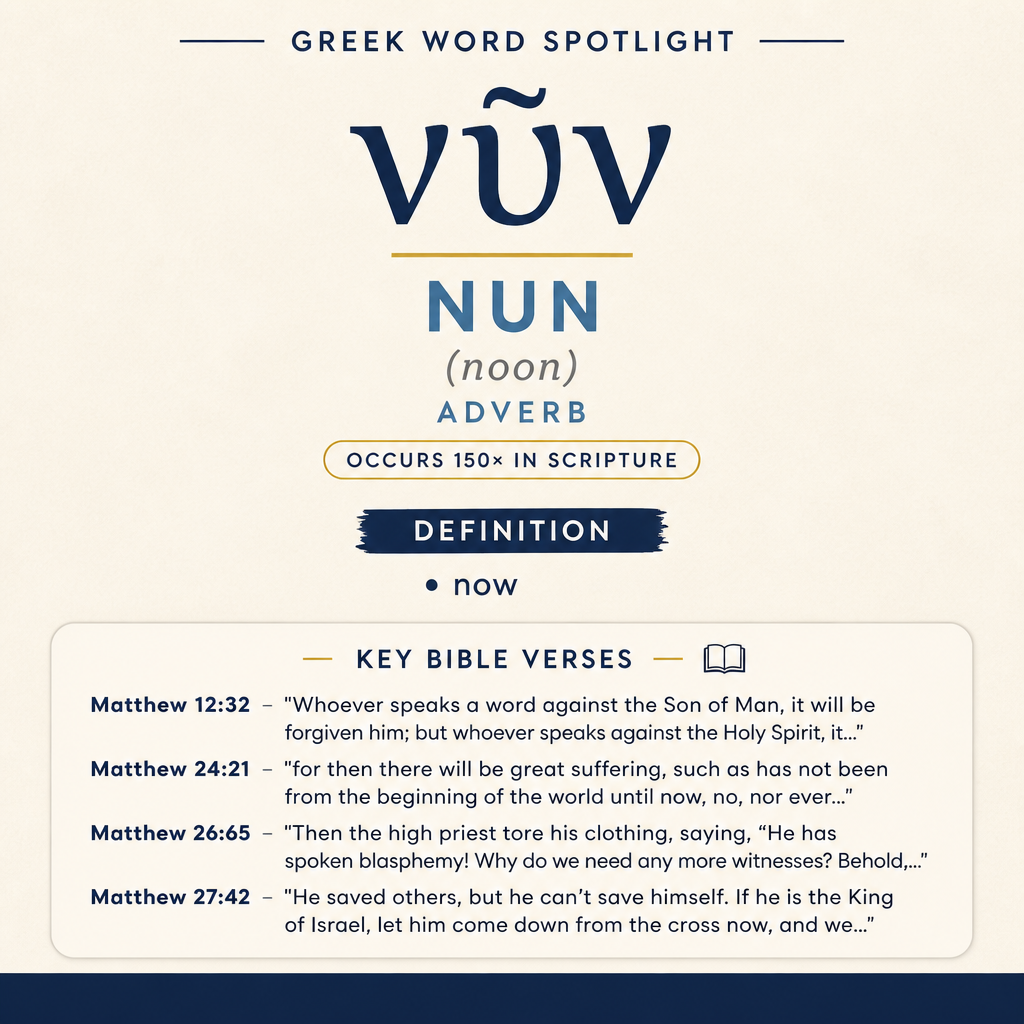
νῦν means “now” and appears 150 times in Scripture, including Matthew 12:32; 24:21; 26:65; 27:42–43 and Mark 10:30; 13:19; 15:32.
Core Meaning
νῦν is the Greek word meaning “now.” It expresses present time in Scripture’s narrative and speech.
Learn More →Scripture Occurrences
νῦν occurs 150 times in Scripture. Examples include Matthew 12:32; 24:21; 26:65; 27:42–43 and Mark 10:30; 13:19; 15:32.
Learn More →Sample Usage
It appears in statements like “until now” (Matthew 24:21) and “now come down from the cross” (Matthew 27:42; Mark 15:32).
Learn More →νῦν expresses the time of “now,” marking what is present in a speaker’s moment, what has continued up to the present, or what begins at the present as a new point of reference. In the passages below it appears in sayings of Jesus, in prophetic discourse, in courtroom accusation, in mockery at the cross, and in songs of praise, repeatedly sharpening the contrast between present time and what lies beyond it.
Occurrences
Matthew 12:32: “Whoever speaks a word against the Son of Man, it will be forgiven him; but whoever speaks against the Holy Spirit, it will not be forgiven him, neither in this age, nor in that which is to come.”
Here “now” functions through the framing of time into “this age” and “that which is to come.” νῦν anchors the warning in the present order of time (“this age”) while the saying stretches forward to another time (“to come”), so the audience hears the matter as one with consequences that reach beyond the immediate moment.
Matthew 24:21: “for then there will be great suffering, such as has not been from the beginning of the world until now, no, nor ever will be.”
νῦν sets the end point of a sweeping comparison: suffering is measured from “the beginning of the world” up to the speaker’s present. The word draws a line at the present moment (“until now”), making the claim cover all prior time and preparing the listener to hear what follows as unparalleled both backward and forward (“nor ever will be”).
Matthew 26:65: “Then the high priest tore his clothing, saying, “He has spoken blasphemy! Why do we need any more witnesses? Behold, now you have heard his blasphemy.”
In this courtroom scene, νῦν presses immediacy and sufficiency: “now you have heard.” The high priest uses “now” to insist that the present hearing itself completes what is needed, turning the moment into a decisive turning point and closing the door on further testimony.
Matthew 27:42: ““He saved others, but he can’t save himself. If he is the King of Israel, let him come down from the cross now, and we will believe in him.”
νῦν sharpens the taunt by demanding an immediate, visible act: “come down… now.” The mockers set “now” as the condition for belief, tying their stated willingness to believe to a present display and making the moment of crucifixion the arena for their challenge.
Matthew 27:43: “He trusts in God. Let God deliver him now, if he wants him; for he said, ‘I am the Son of God.’ ”
Again νῦν is used to force the question into the present: “deliver him now.” The speakers treat “now” as the proper time for divine vindication, implying that the present moment should reveal whether the claim and trust they reference are genuine.
Mark 10:30: “but he will receive one hundred times more now in this time: houses, brothers, sisters, mothers, children, and land, with persecutions; and in the age to come eternal life.”
νῦν divides two horizons of receiving: “now in this time” and “in the age to come.” In the first horizon, “now” is filled out with concrete items (“houses… land”) and also hardship (“with persecutions”), so the word locates discipleship’s recompense and cost within present experience, while leaving “eternal life” explicitly for a later time.
Mark 13:19: “For in those days there will be oppression, such as there has not been the like from the beginning of the creation which God created until now, and never will be.”
As in Matthew’s parallel phrasing, νῦν marks the present endpoint of an absolute comparison, but here the time span is cast as “from the beginning of the creation which God created until now.” “Until now” makes the claim encompass everything up to the present, intensifying the forecast by placing what is coming beyond any precedent within all known time.
Mark 15:32: “Let the Christ, the King of Israel, now come down from the cross, that we may see and believe him.” Those who were crucified with him also insulted him.
νῦν again frames a demand for immediacy—“now come down”—but Mark’s wording also adds purpose: “that we may see and believe.” “Now” is made the gateway to sight and belief, as though a single present act would settle identity and kingship.
Luke 1:48: “for he has looked at the humble state of his servant. For behold, from now on, all generations will call me blessed.”
Here νῦν is embedded in a forward-looking marker: “from now on.” The present moment becomes the starting point for an ongoing future pattern (“all generations will call me blessed”). The word thereby connects a present divine regard (“he has looked…”) with a continuing consequence that begins at the present and extends outward through time.
Luke 2:29: ““Now you are releasing your servant, Master, according to your word, in peace;”
In Simeon’s address, νῦν situates the action of “releasing” in the immediacy of fulfilled expectation: “Now you are releasing your servant.” The “now” makes the moment itself the time of God’s action “according to your word,” so the speaker’s peace is tied to what is occurring in the present.
Luke 5:10: “and so also were James and John, sons of Zebedee, who were partners with Simon. Jesus said to Simon, “Don’t be afraid. From now on you will be catching people alive.”
νῦν establishes a new start point in Simon’s life: “From now on.” The phrase marks a decisive shift from what came before to a future characterized by a new task (“you will be catching people alive”), and “now” gives that shift a clear temporal boundary beginning with Jesus’ present word.
Luke 6:21: “Blessed are you who hunger now, for you will be filled. Blessed are you who weep now, for you will laugh.”
νῦν identifies the present condition of the addressed people—“hunger now,” “weep now”—and places it in direct relation to a future reversal (“you will be filled… you will laugh”). The word makes present hardship the focus, not as the endpoint, but as the current state from which a promised change is anticipated.

Sense and Usage
Across these passages, νῦν repeatedly functions as a temporal pointer that makes a statement concrete by fastening it to the present. Sometimes it marks the present as a boundary in a long span of time, as in the comparisons “until now” (Matthew 24:21; Mark 13:19). In those sayings, “now” is not merely the speaker’s moment; it is the hinge where all prior history is gathered into view, so that what is announced can be described as without precedent “from the beginning” up to the present.
In other contexts, νῦν presses urgency and immediacy in speech acts that demand a decisive response. The high priest’s “Behold, now you have heard his blasphemy” (Matthew 26:65) uses “now” to close deliberation and move toward judgment. The mockers at the crucifixion repeatedly weaponize “now” (“come down… now”; “deliver him now”) to insist that the present moment must yield proof (Matthew 27:42–43; Mark 15:32). Here νῦν is rhetorically sharp: it seeks to force a conclusion in the immediate present and defines what they will accept as evidence.
νῦν can also establish a “now” that begins an extended future. Luke uses this with the explicit starting-point phrasing “from now on” (Luke 1:48; Luke 5:10). In Mary’s song, “from now on” turns the present moment of divine attention into the beginning of a long-lasting reputation across “all generations.” In Jesus’ address to Simon, “from now on” marks the beginning of a redefined vocation. In both, “now” is not fleeting; it functions as the inaugural moment of a new trajectory.
Finally, νῦν can highlight the present in contrast to a future outcome, making present realities intelligible by placing them within a larger time pattern. Mark 10:30 sets “now in this time” alongside “in the age to come,” distributing different kinds of receiving across present and future and naming that the present can include both abundance and “persecutions.” Luke 6:21 similarly addresses people in present need (“hunger now… weep now”) while pointing them toward future satisfaction and joy. In these sayings, “now” draws attention to present experience, but the sentence structure keeps the present from being the whole story; it is the current stage set against a coming change.
Imagery in Context
In these scenes, νῦν often carries the feel of a moment that cannot be ignored: a court hearing where words have just been heard (Matthew 26:65), a cross where onlookers demand immediate rescue (Matthew 27:42–43; Mark 15:32), and personal turning points where a life is reoriented “from now on” (Luke 5:10) or a long horizon opens before the speaker (Luke 1:48). Even in prophecies that span from “the beginning” to the present (Matthew 24:21; Mark 13:19), “now” acts like a line drawn across time, fixing the listener in the present while stretching their view toward what lies ahead.
Sources: Lexical data from Strong’s Exhaustive Concordance and the Translators Brief Lexicon of Extended Strongs for Greek (STEPBible, CC BY). Occurrence data from the Translators Amalgamated Greek New Testament (STEPBible, CC BY). Scripture quotations from the World English Bible (public domain).




