Exploring the Meaning of Nineuites in Greek
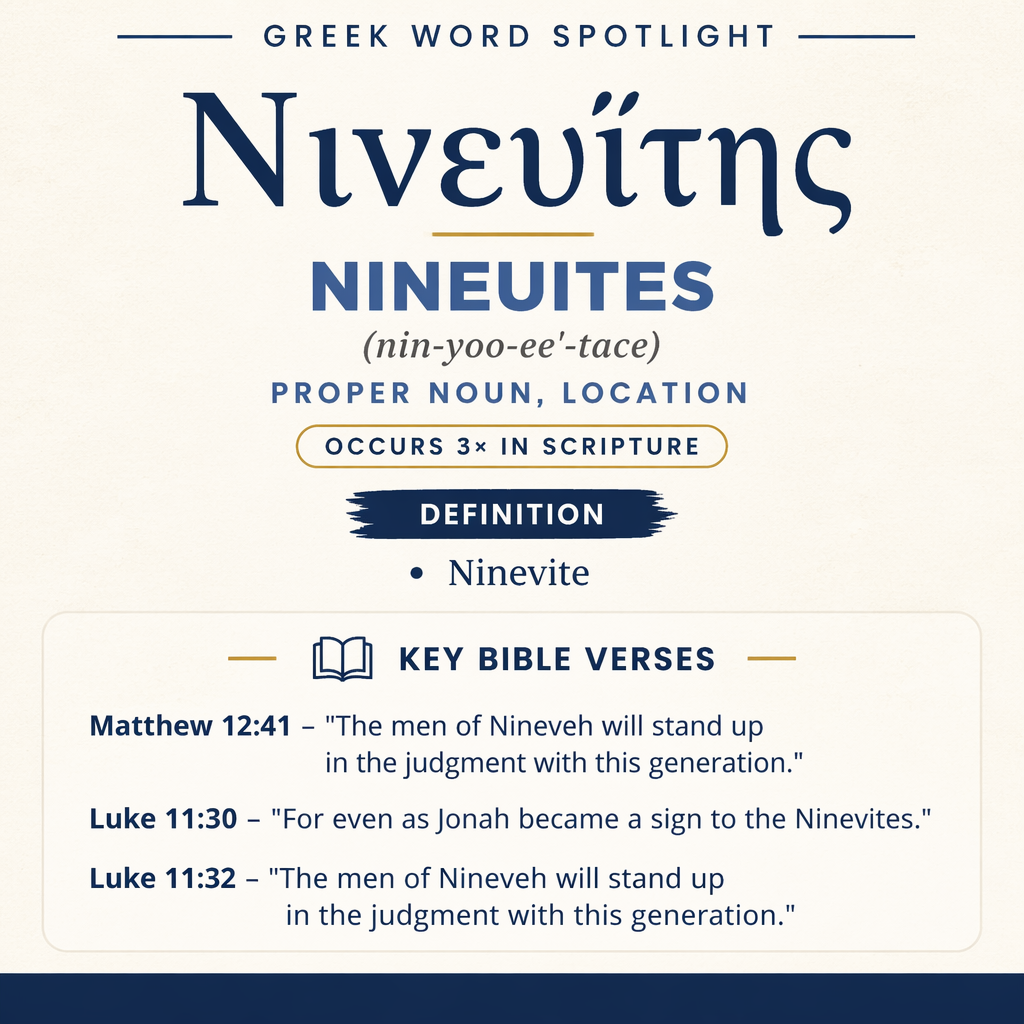
Νινευΐτης means “Ninevite” and appears three times in Scripture: Matthew 12:41; Luke 11:30; Luke 11:32.
New Testament Occurrences
It occurs three times: Matthew 12:41; Luke 11:30; Luke 11:32.
Learn More →Context in Verses
In Matthew 12:41 and Luke 11:32, the men of Nineveh are mentioned as repenting. In Luke 11:30, Jonah is a sign to the Ninevites.
Learn More →Νινευΐτης refers to a “Ninevite,” and it appears in Jesus’ sayings that recall Jonah’s preaching and the response of Nineveh. In these passages the word functions as a concrete designation for people whose repentance becomes a point of comparison in “this generation.”
Root and Related Words
Νινευΐτης (Nineuites) corresponds to the place-name Νινευΐ (Nineui), “Nineveh” (Strong’s G3535). The relationship is that of an inhabitant-term formed from a location name, identifying someone in connection with that city.

Occurrences
Matthew 12:41: “The men of Nineveh will stand up in the judgment with this generation, and will condemn it, for they repented at the preaching of Jonah; and behold, someone greater than Jonah is here.”
Here the word appears in the phrase “The men of Nineveh,” presenting Ninevites as a defined group who take an active role in an end-time scene: they “will stand up in the judgment with this generation.” The designation does more than locate them geographically; it identifies a recognizable body of people whose past response to Jonah (“they repented at the preaching of Jonah”) becomes the basis of their future testimony against those who hear Jesus. The logic of the saying turns on comparison: the Ninevites’ repentance is treated as established, and the presence of “someone greater than Jonah” heightens the seriousness of the present generation’s response.
Luke 11:30: “For even as Jonah became a sign to the Ninevites, so the Son of Man will also be to this generation.”
In this line the word is embedded in an analogy about “a sign.” Jonah’s relationship to the Ninevites is described in compressed form: he “became a sign to the Ninevites.” The term marks the audience for whom Jonah’s role carried that sign-value. By naming the Ninevites, the saying evokes a particular historical audience as a reference point for the way “the Son of Man will also be to this generation.” The word therefore helps define the comparison: as Jonah’s presence and message functioned meaningfully for Nineveh’s people, so the Son of Man’s significance will confront the current audience. The Ninevites are not the topic for their own sake; they are the earlier recipients in a parallel that frames how “this generation” should understand what is happening in front of them.
Luke 11:32: “The men of Nineveh will stand up in the judgment with this generation, and will condemn it: for they repented at the preaching of Jonah, and behold, one greater than Jonah is here.”
This occurrence closely matches the scene described in Matthew, again using “The men of Nineveh” to place Ninevites in the role of witnesses within “the judgment.” The word anchors the portrayal of a corporate group whose defining action is repentance: “they repented at the preaching of Jonah.” In Luke’s phrasing, the condemnation is stated with a colon, tying it directly to the reason given; the word thereby points to people whose response supplies the moral contrast. The closing line, “behold, one greater than Jonah is here,” again makes the comparison sharper: Ninevites responded to Jonah’s preaching, and the present generation is confronted by a greater figure, which intensifies the implied accountability.
Sense and Usage
Across these sayings, “Ninevite” functions as a people-designation grounded in Nineveh, but the emphasis is consistently on the collective character and action of those people. The repeated phrasing “The men of Nineveh” shows that the term is used to speak about Ninevites as a recognizable community rather than as scattered individuals. In both judgment sayings (Matthew 12:41; Luke 11:32), the Ninevites are depicted as standing “with this generation,” so the label brings a different people into the same evaluative setting, making the comparison unavoidable: one group repented at Jonah’s preaching, the other is hearing someone greater.
Luke 11:30 uses the same people-term in a different but related frame: not the courtroom-like scene of judgment, but the interpretive frame of “a sign.” Even there, the word’s force is corporate. Jonah is not described as a sign in the abstract; he becomes a sign “to the Ninevites,” meaning the label identifies the recipients for whom Jonah’s presence and message took on that significance. Thus, while the word itself simply marks someone connected to Nineveh, in these passages it repeatedly gathers up the Ninevites as a moral and interpretive reference point for the audience addressed as “this generation.”
The word also carries a time-bridging effect in the rhetoric of these sayings. By naming the Ninevites, Jesus places a former audience and the current audience side-by-side: Jonah’s hearers and the present hearers. The term therefore helps the sayings move from recollection (“they repented at the preaching of Jonah”) to present confrontation (“someone greater than Jonah is here”; “one greater than Jonah is here”) and on to future outcome (“will stand up in the judgment”). In each case, “Ninevite” functions as an anchor for that remembered response, allowing it to serve as a benchmark in the present and as a voice in the judgment scene.
Imagery
In these passages the Ninevites are pictured not through details of city life, but through courtroom and public-sign imagery: people who “will stand up in the judgment” and people to whom a prophet “became a sign.” The label “men of Nineveh” evokes a gathered company whose shared response to preaching becomes the decisive feature by which they are remembered and by which they are set in comparison with “this generation.”
Sources: Lexical data from Strong’s Exhaustive Concordance and the Translators Brief Lexicon of Extended Strongs for Greek (STEPBible, CC BY). Occurrence data from the Translators Amalgamated Greek New Testament (STEPBible, CC BY). Scripture quotations from the World English Bible (public domain).