Exploring the Meaning of Nikos in Greek
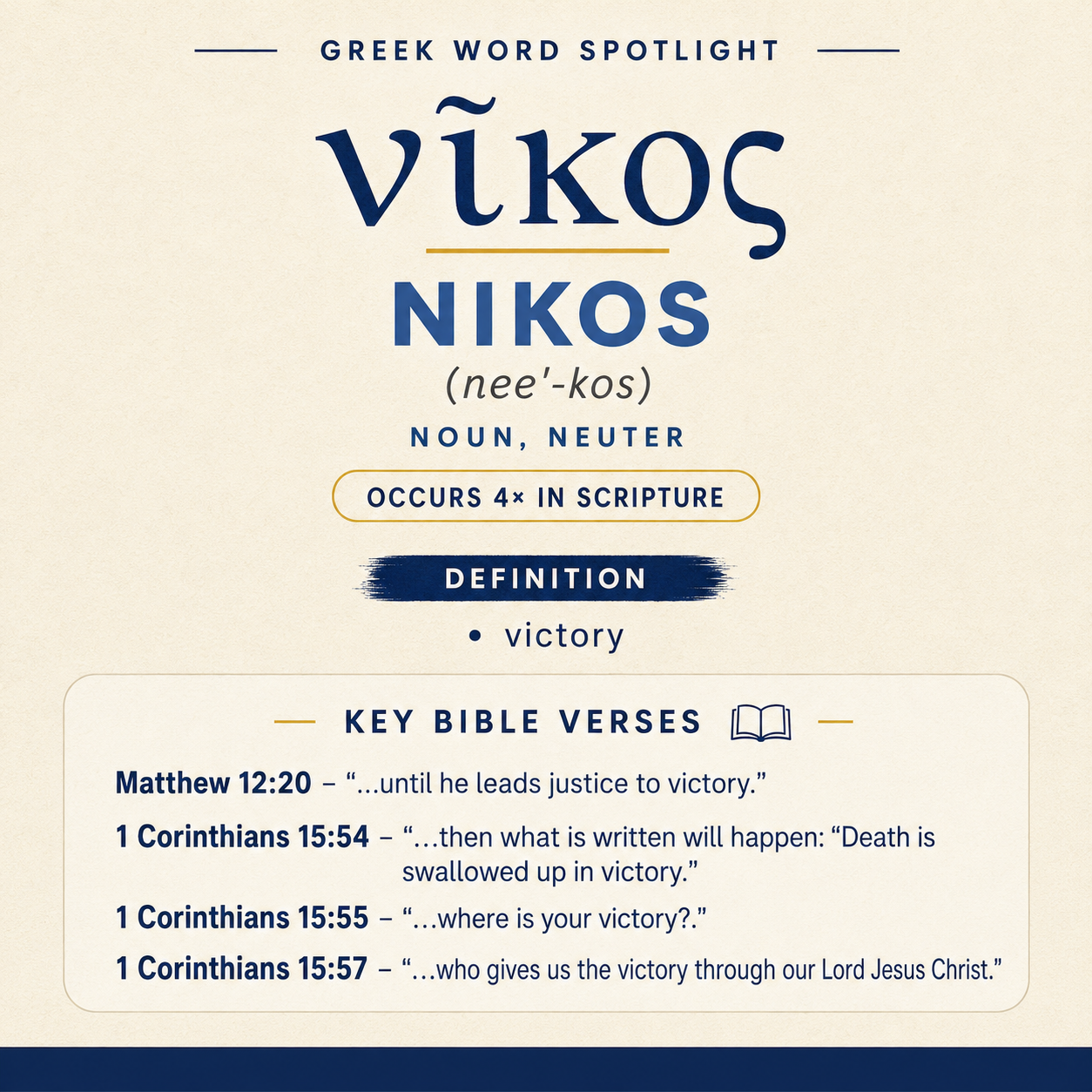
νῖκος (Nikos) means “victory” and occurs four times in Scripture: Matthew 12:20 and 1 Corinthians 15:54–55, 57.
Context Highlights
In Matthew 12:20, justice is led to victory. In 1 Corinthians 15, it is contrasted with death and given through Jesus Christ.
Learn More →νῖκος means “victory” and appears in a small set of New Testament contexts that range from a public outcome (“justice to victory”) to the final reversal of death and the thanksgiving that follows. Its uses in Matthew and 1 Corinthians place the word at moments when a decisive outcome is reached or confidently expected.
Root and Related Words
νῖκος is related to nike (νίκη), “victory” (Strong’s G3529).

Occurrences
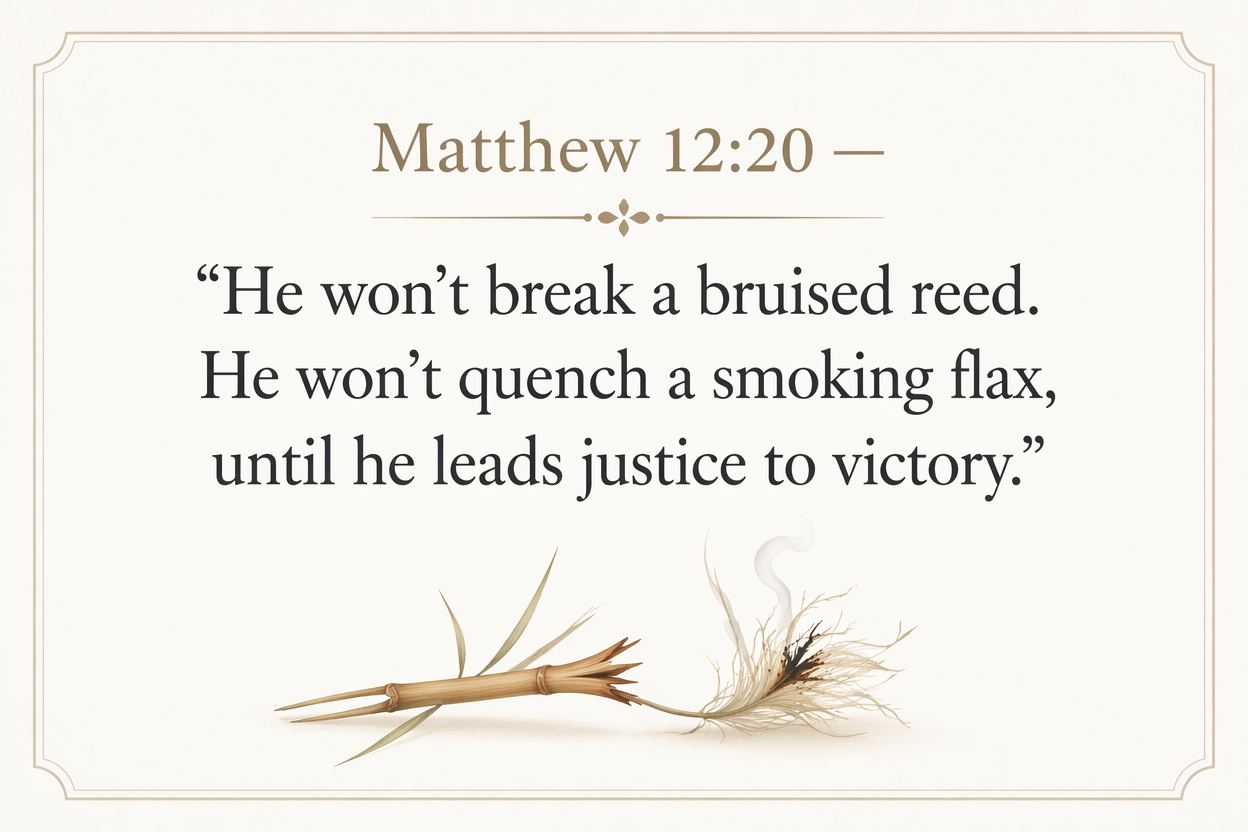
Matthew 12:20 — “He won’t break a bruised reed. He won’t quench a smoking flax, until he leads justice to victory.”
Here “victory” names the settled end-point of “justice.” The line holds two images of something fragile—“a bruised reed” and “a smoking flax”—and denies that it will be crushed or extinguished. Against that backdrop, νῖκος gives the direction of the action: justice is not merely maintained but brought through to a winning outcome. The word therefore carries the sense of an achieved result, the point at which justice is no longer in contest but has prevailed.
1 Corinthians 15:54 — “But when this perishable body will have become imperishable, and this mortal will have put on immortality, then what is written will happen: “Death is swallowed up in victory.””
In this setting “victory” frames a dramatic reversal of death. The verse speaks of transformation—“perishable” becoming “imperishable,” and “mortal” putting on “immortality”—and then announces an event described as fulfillment: “then what is written will happen.” Within that climactic moment, νῖκος is the sphere into which death disappears: it is “swallowed up in victory.” The word marks more than an improvement; it marks a decisive outcome that absorbs the former power of death, leaving no remainder of its claim in the picture painted by the quotation.
1 Corinthians 15:55 — ““Death, where is your sting? Hades, where is your victory?””
This verse turns “victory” into the object of a direct challenge. The address is pointed: “Death” is asked about its “sting,” and “Hades” is asked about its νῖκος. The rhetorical question treats “victory” as something that could be claimed by Hades, yet is now exposed as missing or ineffective in the face of what has just been proclaimed. In this way νῖκος functions as a marker of dominance: to possess “victory” would be to have the upper hand, and the question implies that such an upper hand has been stripped away.
1 Corinthians 15:57 — “But thanks be to God, who gives us the victory through our Lord Jesus Christ.”
Here νῖκος is explicitly granted: God “gives us the victory.” The line is framed as thanksgiving (“thanks be to God”) and identifies the means or channel: “through our Lord Jesus Christ.” The word therefore belongs to the register of gift rather than achievement in this sentence; it is received from God and shared (“gives us”), connecting the preceding taunt over death and Hades with a present confession of the source of the winning outcome.
Sense and Usage
Across these passages, νῖκος consistently names the winning side of a contest—an outcome that stands when opposing forces have been overcome. In Matthew, the contest is implied in the phrase “leads justice to victory”: justice moves toward a conclusion in which it prevails. The surrounding imagery of the bruised reed and the smoking flax places that movement in a setting of gentleness and persistence; “victory” is not achieved by snapping what is bruised or putting out what still smolders, but by carrying justice through to its successful end.
In 1 Corinthians 15, νῖκος takes on a pronounced eschatological weight within the argument of bodily transformation. The sequence “perishable… imperishable” and “mortal… immortality” sets the stage for victory as the final condition that replaces the old order. “Death is swallowed up in victory” gives νῖκος an almost spatial feel: victory is the environment that contains and eliminates death, rather than merely defeating it at arm’s length. Immediately after, “Hades, where is your victory?” shows that νῖκος can be spoken of as a possession or claim—something an adversarial power might be thought to hold. Yet the rhetorical force is that such a claim has been emptied in light of the transformation just described.
Finally, the thanksgiving of 1 Corinthians 15:57 binds the word to divine action. Victory is not presented as a neutral result that simply happens; it is given, and it is given “through our Lord Jesus Christ.” The verse places νῖκος within a relational and theological frame: God is the giver, “us” are the recipients, and the means is stated plainly. This usage also clarifies the tone of the prior taunt: the derision of death’s sting and Hades’s victory rests on a received victory that has a specific source.
Imagery
The imagery attached to νῖκος in these texts is vivid and varied. In Matthew it appears at the end of a pathway—justice being led until it arrives at victory—while the scene is populated by delicate, easily damaged objects that remain unbroken and unquenched. In 1 Corinthians, victory becomes the scene of engulfment, where death is “swallowed up,” and then the ground of confident speech in which death and Hades are addressed as defeated claimants. The final note of thanksgiving presents victory not as an abstract idea but as a concrete gift given from God through Jesus Christ.
Sources: Lexical data from Strong’s Exhaustive Concordance and the Translators Brief Lexicon of Extended Strongs for Greek (STEPBible, CC BY). Occurrence data from the Translators Amalgamated Greek New Testament (STEPBible, CC BY). Scripture quotations from the World English Bible (public domain).