Exploring the Meaning of Nikolaos in Greek
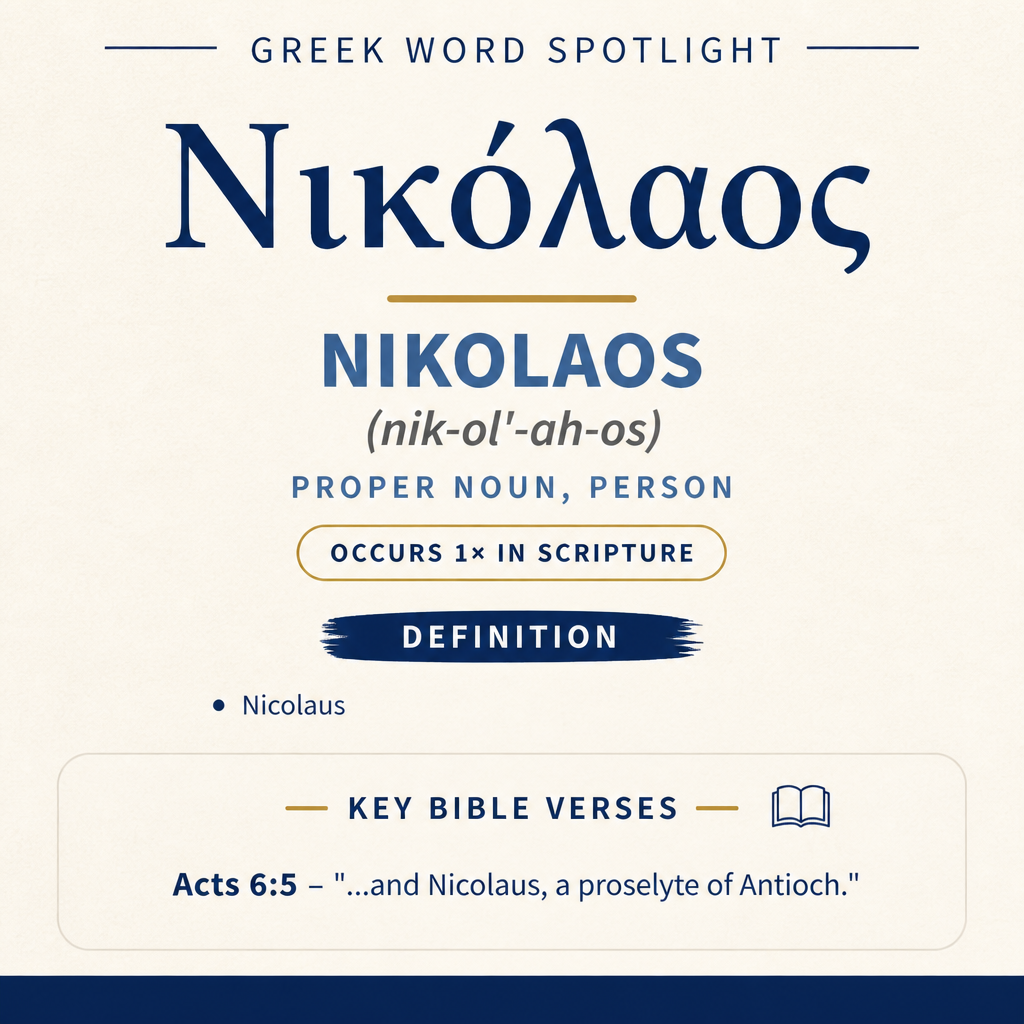
Νικόλαος (Nikolaos) means “Nicolaus” and appears once in Scripture, in Acts 6:5.
Verse Context
In Acts 6:5, the multitude chooses Stephen, Philip, Prochorus, and others; Nicolaus is included in this list.
Learn More →Νικόλαος (Nikolaos) is the personal name “Nicolaus.” It appears once, in a list of men chosen by the Jerusalem congregation in Acts 6:5.
Root and Related Words
Strong’s connects Νικόλαος (Nikolaos) with νῖκος (nikos), “victory” (Strong’s G3534), and with Λαοδικεύς (Laodikeus), “Laodicean” (Strong’s G2994), as a word from which it derives.

Occurrences
“These words pleased the whole multitude. They chose Stephen, a man full of faith and of the Holy Spirit, Philip, Prochorus, Nicanor, Timon, Parmenas, and Nicolaus, a proselyte of Antioch;” (Acts 6:5)
Here Nicolaus is introduced within a public decision made by “the whole multitude.” The name functions as a specific identifier in a roll of selected individuals, placed alongside six others: “Stephen… Philip, Prochorus, Nicanor, Timon, Parmenas.” In this scene the narrative emphasis falls on the community’s unified response—“These words pleased the whole multitude”—and on the concrete outcome of that agreement: “They chose” named men. Nicolaus is distinguished from the others by an added descriptor: “a proselyte of Antioch.” That brief apposition does two things in the immediate context: it supplies his religious status (“proselyte”) and attaches him to a geographic origin (“of Antioch”). Within the list, this extra information marks him as noteworthy in a way the other names in the verse are not, since only Stephen is similarly expanded by a description (“a man full of faith and of the Holy Spirit”), while Nicolaus is expanded by background and location.
The placement of Nicolaus at the end of the sequence also makes his descriptor feel like a concluding note to the list: the reader ends the verse with a clear sense that among those chosen was someone whose connection extended beyond the immediate locale, linking the selection to Antioch by way of a convert. The name itself, used in this administrative moment, serves the text’s concern for accountability and concreteness: the choice is not abstract, but embodied in identifiable persons.
Sense and Usage
As a personal name, “Nicolaus” carries its main communicative force by anchoring the narrative to an individual. Acts 6:5 does not present Nicolaus as a mere incidental bystander; he is one of the persons formally chosen in a decision endorsed by a gathered community. In that sense, the name functions as part of a record of appointment: it signals that the selection was specific enough to be reported by naming those chosen.

The usage also shows how a proper name in Acts can be accompanied by a short identifying tag when the author wishes to locate a person socially or geographically. In this single occurrence the tag is compact—“a proselyte of Antioch”—yet it is sufficient to set Nicolaus apart within a list where most names stand alone. “Proselyte” places him among those who have entered Israel’s religious life as converts, and “of Antioch” associates him with a well-known city of the eastern Mediterranean world. Together, these descriptors give Nicolaus a defined profile within the community’s action: he is not only chosen, but chosen as someone whose background is explicitly mentioned. The verse thereby uses the name “Nicolaus” not just to fill out a roster, but to portray the breadth of those included in the community’s decision.
Because the narrative supplies no speech, action, or later development for Nicolaus in this verse, the meaning “Nicolaus” operates at the level of identification rather than characterization. The characterization is carried instead by the appositional description attached to his name and by the communal context of selection. The name’s presence in a list alongside men described (in Stephen’s case) by spiritual qualities and (in Nicolaus’s case) by background suggests that the author is attentive both to personal identity and to the makeup of the group being appointed.
Imagery
The lone appearance of Nicolaus evokes the scene of an assembled “multitude” settling on a practical course of action and then naming the people who will carry it out. The verse’s imagery is not symbolic but civic and communal: agreement, selection, and a roster of names, ending with one man singled out as “a proselyte of Antioch.”
Sources: Lexical data from Strong’s Exhaustive Concordance and the Translators Brief Lexicon of Extended Strongs for Greek (STEPBible, CC BY). Occurrence data from the Translators Amalgamated Greek New Testament (STEPBible, CC BY). Scripture quotations from the World English Bible (public domain).