Exploring the Meaning of Nikolaites in Greek
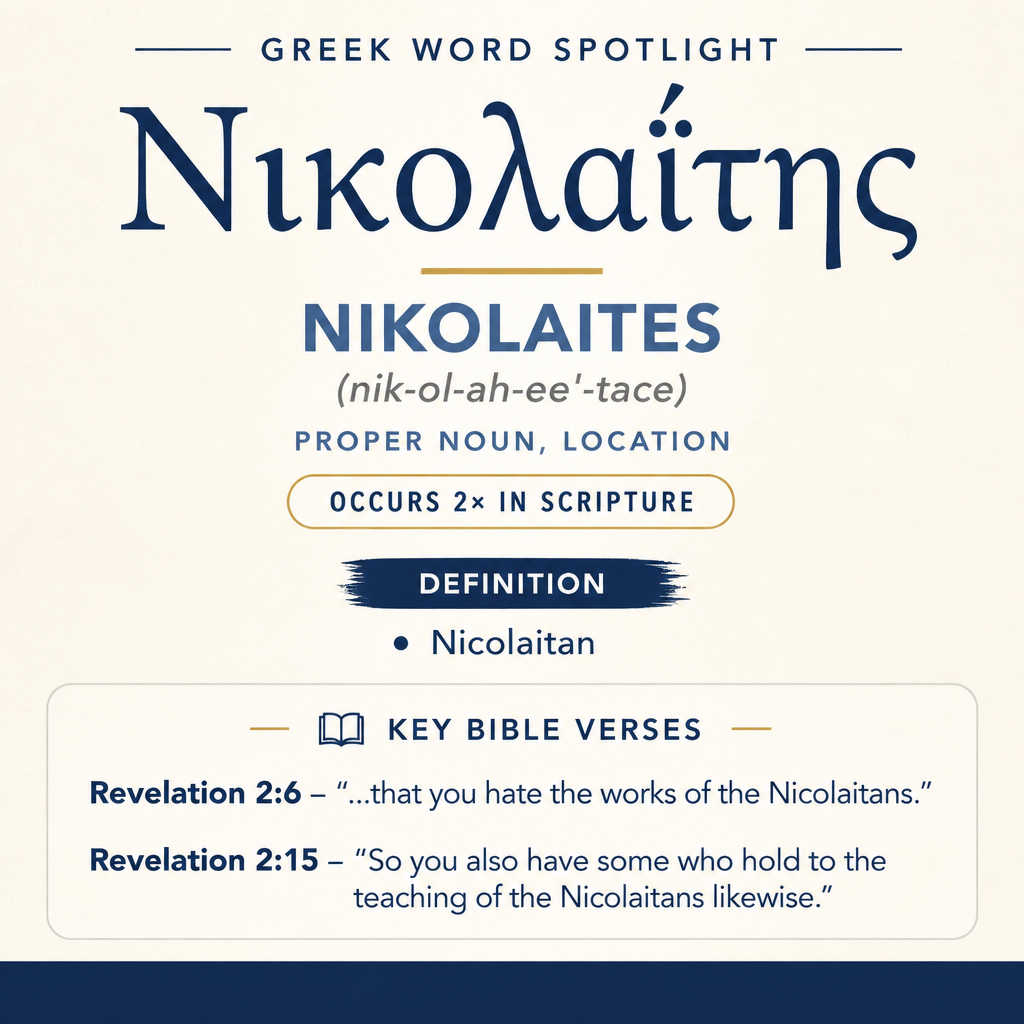
Νικολαΐτης means “Nicolaitan” and appears twice in Scripture, in Revelation 2:6 and 2:15.
Biblical Occurrences
The word occurs 2 times in Scripture. It appears in Revelation 2:6 and Revelation 2:15.
Learn More →Revelation Context
Revelation 2:6 mentions hating “the works of the Nicolaitans.” Revelation 2:15 mentions some who hold “the teaching of the Nicolaitans.”
Learn More →Νικολαΐτης means “Nicolaitan” and appears only in Revelation 2, where it is used in two brief but pointed statements: one about “the works of the Nicolaitans” and one about “the teaching of the Nicolaitans.” In both places it functions as a label for a group whose practices and instruction are treated as spiritually dangerous within the messages to the churches.
Root and Related Words
Νικολαΐτης (Nikolaites) is derived from the name Νικόλαος (Nikolaos), “Nicolaus” (Strong’s G3532). The relationship is presented as derivational: the group-name is formed from the personal name.

Occurrences
“But this you have, that you hate the works of the Nicolaitans, which I also hate.” (Revelation 2:6)
Here Νικολαΐτης appears in the plural (“the Nicolaitans”) in a sentence that contrasts commendation with moral evaluation. The hearers are told, “this you have,” and what they “have” is a settled stance: they “hate the works of the Nicolaitans.” The term therefore identifies the people whose “works” are in view, marking those deeds as a recognizable set attached to a known name. The speaker then adds, “which I also hate,” aligning divine judgment with the congregation’s rejection. In this setting, the word does not stand alone as a mere identifier; it is welded to “works,” so that “Nicolaitans” functions as a shorthand for a pattern of behavior that is to be repudiated. The statement also implies that the congregation’s hatred is not an ungrounded hostility toward persons as such, but a moral opposition to their “works,” with the name supplying a concrete target for that opposition.
“So you also have some who hold to the teaching of the Nicolaitans likewise.” (Revelation 2:15)
In this second occurrence, Νικολαΐτης again appears in the plural, but now joined to “teaching” rather than “works.” The line begins, “So you also have some…,” shifting from the earlier commendation (“this you have”) to a fault found “among” the community: there are “some who hold to the teaching of the Nicolaitans.” The verb “hold to” portrays adherence and attachment—an ongoing loyalty to what is taught—so the word marks not only an external group but an internal problem: certain members have embraced Nicolaitan instruction. The addition of “likewise” connects this situation to what immediately precedes in the message’s reasoning, portraying the Nicolaitan teaching as part of a broader pattern the hearers are being warned about. In this scene, “Nicolaitans” carries the weight of an identifiable teaching tradition; it is not merely that certain individuals behave badly, but that they cling to an articulated body of instruction associated with this named group.
Sense and Usage
Across its two uses, Νικολαΐτης operates as a group-designation (“Nicolaitans”) that is meaningful because it attaches to two spheres of communal life: action (“works”) and instruction (“teaching”). The pairing matters. Revelation 2:6 presents the Nicolaitans as known by their “works,” and the congregation is commended for hating those works, with the speaker explicitly sharing that hatred. Revelation 2:15 presents the Nicolaitans as known by their “teaching,” and the congregation is criticized because “some” within it “hold to” that teaching. Together the passages show how the name functions rhetorically: it can summarize a recognizable moral threat in both behavior and doctrine, and it can locate the danger either outside the community (as deeds to be rejected) or inside it (as teaching some have adopted).
The two collocations also sketch a basic range of how the label is deployed. In one instance, the emphasis falls on evaluation—“you hate… which I also hate”—placing “Nicolaitans” in the field of condemnation. In the other, the emphasis falls on allegiance—“some who hold to the teaching”—placing “Nicolaitans” in the field of influence and persuasion. The word thus helps the text speak about community boundaries: what a church is praised for rejecting and what it is rebuked for tolerating. Although the term itself is simply a designation, Revelation’s use makes it a compact marker for a contested identity within the churches’ moral and instructional life.
The plural form in both verses contributes to this effect. “The Nicolaitans” are treated as a collectivity with enough profile to be named, and their “works” and “teaching” are treated as coherent enough to be spoken of as definable entities. That coherence is part of the word’s function in these lines: it lets the messages address a complex reality—patterns of conduct and bodies of instruction—under a single recognizable label, making the exhortation and rebuke sharper and more concrete.
Imagery
Revelation 2 frames the Nicolaitans through two kinds of imagery without describing details: “works” that are hated and “teaching” that is held to. The name Νικολαΐτης therefore evokes not a place or object but a social presence within the churches—people whose influence is felt either through what they do or through what they teach—and it does so in a way that presses the hearers toward discernment about both practice and belief.
Sources: Lexical data from Strong’s Exhaustive Concordance and the Translators Brief Lexicon of Extended Strongs for Greek (STEPBible, CC BY). Occurrence data from the Translators Amalgamated Greek New Testament (STEPBible, CC BY). Scripture quotations from the World English Bible (public domain).