
Exploring the Meaning of Nekroo in Greek
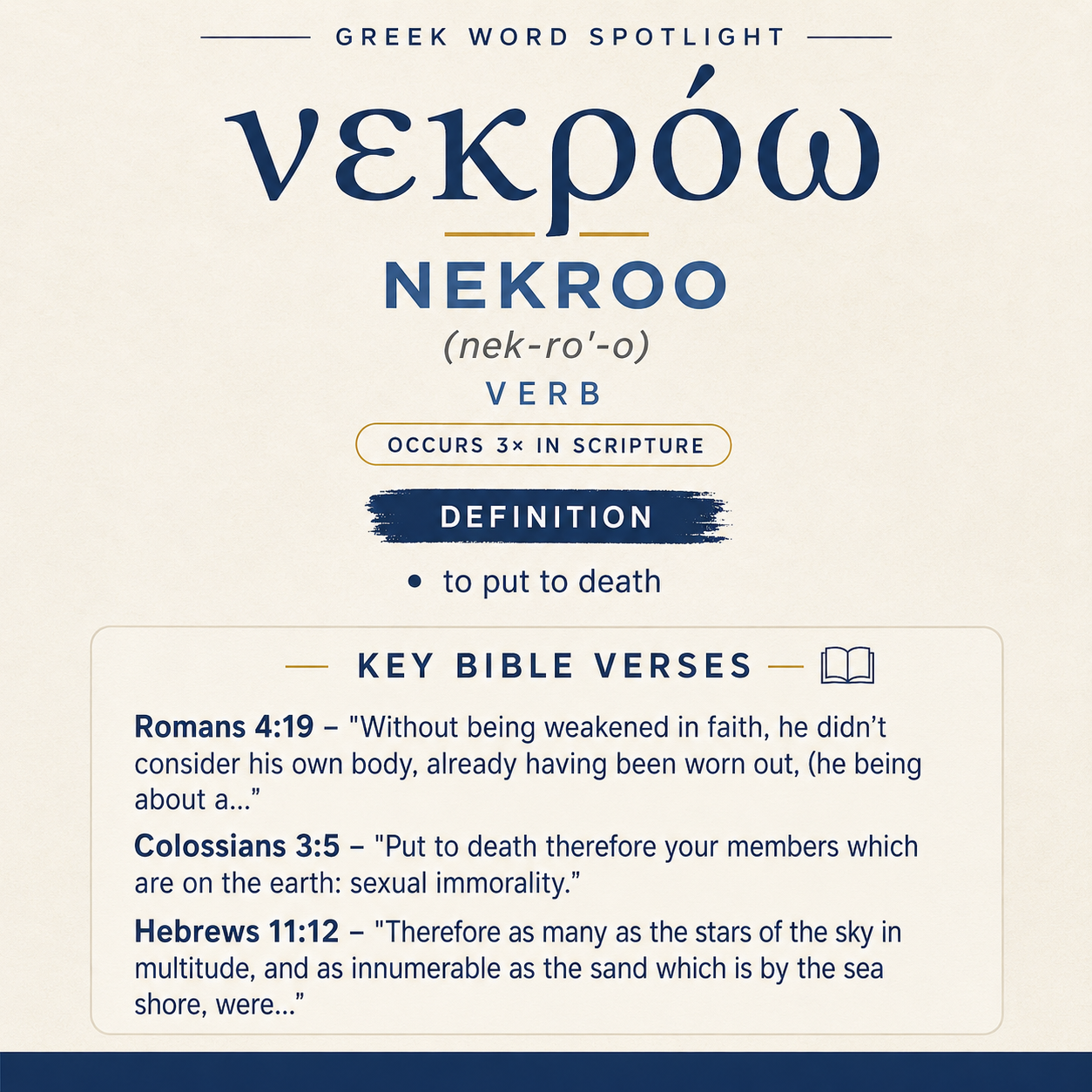
νεκρόω means “to put to death” and occurs three times: Romans 4:19, Colossians 3:5, and Hebrews 11:12.
Where It Appears
This verb occurs 3 times in Scripture. The references are Romans 4:19, Colossians 3:5, and Hebrews 11:12.
Learn More →Context Glimpses
In Colossians 3:5 it is used in the command, “Put to death therefore your members which are on the earth.” It also occurs in Romans 4:19 and Hebrews 11:12.
Learn More →νεκρόω means “to put to death.” It appears in three New Testament contexts that range from physical incapacity described as “deadness” to a moral imperative addressed to believers.
Root and Related Words
νεκρόω is related to nekros (νεκρός), “dead” (Strong’s G3498).

Occurrences
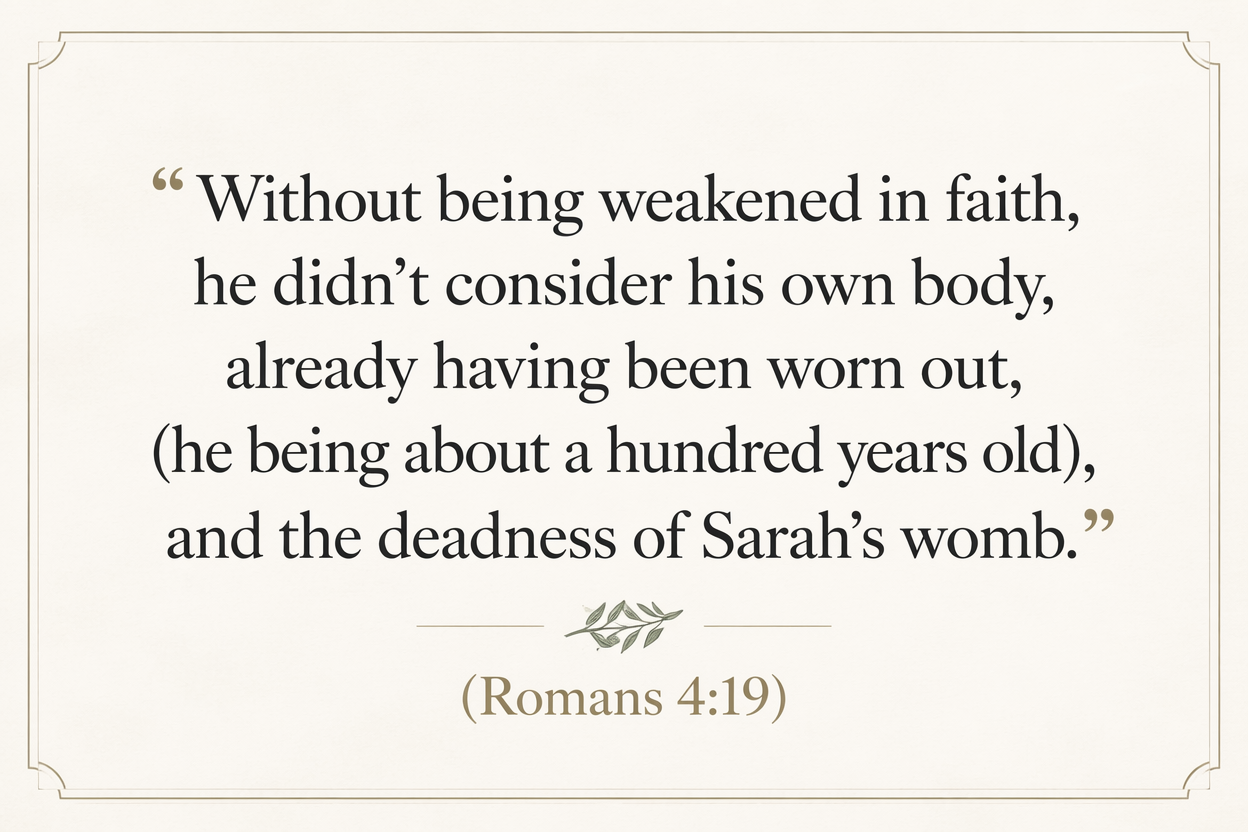
“Without being weakened in faith, he didn’t consider his own body, already having been worn out, (he being about a hundred years old), and the deadness of Sarah’s womb.” (Romans 4:19)
In this sentence Paul places “the deadness of Sarah’s womb” alongside Abraham’s own body “already having been worn out.” The word functions to name a condition of lifelessness or incapacity within the procreative sphere: the womb is characterized as marked by “deadness,” set in parallel with the narrator’s emphasis on age (“about a hundred years old”). Within the flow of the verse, this description serves the larger contrast Paul draws: Abraham’s faith is portrayed as not being “weakened” even while these bodily realities stand in view. νεκρόω, therefore, contributes the starkness of a death-related description to the argument—language suited to underscore how human prospects appear closed when evaluated solely by physical condition.
“Put to death therefore your members which are on the earth: sexual immorality, uncleanness, depraved passion, evil desire, and covetousness, which is idolatry.” (Colossians 3:5)
Here νεκρόω is cast as a direct imperative: “Put to death therefore your members which are on the earth.” The command is immediately unpacked through a list—“sexual immorality, uncleanness, depraved passion, evil desire, and covetousness”—so that “your members” are portrayed not merely as body parts but as the sphere in which these earthly practices operate. The verb presses for decisive action: these patterns are not to be managed or accommodated but dealt with in terms appropriate to death. The logic of the verse also matters: “therefore” connects this command to a preceding rationale (not quoted here), and within the verse itself the list specifies what is to be targeted. The word’s contribution is the severity of the demanded response; the behaviors named are treated as incompatible with the life implied by the exhortation, and the remedy is framed with death-language.
“Therefore as many as the stars of the sky in multitude, and as innumerable as the sand which is by the sea shore, were fathered by one man, and him as good as dead.” (Hebrews 11:12)
In Hebrews the word appears in a description of Abraham as “as good as dead.” The verse juxtaposes two extremes: on the one hand, an uncountable multitude—“as many as the stars of the sky in multitude… as innumerable as the sand which is by the sea shore”—and on the other hand, the single progenitor described with death-like terminology. Calling him “as good as dead” draws attention to human inability at the point where the promised outcome is astonishingly abundant. The phrase does not linger on the mechanics of death; rather, it marks a functional condition: the man who fathers the multitude is portrayed as having reached a state where ordinary expectation would be that fathering is no longer possible. νεκρόω supplies the rhetorical force of that condition, heightening the contrast between natural limitation and the resulting multitude.
Sense and Usage
Across these passages, “to put to death” operates in two closely related ways: as an idiom for a state that resembles death in its effects, and as a call for decisive elimination. Romans 4:19 and Hebrews 11:12 employ death-language to portray human incapacity—Sarah’s womb described by “deadness,” and Abraham described as “as good as dead.” In both, the point is not simply that death is present, but that the relevant capacity for generating life is portrayed as effectively extinguished. The word thus serves as a verbal marker for impossibility within ordinary human limits, and it helps explain why the outcome (implied in Romans by the surrounding argument about faith, and stated in Hebrews by the multitude of descendants) stands out as remarkable.
Colossians 3:5 shifts from description to directive. The same death-frame becomes a moral strategy: what belongs to “the earth” in the believer’s “members” is to be treated as something to be killed off. The list that follows shows the practical target of the command—concrete behaviors and desires—and the final identification, “covetousness, which is idolatry,” gives the list a theological weight within the verse itself. νεκρόω here carries the sense of intentional, forceful action: the realities named are to be brought to an end. Because the command is phrased in terms of death, the action envisioned is not partial restraint but a decisive rupture with the practices enumerated.
When the three occurrences are read together, the word’s definition remains stable while its application differs by context. In Romans and Hebrews, death-language defines the human situation at the limit—worn-out bodies and an “as good as dead” patriarch. In Colossians, death-language defines the required response to a set of earthly sins. Both uses share a common feature: they present death as a boundary that ends a capacity or a practice. Whether the boundary is experienced as human weakness (Romans, Hebrews) or enacted as moral obedience (Colossians), the word communicates finality rather than mere reduction.
Imagery
The passages attach vivid imagery to νεκρόω. In Romans 4:19, the imagery is intimate and bodily—“the deadness of Sarah’s womb”—paired with the picture of age and a body “worn out.” In Hebrews 11:12, the image expands outward: a man “as good as dead” stands at the origin of descendants compared to “the stars of the sky” and “the sand… by the sea shore.” Colossians 3:5 turns the imagery inward again, locating the battleground in “your members which are on the earth” and insisting that what thrives there in the form of listed sins must be put to death.
Sources: Lexical data from Strong’s Exhaustive Concordance and the Translators Brief Lexicon of Extended Strongs for Greek (STEPBible, CC BY). Occurrence data from the Translators Amalgamated Greek New Testament (STEPBible, CC BY). Scripture quotations from the World English Bible (public domain).




