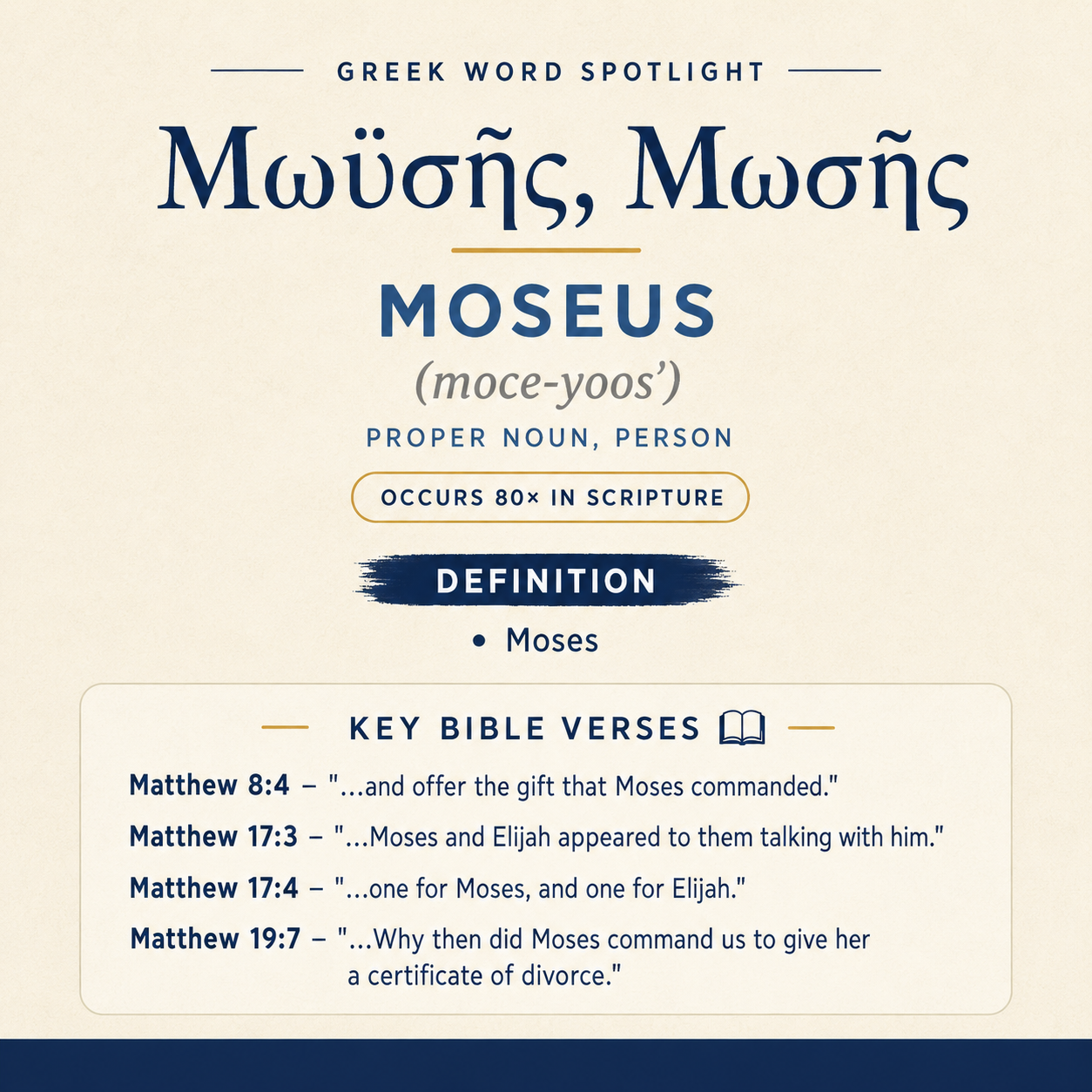
Μωϋσῆς / Μωσῆς refers to Moses. In these Gospel scenes, the name functions as a fixed point of appeal for commanded gifts, ethical instruction, disputed permissions, and a striking appearance alongside Elijah.
Occurrences
“Jesus said to him, “See that you tell nobody, but go, show yourself to the priest, and offer the gift that Moses commanded, as a testimony to them.”” (Matthew 8:4)
Here Moses is invoked as the one who “commanded” a particular “gift” connected with priestly inspection. The name anchors Jesus’ directive in an established command: the healed man is to go to the priest and present what Moses commanded, and the act is framed as “a testimony to them.” Moses, then, stands in this saying as the source of a recognized requirement tied to priestly procedure and public confirmation.
“Behold, Moses and Elijah appeared to them talking with him.” (Matthew 17:3)
In this scene Moses is not cited as an authority but presented as a person who “appeared” and was “talking with him.” The narrative force of the name lies in presence and conversation: Moses is depicted as an identifiable figure who can appear and converse in a moment of revelation witnessed by “them.”
“Peter answered, and said to Jesus, “Lord, it is good for us to be here. If you want, let’s make three tents here: one for you, one for Moses, and one for Elijah.”” (Matthew 17:4)
Peter’s proposal treats Moses as one of three honored figures for whom separate “tents” might be made. Moses’ name is placed alongside Jesus and Elijah as a distinct recipient of lodging, which shows that Moses is perceived as personally present and worthy of a concrete response in the moment (“If you want, let’s make…”).
“They asked him, “Why then did Moses command us to give her a certificate of divorce, and divorce her?”” (Matthew 19:7)
Moses is introduced as the one who “command[ed]” a practice: giving “a certificate of divorce” and divorcing. The questioners use Moses’ name to press Jesus with an apparent obligation (“command us”), tying their challenge to a command attributed to Moses and phrasing it in terms of what “us” must do.
“He said to them, “Moses, because of the hardness of your hearts, allowed you to divorce your wives, but from the beginning it has not been so.”” (Matthew 19:8)
Jesus’ reply keeps Moses central but reframes the earlier “command” language in terms of permission: Moses “allowed you” to divorce, and the allowance is connected to “the hardness of your hearts.” In this sentence Moses functions as the named mediator of a concession, while Jesus contrasts that allowance with a broader claim about what is true “from the beginning.” The name thus bears explanatory weight in a moral dispute: Moses is cited to account for a permitted practice without making that practice the ultimate pattern.
“saying, “Teacher, Moses said, ‘If a man dies, having no children, his brother shall marry his wife, and raise up offspring for his brother.’”” (Matthew 22:24)
Moses appears here as a quoted speaker (“Moses said”), and the cited instruction is presented in conditional-legal form: “If a man dies, having no children…” followed by what “his brother shall” do. Moses’ name authorizes a specific rule concerning marriage and family responsibility, and the direct quotation gives the sense that the interlocutors are appealing to a settled, remembered formulation.
“saying, “The scribes and the Pharisees sat on Moses’ seat.”” (Matthew 23:2)
“Moses’ seat” uses Moses’ name to designate a recognized position associated with teaching or authority. The statement identifies the scribes and Pharisees as occupying that seat; Moses, therefore, serves as the reference point that defines what kind of seat it is, and the phrase implies a public, acknowledged link between Moses and the place from which these leaders act.
“and said to him, “See you say nothing to anybody, but go show yourself to the priest, and offer for your cleansing the things which Moses commanded, for a testimony to them.”” (Mark 1:44)
This is closely parallel to Matthew 8:4 in function: Moses is again the one who “commanded” certain “things” connected with “cleansing,” priestly examination, and testimony. Moses’ name here marks continuity with a known set of commanded offerings; the commanded action is not merely private piety but is directed toward the priest and framed as “a testimony to them.”
“For Moses said, ‘Honor your father and your mother;’ and, ‘He who speaks evil of father or mother, let him be put to death.’” (Mark 7:10)
Moses is cited as a voice for moral obligation (“Honor your father and your mother”) and for a severe sanction against abuse of parents (“let him be put to death”). The pairing of two quoted lines under “Moses said” makes Moses’ name function as the header for both the positive command and the negative prohibition with its penalty, binding them together as a unified appeal to authoritative instruction.
“Elijah and Moses appeared to them, and they were talking with Jesus.” (Mark 9:4)
As in Matthew 17:3, Moses appears alongside Elijah, but Mark places Elijah first and emphasizes that “they were talking with Jesus.” Moses’ name again contributes the idea of a real, identifiable person participating in an encounter—present, visible, and engaged in conversation with Jesus in front of witnesses (“to them”).
“Peter answered Jesus, “Rabbi, it is good for us to be here. Let’s make three tents: one for you, one for Moses, and one for Elijah.”” (Mark 9:5)
Peter’s reaction mirrors Matthew 17:4, with the same concrete proposal of “three tents.” Moses is treated as one of the three figures to be accommodated, and the repetition of Moses’ name in this proposal underscores Peter’s recognition of Moses as a distinct, present figure—someone for whom a separate shelter would make sense.
“He answered, “What did Moses command you?”” (Mark 10:3)
Here Moses is invoked in a pointed question about obligation: “What did Moses command you?” The name functions as the standard by which the issue under discussion is to be judged. Moses’ “command” is assumed to be known by the hearers (“you”), and the question treats it as a decisive reference point for sorting out what should be done.
Sense and Usage
Across these passages, Moses functions in two main ways: as a living, recognizable person within a narrated appearance, and as a named authority whose words and commands are cited in disputes and instructions. The appearance scenes (Matthew 17:3–4; Mark 9:4–5) portray Moses as present and interactive—someone who can “appear,” be seen alongside Elijah, and be spoken of as a candidate for a “tent.” In those moments the name does not introduce a rule or quotation; it identifies a person participating in a revelatory event centered on Jesus.
In the teaching and controversy scenes, Moses’ name becomes shorthand for a body of instruction expressed as “commanded” (Matthew 8:4; Mark 1:44; Mark 10:3), “said” (Matthew 22:24; Mark 7:10), and even “allowed” (Matthew 19:8). These verbs shape how Moses is being appealed to. “Commanded” presents Moses as the giver of binding requirements, whether about offerings related to cleansing and priestly testimony or about what hearers are expected to know and do. “Said” introduces direct quotation and frames Moses as a speaker whose formulation can be cited to settle moral duties toward parents (with stated consequences) and to pose legal puzzles about family obligations after a death. “Allowed” introduces a different category: Moses is named as the one through whom permission was granted in response to “hardness of your hearts,” which in Matthew 19:8 becomes part of Jesus’ argument that an allowance is not the final measure of what is right “from the beginning.”
Finally, “Moses’ seat” (Matthew 23:2) shows Moses’ name used possessively to characterize an institutional location occupied by scribes and Pharisees. The phrase depends on Moses being a widely recognized figure whose association can define the significance of a “seat” without further explanation: Moses supplies the identifying label that makes the seat intelligible as a particular kind of authoritative position.
Imagery
The passages present two vivid pictures attached to Moses’ name. One is the courtroom-like or public setting implied by priests, commanded gifts, and “a testimony to them” (Matthew 8:4; Mark 1:44), where Moses’ authority is embodied in concrete offerings and public verification. The other is the mountain-like tableau of sudden appearance and proposed shelters—Moses and Elijah present, conversing with Jesus, while disciples react by wanting to build “three tents” (Matthew 17:3–4; Mark 9:4–5). Between these, Moses is both the name attached to commands and quotations and the name of a person who can be spoken to and accommodated within the narrative world of the Gospels.
Sources:
Lexical data from Strong’s Exhaustive Concordance and the Translators Brief Lexicon of Extended Strongs for Greek (STEPBible, CC BY). Occurrence data from the Translators Amalgamated Greek New Testament (STEPBible, CC BY). Scripture quotations from the World English Bible (public domain).