Exploring the Meaning of Moria in Greek
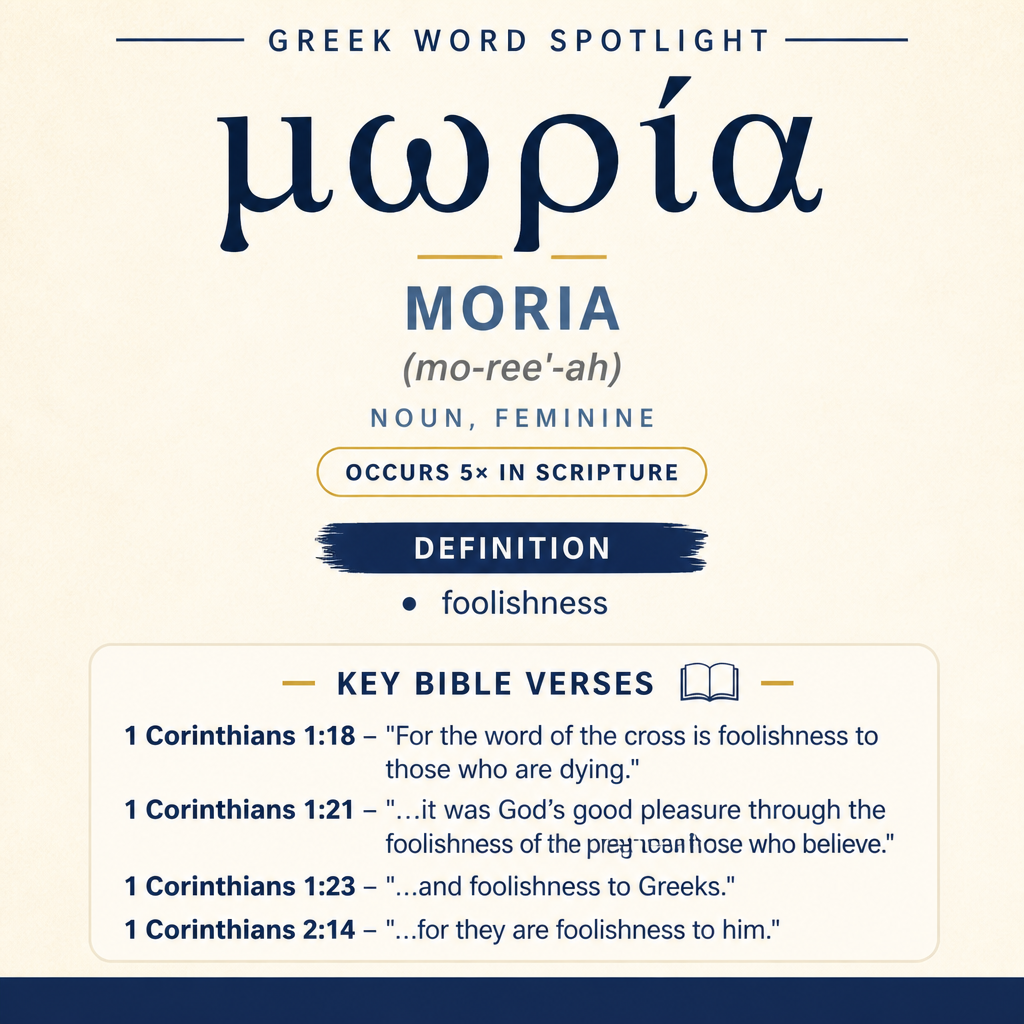
μωρία means “foolishness” and appears five times in Scripture, all in 1 Corinthians 1–3.
Core Meaning
μωρία is defined as “foolishness.” In 1 Corinthians it describes how some assess the message and wisdom associated with God.
Learn More →Where It Appears
This noun occurs 5 times, all in 1 Corinthians: 1:18, 1:21, 1:23, 2:14, and 3:19.
Learn More →Context in Corinthians
It is used for how those who are perishing or “natural” view the word of the cross and the things of God’s Spirit. It also contrasts worldly wisdom with God’s perspective (1 Corinthians 3:19).
Learn More →μωρία names “foolishness” in Paul’s argument in 1 Corinthians, where it frames how the message about Christ and the cross is judged from different standpoints. Across these passages it marks a verdict—what some call folly—and it becomes a way to contrast human evaluation with God’s perspective.
Root and Related Words
μωρία (Moria) derives from μωρός (moros), “foolish” (Strong’s G3474). The related adjective supplies the descriptive idea from which the noun expresses the quality or characterization.

Occurrences
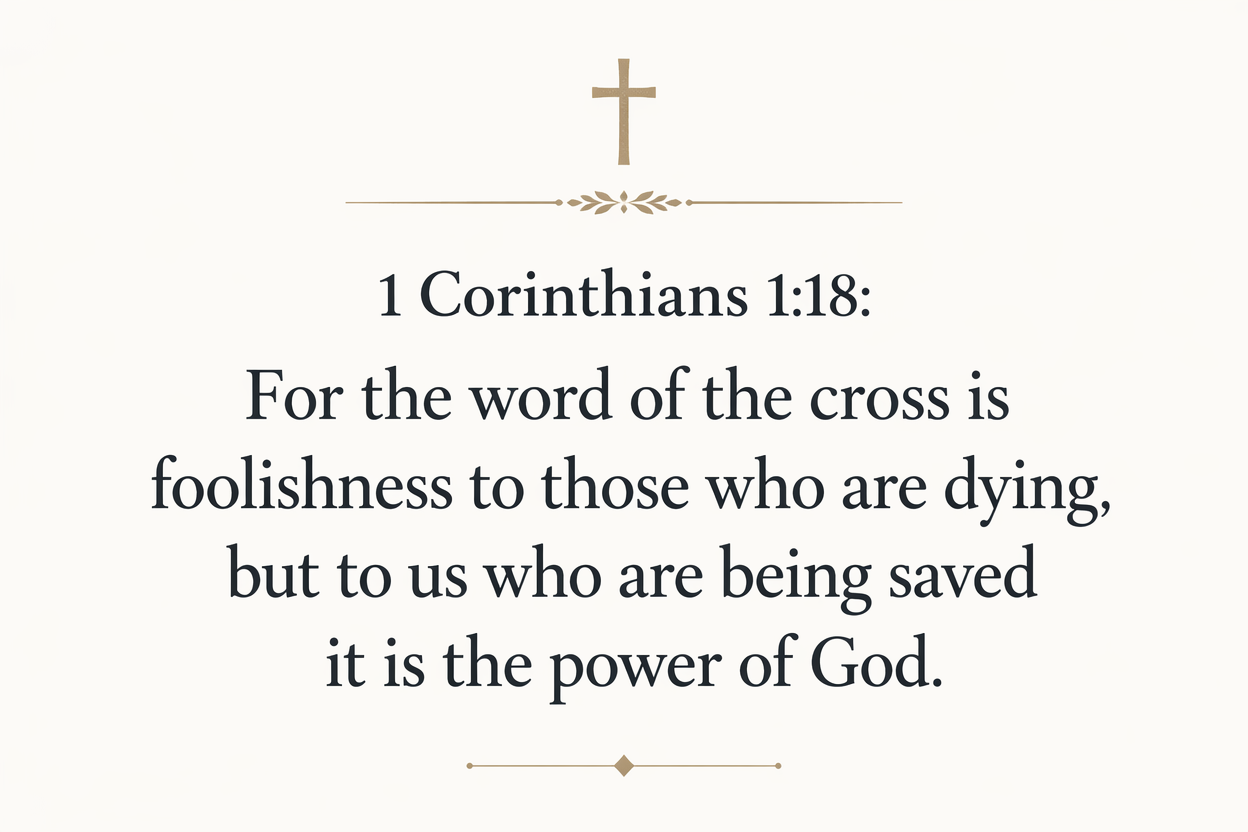
1 Corinthians 1:18: For the word of the cross is foolishness to those who are dying, but to us who are being saved it is the power of God.
Here μωρία is attached to “the word of the cross,” and it is explicitly relative to a group: “to those who are dying.” The same message is simultaneously characterized in a sharply different way for another group (“to us who are being saved”), where it is “the power of God.” μωρία therefore functions as a label placed on the cross-centered word when it is assessed from within one trajectory (“dying”), and it helps establish the passage’s central contrast between human appraisal and divine power.
1 Corinthians 1:21: For seeing that in the wisdom of God, the world through its wisdom didn’t know God, it was God’s good pleasure through the foolishness of the preaching to save those who believe.
In this line μωρία is paired with “the preaching,” presenting the preached message as “foolishness” in the very setting where the world’s “wisdom” fails to know God. The noun is tied to God’s own purpose (“God’s good pleasure”) and to a saving outcome (“to save those who believe”). The effect is that what can be dismissed as μωρία is also described as the chosen means by which God brings salvation, setting “the wisdom of God” over against “the world through its wisdom.”
1 Corinthians 1:23: but we preach Christ crucified: a stumbling block to Jews, and foolishness to Greeks,
μωρία here is one side of a twofold reception of “Christ crucified.” For Jews the preached Christ is “a stumbling block,” while “to Greeks” it is “foolishness.” The noun thus names a culturally located evaluation (“to Greeks”) of the same proclamation (“we preach Christ crucified”). Within the sentence, μωρία is not merely a general moral critique but a specific verdict rendered on the content of the preaching—Christ in his crucifixion.
1 Corinthians 2:14: Now the natural man doesn’t receive the things of God’s Spirit, for they are foolishness to him, and he can’t know them, because they are spiritually discerned.
In this context μωρία is linked to “the things of God’s Spirit” as they appear to “the natural man.” The verse describes an inability and a refusal: he “doesn’t receive” these things; “they are foolishness to him”; and “he can’t know them.” μωρία therefore marks the natural person’s assessment of spiritual realities and is bound up with the stated reason: “because they are spiritually discerned.” The noun expresses the evaluative barrier that accompanies a lack of spiritual discernment.
1 Corinthians 3:19: For the wisdom of this world is foolishness with God. For it is written, “He has taken the wise in their craftiness.”
Here μωρία is no longer something that people say about the gospel; it is what God counts “the wisdom of this world” to be. The prepositional framing (“with God”) locates the judgment in God’s perspective, and the supporting citation about taking “the wise in their craftiness” reinforces the critique of worldly cleverness. In this usage μωρία functions as a divine evaluation of what the world prizes as wisdom, turning the earlier contrast back upon the world itself.
Sense and Usage
Across these five occurrences, μωρία consistently operates as an assessment—an ascription of “foolishness” made from a particular standpoint. In 1 Corinthians 1, it repeatedly attaches to the proclaimed message (“the word of the cross,” “the preaching,” “Christ crucified”), highlighting that the same proclamation can be received under opposing descriptions depending on the hearer’s orientation: those “dying” regard it as μωρία, while those “being saved” recognize “the power of God” (1:18). The noun’s role is sharpened by its association with “wisdom”: the world “through its wisdom didn’t know God,” yet God chose to save through what can be called μωρία (1:21). In other words, μωρία becomes a key term in a reversal, where the category used to dismiss the message is shown to coincide with God’s effective saving action.
In 1 Corinthians 1:23 μωρία is explicitly audience-relative (“to Greeks”), which underscores that the term is not introduced as a detached definition of the message but as the label it receives in certain settings. The pairing with “a stumbling block to Jews” shows that μωρία can stand as one of multiple reactions to the same preached content, and that these reactions can be mapped to identifiable groups without changing what is preached (“Christ crucified”).
In 1 Corinthians 2:14 μωρία is woven into the epistemic and receptive posture of “the natural man.” The term aligns with incapacity (“he can’t know them”) and non-reception (“doesn’t receive”), and the explanation “because they are spiritually discerned” indicates that μωρία is not merely a spontaneous insult but the natural person’s way of classifying what lies outside his discernment. The noun thus serves to name a perception that accompanies spiritual unreadiness: the things of the Spirit appear as μωρία, and so they are neither welcomed nor understood.
Finally, 1 Corinthians 3:19 flips the direction of the judgment. Earlier, μωρία is what some people call the gospel; here it is what God calls “the wisdom of this world.” The noun therefore marks a two-directional contrast: what the world dismisses in the gospel is, in God’s economy, powerful and saving (1:18, 1:21), and what the world esteems as wisdom is, in God’s assessment, μωρία (3:19). Read together, these uses show μωρία as a term that exposes competing standards of evaluation—human standards shaped by worldly wisdom and natural perception, and God’s standard that unmasks craftiness and accomplishes salvation through preaching.
Imagery and Contrast
The passages give μωρία a vivid argumentative setting: a preached message publicly heard and publicly judged. “The word of the cross” and “Christ crucified” stand at the center (1:18, 1:23), and μωρία names the verdict that can fall on that proclamation in the ears of those who do not receive “the things of God’s Spirit” (2:14). At the same time, the word participates in a reversal where God’s viewpoint reclassifies worldly “wisdom” itself as μωρία (3:19), pressing the reader to see how sharply the same realities can be labeled depending on whether one measures “with God” or “through its wisdom.”
Sources: Lexical data from Strong’s Exhaustive Concordance and the Translators Brief Lexicon of Extended Strongs for Greek (STEPBible, CC BY). Occurrence data from the Translators Amalgamated Greek New Testament (STEPBible, CC BY). Scripture quotations from the World English Bible (public domain).