
Exploring the Meaning of Moschos in Greek
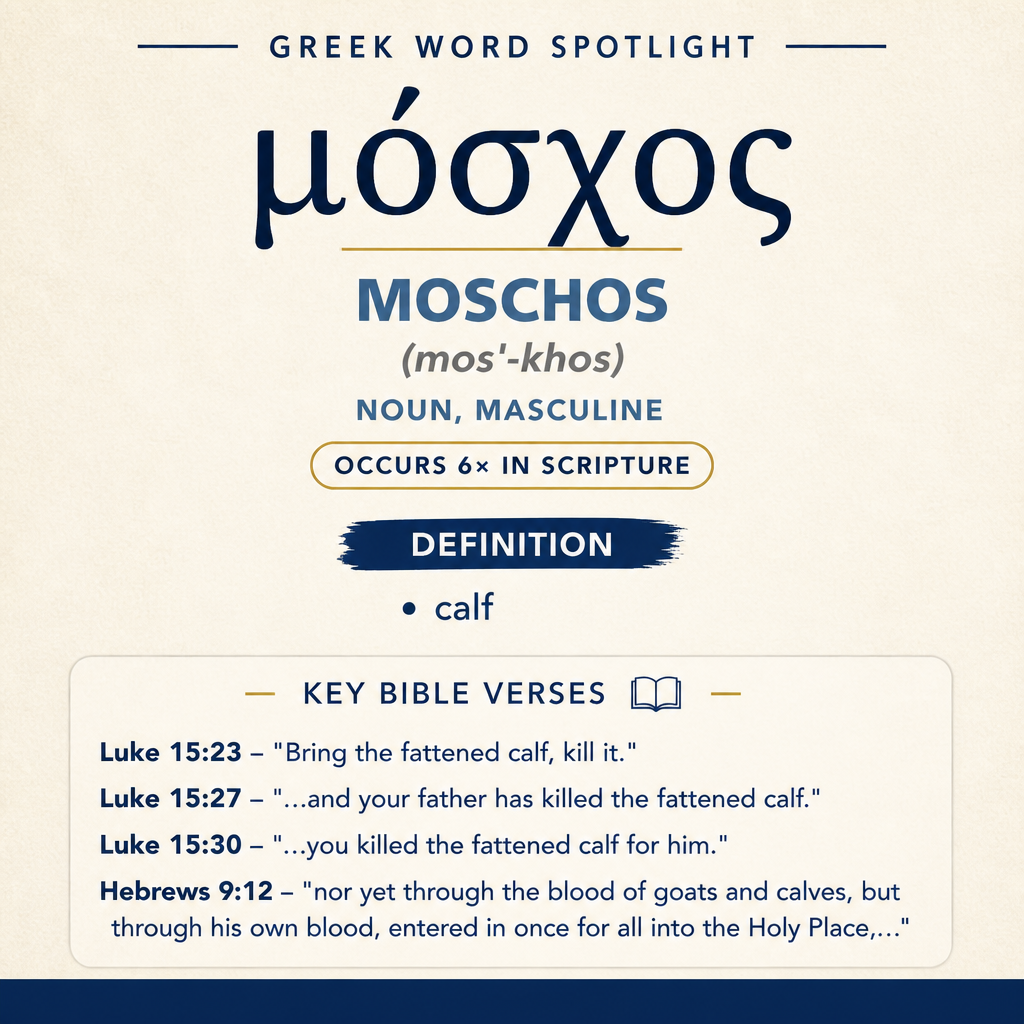
μόσχος means “calf” and appears six times in Scripture in Luke 15, Hebrews 9, and Revelation 4.
Where It Appears
It occurs six times: Luke 15:23, 15:27, 15:30; Hebrews 9:12, 9:19; Revelation 4:7.
Learn More →How It’s Used
In Luke 15 it refers to the fattened calf prepared for a celebration. In Hebrews 9 it appears with blood of goats and calves, and in Revelation 4:7 a creature is like a calf.
Learn More →μόσχος refers to a “calf.” In the New Testament it appears in a parable scene of household celebration (Luke 15), in sacrificial-cultic language about blood (Hebrews 9), and in visionary description of a heavenly creature’s likeness (Revelation 4).
Occurrences
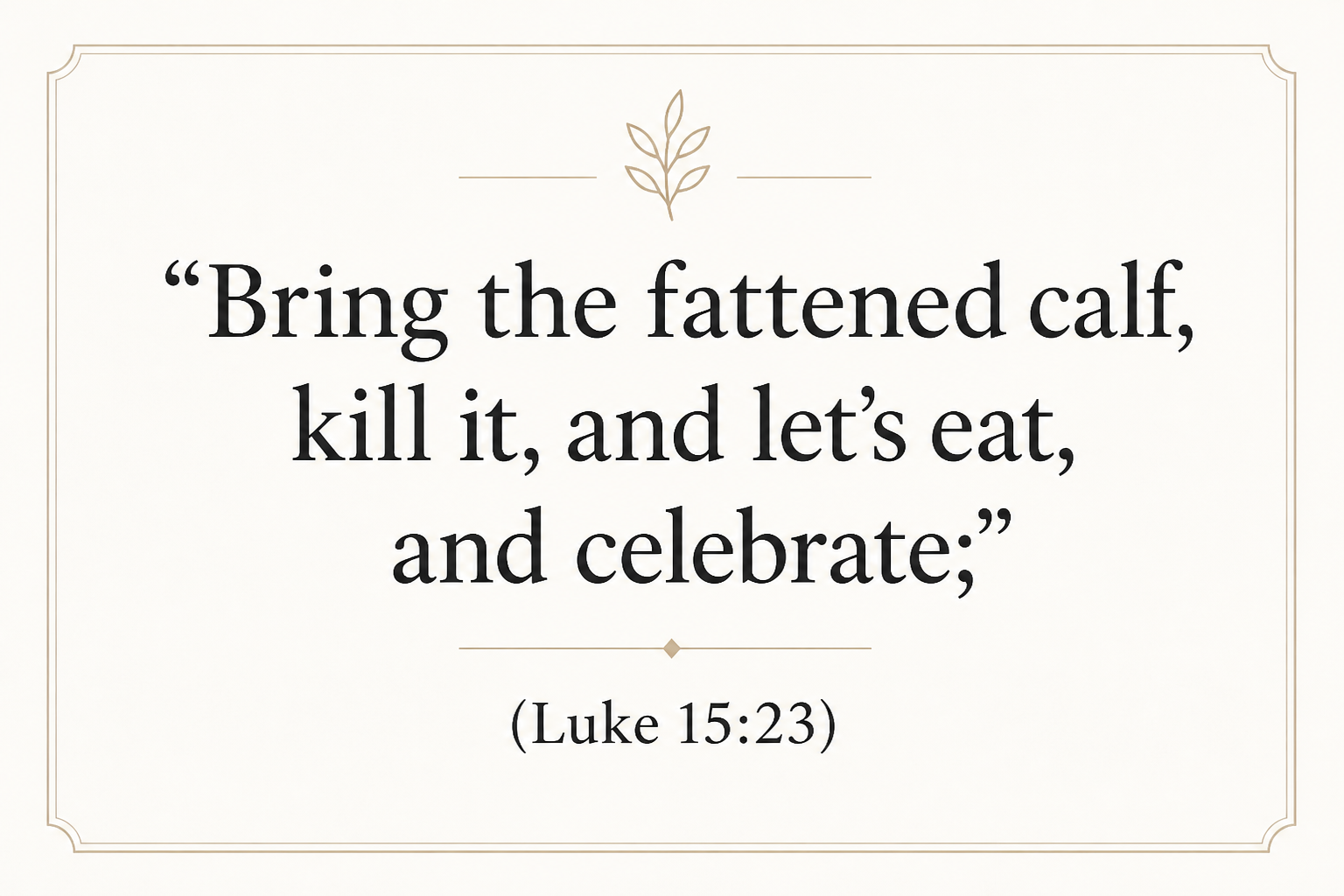
“Bring the fattened calf, kill it, and let’s eat, and celebrate;” (Luke 15:23)
Here μόσχος is the animal prepared for a feast: it is “fattened,” then “kill[ed],” and its meat becomes the basis for communal eating and celebration. The word anchors the father’s command in a concrete act of costly provision—an animal raised for a special occasion and then used to mark a turning point in the household.
“He said to him, ‘Your brother has come, and your father has killed the fattened calf, because he has received him back safe and healthy.’” (Luke 15:27)
μόσχος is again “the fattened calf,” now functioning as the reportable proof that reconciliation has taken place: the father “has killed” it “because he has received him back safe and healthy.” The calf’s slaughter is not random hospitality but a response tied to a specific outcome—receiving someone back—and the animal becomes the event’s unmistakable sign within the household.
“But when this your son came, who has devoured your living with prostitutes, you killed the fattened calf for him.’” (Luke 15:30)
In this complaint, μόσχος appears in the mouth of the aggrieved speaker, and its role shifts from simple feast-provision to contested symbol. “You killed the fattened calf for him” expresses perceived disproportion: the calf, as a notably prepared animal, represents a lavish welcome that the speaker judges undeserved in light of the accusation that the returning son “has devoured your living with prostitutes.” The word therefore carries emotional weight: it is the tangible focus of resentment precisely because it is a valued, celebratory animal.
“nor yet through the blood of goats and calves, but through his own blood, entered in once for all into the Holy Place, having obtained eternal redemption.” (Hebrews 9:12)
Here μόσχος is plural (“calves”) and appears in a paired list with “goats,” within the phrase “the blood of goats and calves.” The calf is not presented as food but as a source of sacrificial blood; it belongs to a set of animals whose blood is contrasted with “his own blood.” The mention of calves, therefore, contributes to the texture of cultic imagery: it evokes a familiar category of offerings whose blood could be brought near, while the sentence’s argument turns on a decisive distinction between animal blood and “his own blood,” and on the action of entering “once for all into the Holy Place.”
“For when every commandment had been spoken by Moses to all the people according to the law, he took the blood of the calves and the goats, with water and scarlet wool and hyssop, and sprinkled both the book itself and all the people,” (Hebrews 9:19)
μόσχος again appears as plural “calves,” now in a narrated ritual sequence. The calf’s contribution is specifically as “the blood of the calves,” taken together with “the goats,” and combined “with water and scarlet wool and hyssop.” That mixture is then used in an act of application: it is “sprinkled both the book itself and all the people.” In this setting the calf is not foregrounded as an individual animal but as part of an embodied, material process—blood handled, combined with other ritual elements, and applied to objects and people—supporting the portrayal of covenantal or legal enactment through tangible substances.
“The first creature was like a lion, and the second creature like a calf, and the third creature had a face like a man, and the fourth was like a flying eagle.” (Revelation 4:7)
Here μόσχος is used in a simile: “the second creature like a calf.” The calf serves as one of four points of comparison that describe the creatures by recognizable likenesses—lion, calf, a man’s face, and a flying eagle. In this sentence the calf contributes its distinctive profile as an animal-image, functioning descriptively rather than sacrificially or culinary. The effect is to render the visionary scene speakable by appeal to concrete created forms.

Sense and Usage
Across these passages, μόσχος consistently denotes a calf, but the contexts show three distinct kinds of usage: celebratory household slaughter for feasting (Luke 15), sacrificial blood language (Hebrews 9), and visionary likeness (Revelation 4). In Luke 15 the calf is specified as “fattened,” highlighting preparation and value; it is not merely an available animal but one deliberately set aside, which is why its killing can communicate both joy (Luke 15:23, 15:27) and provocation (Luke 15:30). The calf’s role there is inseparable from the household’s social meaning: eating and celebrating require a costly, visible act, and the calf becomes the chosen vehicle of that act.
In Hebrews 9, the calf is encountered through its blood. The word enters a world where blood can be taken, combined with other materials, and used in a sprinkling action. Two features stand out in the quoted lines: first, calves are paired with goats as representative sacrificial animals (“the blood of goats and calves,” Hebrews 9:12; “the blood of the calves and the goats,” Hebrews 9:19); second, the blood is described in relation to access and application—either contrasted with entry “into the Holy Place” through “his own blood” (Hebrews 9:12) or described as something sprinkled “both the book itself and all the people” (Hebrews 9:19). In these sentences μόσχος contributes to a vocabulary of tangible ritual life: it is not the animal’s youth or tenderness that is emphasized, but the fact that calves belong to the sphere where blood is the relevant element.
Revelation 4:7 uses μόσχος without any mention of slaughter or blood. The calf supplies a stable, recognizable creature-image that can be set alongside other animal and human likenesses to describe the second creature. The simile “like a calf” works by evoking a concrete form that readers can picture, allowing the visionary description to proceed by comparison rather than by anatomical detail. The word’s sense remains the same, but its function is purely imagistic, contributing to a composite depiction of heavenly beings.
When these uses are set side by side, μόσχος shows a range of associations that arise from setting rather than from any shift in definition. A calf can be a prized animal for a feast (Luke 15), an animal whose blood belongs to sacrificial handling (Hebrews 9), and a familiar creature whose appearance can describe something seen in a vision (Revelation 4). The same concrete referent is thus able to carry themes of celebration, ritual, and description, depending on whether the text places the calf at the dinner table, at the place of blood application, or in a scene of heavenly likenesses.
Imagery
The passages attach memorable images to μόσχος by situating the calf at moments of heightened meaning. Luke 15 makes the calf the centerpiece of a homecoming celebration: “Bring the fattened calf, kill it, and let’s eat, and celebrate;” (Luke 15:23). Hebrews 9 turns attention from the animal’s body to its blood as a handled substance—blood taken, mixed “with water and scarlet wool and hyssop,” and sprinkled “both the book itself and all the people” (Hebrews 9:19). Revelation 4 places the calf-image in a tableau of living creatures, where “the second creature like a calf” (Revelation 4:7) contributes to the scene’s vividness by drawing on ordinary created forms to speak of extraordinary realities.
Sources: Lexical data from Strong’s Exhaustive Concordance and the Translators Brief Lexicon of Extended Strongs for Greek (STEPBible, CC BY). Occurrence data from the Translators Amalgamated Greek New Testament (STEPBible, CC BY). Scripture quotations from the World English Bible (public domain).





