Exploring the Meaning of Misthotos in Greek
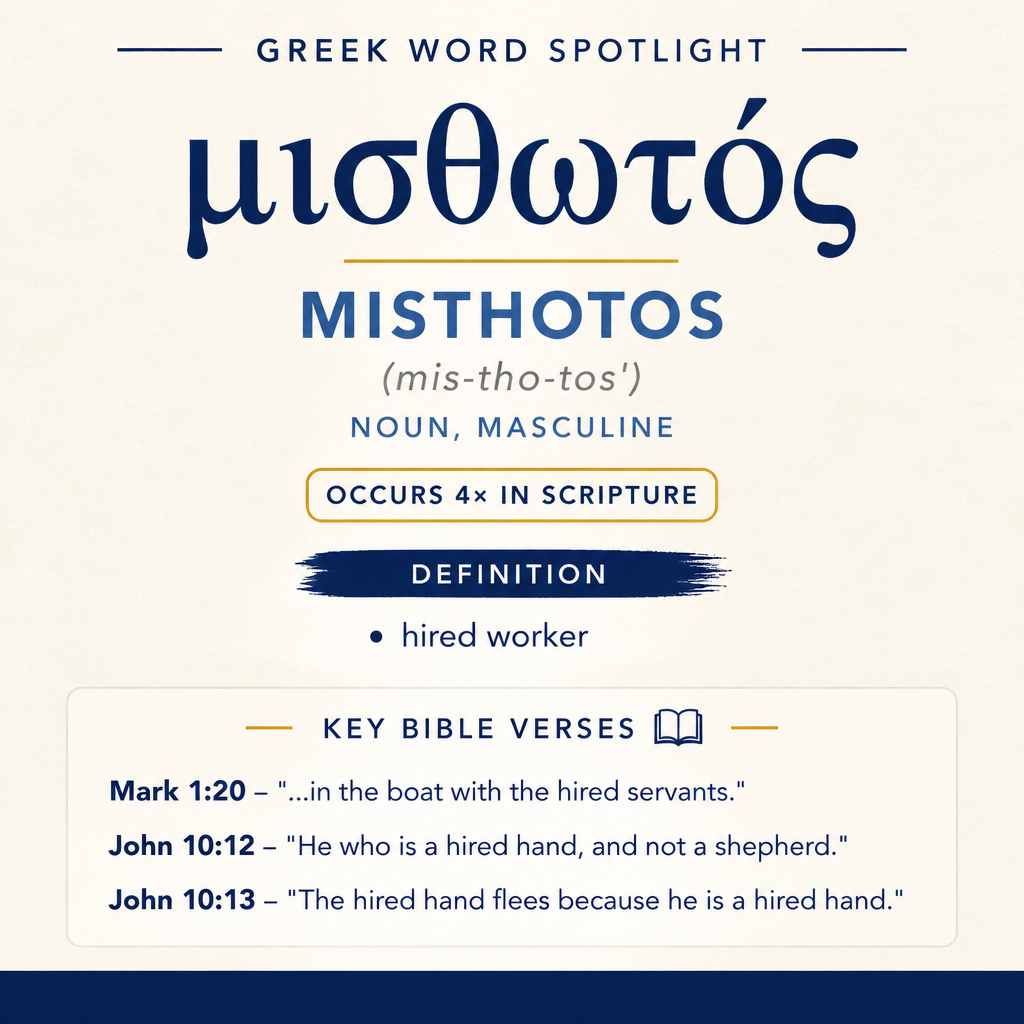
μισθωτός means “hired worker” and appears in Mark 1:20 and John 10:12–13.
Context Snapshots
In Mark 1:20, hired servants remain in the boat with Zebedee. In John 10:12–13, the hired hand flees when a wolf comes and doesn’t care for the sheep.
Learn More →μισθωτός refers to a “hired worker,” someone engaged for service on the basis of being hired. In the New Testament it appears in a brief narrative detail in Mark and in Jesus’ shepherd imagery in John 10.
Root and Related Words
μισθωτός is connected with the verb misthoo (μισθόω), “to hire” (Strong’s G3409). The relationship between the verb and μισθωτός places the noun in the setting of contracted labor: the person is defined by being hired for work.

Occurrences
“Immediately he called them, and they left their father, Zebedee, in the boat with the hired servants, and went after him.” (Mark 1:20)
Here μισθωτός appears in a concrete, everyday scene on the shore: Zebedee remains “in the boat with the hired servants.” The term contributes a snapshot of how the fishing work was staffed. These are not described as family members or partners in the decision to follow Jesus; rather, they are the workers who remain with Zebedee as the sons depart. By naming them as hired servants, the verse conveys that the boat’s work could continue under paid labor even as a key part of the household (James and John in the immediate context) leaves “immediately.” The word therefore functions as a social and economic marker within the narrative: Zebedee is not alone, and the operation includes people engaged specifically as employees.

“He who is a hired hand, and not a shepherd, who doesn’t own the sheep, sees the wolf coming, leaves the sheep, and flees. The wolf snatches the sheep, and scatters them.” (John 10:12)
In this sentence μισθωτός is set in explicit contrast with “a shepherd.” The hired hand is described in relation to the flock: he “doesn’t own the sheep,” and his response to danger is to abandon them. The term marks the character’s role as one who works with the sheep without possessing them; this is the stated point of contrast in the verse. When the wolf appears, the hired hand’s decisive action is flight—“leaves the sheep, and flees”—and the consequence is immediate vulnerability for the flock: “The wolf snatches the sheep, and scatters them.” Within the imagery, μισθωτός names the person whose connection to the sheep is mediated by employment, and that employment-status frames the logic of the scene: danger reveals what kind of relationship he has to the flock.
“The hired hand flees because he is a hired hand, and doesn’t care for the sheep.” (John 10:13)
This verse tightens the explanation by repeating μισθωτός and making it the stated reason for his flight: “because he is a hired hand.” The word thus carries argumentative weight, not merely descriptive detail. The sentence adds the internal disposition that corresponds to the action: he “doesn’t care for the sheep.” In the flow of thought, μισθωτός identifies the category of person whose motivation is insufficient to stand firm when threatened. The repetition also turns the term into a label that summarizes a pattern: hired status is aligned with fleeing, and with a lack of care for the flock in the moment of crisis.
Sense and Usage
Across these passages μισθωτός consistently denotes a worker engaged on hire, but the narrative contexts bring out different dimensions of what that can signify. In Mark 1:20, the word is neutral and practical: it names the people present in the boat alongside Zebedee, highlighting that the fishing work includes employees. The term functions as part of the scene’s realism, showing that the departure of the sons does not leave the boat without labor. Nothing in the sentence assigns blame or praise to the hired servants; the term simply locates them within the work setting as paid workers.
In John 10:12–13, the same word is used within moral and relational contrast. The hired hand is defined by what he is “not”: “not a shepherd,” and by what he lacks: he “doesn’t own the sheep.” The imagery does not alter the basic sense of “hired worker,” but it uses that sense to frame a distinction in commitment. The hired worker has a real role among the sheep—he is present enough to “see[] the wolf coming”—yet when the crisis arrives, he abandons them. The verses make the causal chain explicit: hired status corresponds to a response of self-preservation rather than protective care, and the consequence is the flock’s exposure to harm (“snatches” and “scatters”).
These uses show μισθωτός operating on two levels. First, it denotes a recognizable labor role: someone employed for work alongside an owner or leader. Second, in John’s shepherd discourse the term becomes a way to speak about the quality of a person’s relationship to those under his charge. The hired worker’s defining feature in that discourse is not skill but attachment: his connection is framed as employment rather than ownership or shepherding identity, and that difference emerges when risk appears. Thus μισθωτός can serve either as a straightforward designation of staff (Mark) or as a foil that sharpens a contrast between mere employment and genuine responsibility (John).
The repeated phrasing in John 10:13—“because he is a hired hand”—shows how the word can be used almost proverbially within an argument: the label itself is treated as sufficient explanation for the behavior described. In other words, μισθωτός is not only a noun identifying someone’s job-status; in this setting it summarizes a stance toward the flock that is revealed under pressure.
Imagery
The imagery attached to μισθωτός spans two scenes: a working boat with employees at hand (Mark 1:20), and an open pasture threatened by a predator (John 10:12–13). Together they present the hired worker as a familiar figure in daily labor, and also as a figure whose hired status can be set against the deeper bonds implied by shepherding—bonds tested when the wolf comes and the flock must be defended.
Sources: Lexical data from Strong’s Exhaustive Concordance and the Translators Brief Lexicon of Extended Strongs for Greek (STEPBible, CC BY). Occurrence data from the Translators Amalgamated Greek New Testament (STEPBible, CC BY). Scripture quotations from the World English Bible (public domain).