Exploring the Meaning of Misthos in Greek
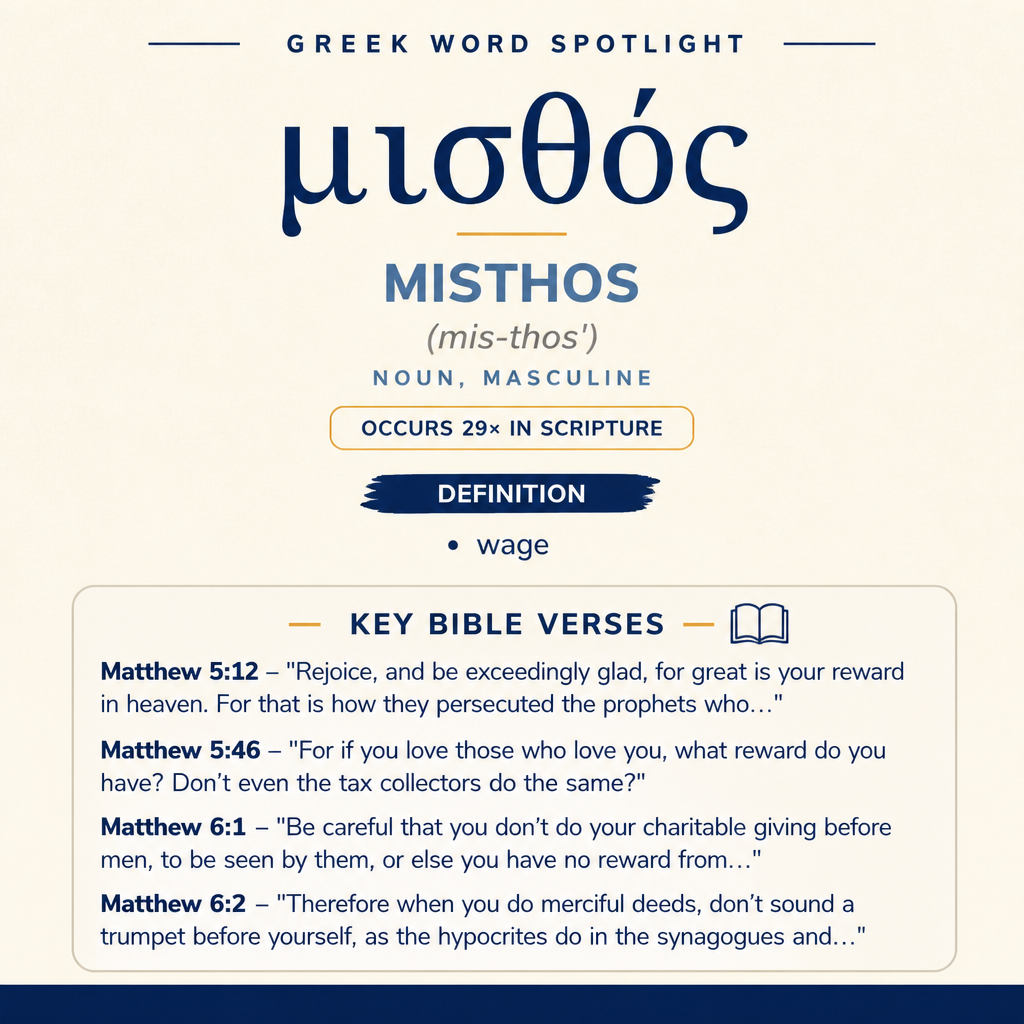
μισθός (Misthos) means “wage” and appears 29 times in Scripture, including multiple occurrences in Matthew.
Core Meaning
μισθός is defined as “wage.” In the provided verses, it is rendered as “reward.”
Learn More →Matthew Occurrences
The listed occurrences are all in Matthew: 5:12, 5:46, 6:1, 6:2, 6:5, 6:16, 10:41, and 10:42. These passages speak of reward in heaven and reward connected to visible acts.
Learn More →Context In Verses
Matthew 6 connects reward to motives in giving, praying, and fasting. Matthew 10 connects reward to receiving a prophet, a righteous person, or giving a cup of cold water.
Learn More →μισθός refers to a wage, whether pictured as ordinary pay for labor or as the recompense expected for a course of action. In the passages where it appears, it can describe both present, humanly granted pay and a reward located “in heaven,” set within Jesus’ teaching about persecution, motives, and simple acts of mercy.
Occurrences
Matthew 5:12 — “Rejoice, and be exceedingly glad, for great is your reward in heaven. For that is how they persecuted the prophets who were before you.”
Here μισθός is framed as a “reward in heaven” that corresponds to the experience of being persecuted. The word functions as a counterweight to suffering: persecution is not treated as a loss without remainder, because the wage attached to faithful endurance is declared “great.” The reference to “the prophets who were before you” places this wage within a recognizable pattern of mistreatment and vindication, while keeping the reward itself located with God (“in heaven”).

Matthew 5:46 — “For if you love those who love you, what reward do you have? Don’t even the tax collectors do the same?”
μισθός serves as the measure of what love is “worth” when it is merely reciprocal. The question assumes that actions can be evaluated in terms of the wage they properly yield; love that mirrors the world’s easy patterns is presented as producing no distinctive reward. The comparison with “tax collectors” sharpens the point: when behavior is common even among those viewed negatively, it does not stand out as the kind of act that carries a meaningful wage.
Matthew 6:1 — ““Be careful that you don’t do your charitable giving before men, to be seen by them, or else you have no reward from your Father who is in heaven.”
In this warning, μισθός is attached to the source of payment: “from your Father who is in heaven.” The word helps express a transfer of “paymaster,” as it were. If charitable giving is performed “to be seen by” people, the Father’s reward is forfeited; the act may still generate some outcome, but not the wage that comes from God. The verse uses μισθός to draw a clear line between motive (“to be seen”) and the kind of wage one should expect.
Matthew 6:2 — “Therefore when you do merciful deeds, don’t sound a trumpet before yourself, as the hypocrites do in the synagogues and in the streets, that they may get glory from men. Most certainly I tell you, they have received their reward.”
μισθός here is the payment already collected: “they have received their reward.” The scene is public and performative (“in the synagogues and in the streets”), and the intended payoff is “glory from men.” In that setting, μισθός functions almost like a receipt: the hypocrites’ wage arrives in the form they sought—human admiration—so nothing further remains to be paid in another sphere.
Matthew 6:5 — ““When you pray, you shall not be as the hypocrites, for they love to stand and pray in the synagogues and in the corners of the streets, that they may be seen by men. Most certainly, I tell you, they have received their reward.”
The same wage logic is applied to prayer. By linking μισθός to being “seen by men,” the verse treats public visibility as a kind of compensation that can exhaust the wage due. The locations (“synagogues” and “corners of the streets”) underline the pursuit of notice, and μισθός marks the result: the act’s payoff has been cashed out already in human attention.
Matthew 6:16 — ““Moreover when you fast, don’t be like the hypocrites, with sad faces. For they disfigure their faces, that they may be seen by men to be fasting. Most certainly I tell you, they have received their reward.”
μισθός again names the wage that corresponds to public religious performance. The “sad faces” and deliberately “disfigure[d]” appearance are part of a strategy to be recognized “by men” as fasting. μισθός captures the transactional nature of such display: the recognition is the pay, and the statement that they have received it implies finality—what they wanted is what they got.
Matthew 10:41 — “He who receives a prophet in the name of a prophet will receive a prophet’s reward. He who receives a righteous man in the name of a righteous man will receive a righteous man’s reward.”
In this saying, μισθός is attached to welcoming and recognizing others “in the name of” who they are. The “prophet’s reward” and “righteous man’s reward” connect the wage to the status and calling of the person received. μισθός thus helps express a principle of participation: honoring the messenger aligns one with the messenger’s recompense, not because of the recipient’s prominence but because of the deliberate identification (“in the name of”).
Matthew 10:42 — “Whoever gives one of these little ones just a cup of cold water to drink in the name of a disciple, most certainly I tell you he will in no way lose his reward.”
μισθός here is tied to a small, concrete kindness: “just a cup of cold water.” The phrase “will in no way lose his reward” makes μισθός the assured wage for an act easily overlooked. The emphasis falls on both the modesty of the deed (“one of these little ones”) and the intention (“in the name of a disciple”), with μισθός guaranteeing that such hidden generosity is not wasted effort.
Matthew 20:8 — “When evening had come, the lord of the vineyard said to his manager, ‘Call the laborers and pay them their wages, beginning from the last to the first.’”
This occurrence places μισθός in an everyday labor setting: hired workers receiving wages at day’s end. The command to pay “beginning from the last to the first” situates μισθός within a structured distribution, and the vineyard scene gives the word its plain economic force. In this context, μισθός names the expected compensation for work performed, administered by authority (“the lord of the vineyard”) through an agent (“his manager”).
Mark 9:41 — “For whoever will give you a cup of water to drink in my name, because you are Christ’s, most certainly I tell you, he will in no way lose his reward.”
μισθός is again linked to a cup of water, but Mark’s wording highlights the relationship to Jesus: “in my name, because you are Christ’s.” The wage is promised for support given to those identified with Christ, and the strong assurance (“most certainly… will in no way lose”) treats μισθός as secure and not subject to being overlooked. The act is ordinary; the reason for it—belonging to Christ—gives it its rewarded character.
Luke 6:23 — “Rejoice in that day, and leap for joy, for behold, your reward is great in heaven, for their fathers did the same thing to the prophets.”
μισθός again stands opposite persecution, this time coupled with exuberant response: “Rejoice… and leap for joy.” The reward is described as “great in heaven,” reinforcing the idea that the wage is not controlled by social approval on earth. The reference to what “their fathers did… to the prophets” places present hostility in continuity with earlier rejection, with μισθός naming the promised compensation that makes joy reasonable even under pressure.
Luke 6:35 — “But love your enemies, and do good, and lend, expecting nothing back; and your reward will be great, and you will be children of the Most High; for he is kind toward the unthankful and evil.”
Here μισθός is set alongside actions that deliberately refuse normal repayment: love enemies, do good, lend “expecting nothing back.” The wage is not the borrower’s return; it is a “great” reward that accompanies imitating divine kindness (“he is kind toward the unthankful and evil”). In this setting, μισθός reinforces that one can act generously without immediate compensation from people while still having a promised wage.

Sense and Usage
Across these passages, μισθός consistently carries the idea of compensation that matches an action, but the scenes clarify that the decisive question is not whether an act has a payoff, but what sort of payoff and from whom. In Matthew 20:8 the word sits naturally in the sphere of employment: laborers are to be paid at evening, and μισθός is the straightforward wage due for work. That concrete use provides a baseline for the other contexts, where the “wage” metaphor is extended to ethical and religious behavior.
In Matthew 6:1–16, μισθός exposes the danger of performative piety. Charitable giving, prayer, and fasting are treated as actions that can be “paid” in more than one way. When the motive is “to be seen by men,” human recognition functions as the wage, and the repeated declaration “they have received their reward” presents that wage as already collected and therefore complete. The word thus helps express a moral economy: seeking public glory converts religious practice into a transaction whose payout is limited to the public’s attention.
In Matthew 5:12, Luke 6:23, and Luke 6:35, μισθός is located “in heaven” and described as “great.” The wage is not merely a private feeling of satisfaction, nor a social benefit, but a reward anchored in God’s realm and character. These sayings connect the promised reward with situations where normal calculations fail: persecution for faithfulness, or generosity offered without expectation of return. μισθός functions as the promised recompense that makes such countercultural behavior intelligible.
Finally, in Matthew 10:41–42 and Mark 9:41, μισθός attaches to welcoming and assisting others “in the name of” a prophet, a righteous man, a disciple, or Christ. The repeated emphasis on naming indicates that the wage is tied to recognizing and honoring a person’s identity and allegiance. Even a minimal gift—“just a cup of cold water”—is treated as an act with a secured wage, because its significance lies not in its size but in the relationship it acknowledges.
Imagery in Context
The word’s imagery ranges from the tangible to the transcendent. The vineyard payday in Matthew 20:8 evokes wages counted out at day’s end, while the repeated “reward in heaven” in Matthew 5:12 and Luke 6:23 places μισθός beyond the reach of persecutors. Between these poles, Matthew 6:2–16 pictures a different kind of “payday”: public applause received immediately by those who practice religion for display, a wage that arrives quickly and ends quickly. The cup of cold water in Matthew 10:42 and Mark 9:41 provides a final concrete image—small, refreshing, and easily missed—yet spoken of as an act that “will in no way lose” its wage.
Sources: Lexical data from Strong’s Exhaustive Concordance and the Translators Brief Lexicon of Extended Strongs for Greek (STEPBible, CC BY). Occurrence data from the Translators Amalgamated Greek New Testament (STEPBible, CC BY). Scripture quotations from the World English Bible (public domain).