
Exploring the Meaning of Mimnesko in Greek
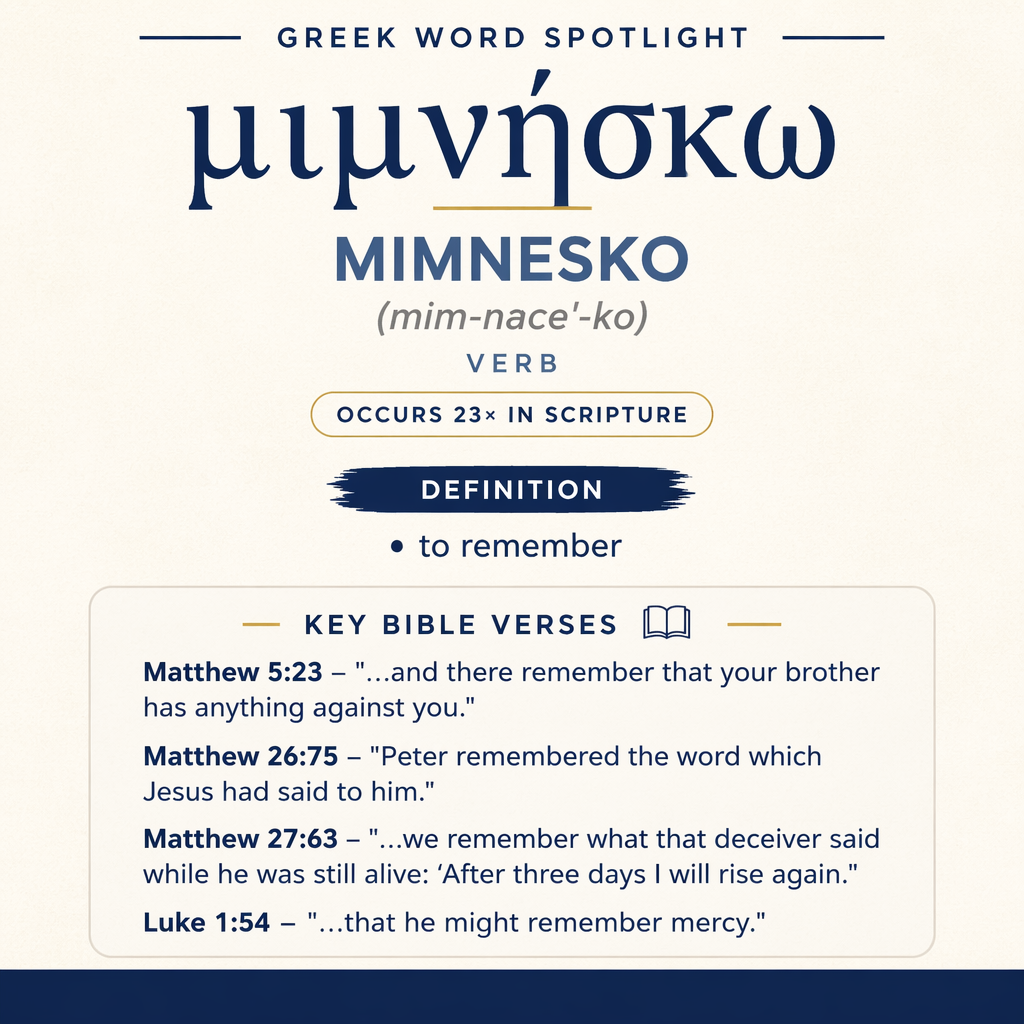
μιμνήσκω (Mimnesko) means “to remember” and appears 23 times in Scripture, including in Matthew, Luke, and other passages.
Core Meaning
μιμνήσκω means “to remember.” It describes recalling words, actions, or covenant mercy in the passages listed.
Learn More →Gospel Examples
In Matthew, it appears when Peter remembered Jesus’ words (Matthew 26:75) and when others recalled his saying (Matthew 27:63). In Luke, it includes calls to remember mercy and covenant (Luke 1:54, 1:72).
Learn More →Appeals to Remember
It is used as a direct appeal, as in “Lord, remember me” (Luke 23:42). It also appears as an instruction to recall Jesus’ prior words (Luke 24:6).
Learn More →μιμνήσκω means “to remember” and appears in a range of Gospel settings where recalling words, obligations, mercy, and lived experience becomes decisive. The verb regularly marks a turning point: something previously heard, promised, written, or lived is brought back to mind with moral, interpretive, or emotional force.
Occurrences
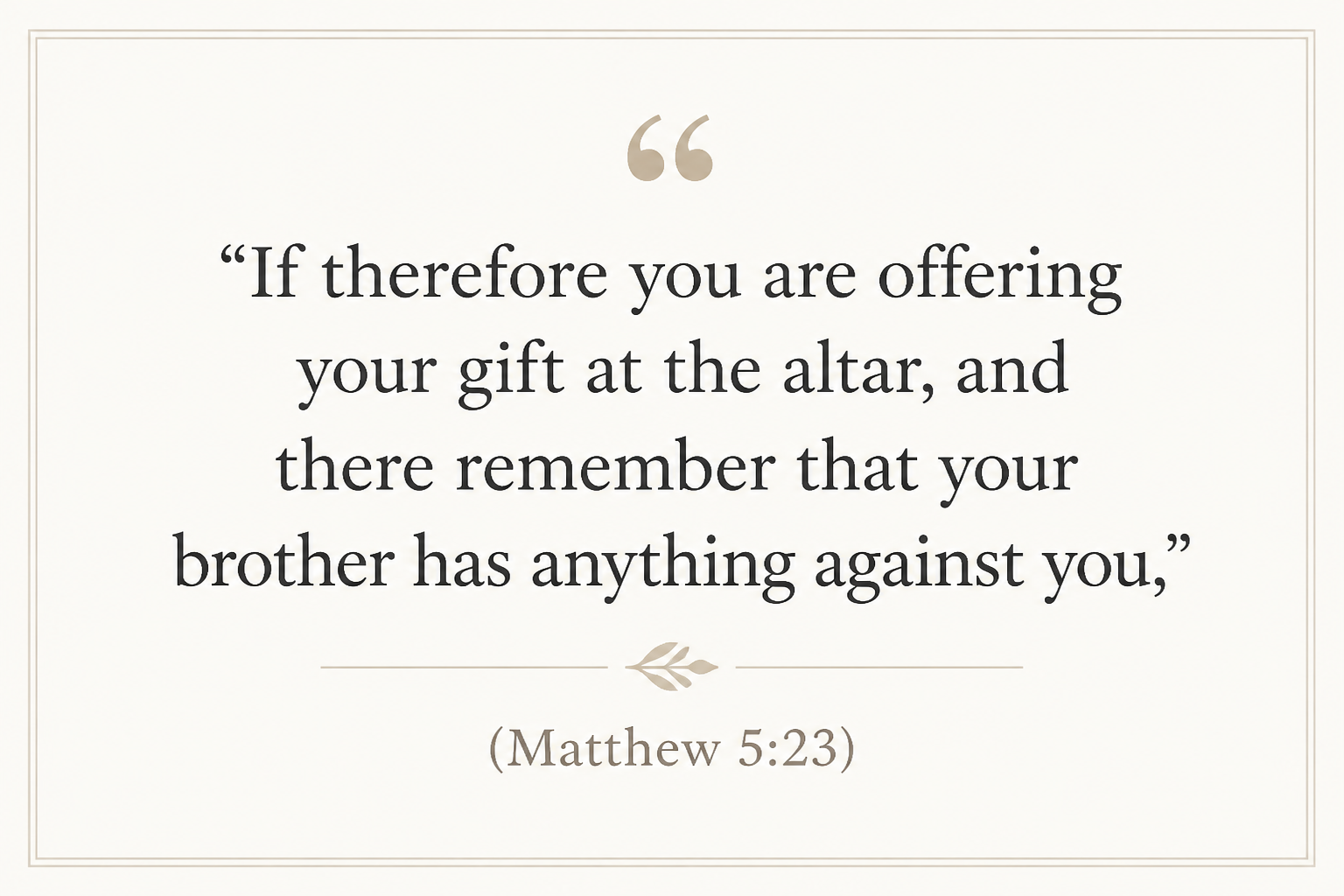
“If therefore you are offering your gift at the altar, and there remember that your brother has anything against you,” (Matthew 5:23)
Here μιμνήσκω names an internal recollection that interrupts an outward religious act. The remembering happens “there” at the altar, and its content is relational: “your brother has anything against you.” The verb frames remembrance as an awakening to an unresolved obligation that the worshiper had not been acting on in that moment.
“Peter remembered the word which Jesus had said to him, “Before the rooster crows, you will deny me three times.” Then he went out and wept bitterly.” (Matthew 26:75)
μιμνήσκω triggers recognition after an event has unfolded. Peter’s remembering is not generic recollection but the specific retrieval of “the word which Jesus had said,” now matched to Peter’s actions. The narrative consequence is immediate and personal—“he went out and wept bitterly”—so the verb carries the weight of a remembered saying that exposes what has just happened.
“saying, “Sir, we remember what that deceiver said while he was still alive: ‘After three days I will rise again.’” (Matthew 27:63)
The speakers use μιμνήσκω to appeal to remembered speech as grounds for action. The remembered material is a quotation—“After three days I will rise again”—and the remembering is communal (“we remember”). By locating the saying “while he was still alive,” the verb anchors their present concern in a past utterance they claim to recall accurately.
“He has given help to Israel, his servant, that he might remember mercy,” (Luke 1:54)
In this line, μιμνήσκω is oriented toward mercy as the object of remembrance. The remembering is linked to divine help given to “Israel, his servant,” and it portrays remembrance as purposeful: help is given “that he might remember.” The verb thus portrays remembering as a directed act with covenantal resonance in the immediate context.
“to show mercy toward our fathers, to remember his holy covenant,” (Luke 1:72)
μιμνήσκω pairs with mercy again, now explicitly connected with “his holy covenant.” Remembering is set alongside “to show mercy,” suggesting that remembrance and mercy belong together as coordinated divine actions. The object “his holy covenant” gives remembrance a defined content: what is remembered is a particular commitment.
““But Abraham said, ‘Son, remember that you, in your lifetime, received your good things, and Lazarus, in the same way, bad things. But here he is now comforted, and you are in anguish.” (Luke 16:25)
Here μιμνήσκω is an imperative calling for recollection of one’s own lived past—“in your lifetime.” The remembered content contrasts two life-stories: “you…received your good things” versus Lazarus receiving “bad things.” The verb functions as a summons to face remembered realities that explain the present reversal: “now comforted” versus “you are in anguish.”
“He said to Jesus, “Lord, remember me when you come into your Kingdom.”” (Luke 23:42)
μιμνήσκω appears as a direct request addressed to Jesus. The speaker asks to be remembered at a future moment: “when you come into your Kingdom.” Remembering here is not recollecting a fact already known in the scene; it is a plea for the speaker to be held in mind at the decisive time implied by the coming Kingdom.
“He isn’t here, but is risen. Remember what he told you when he was still in Galilee,” (Luke 24:6)
μιμνήσκω is a summons to recall prior instruction as the interpretive key to present events. The command “Remember” is attached to “what he told you,” and the time reference “when he was still in Galilee” directs the hearers back to earlier teaching. The verb therefore functions as a bridge between earlier words and the startling present claim, “He isn’t here, but is risen.”
“They remembered his words,” (Luke 24:8)
This brief statement presents μιμνήσκω as the moment of comprehension and alignment. The content—“his words”—is not expanded here, but the succinctness emphasizes the act itself: recollection happens, and it is sufficient to move the narrative forward. The verb marks the shift from hearing the announcement to connecting it with what had been said before.
“His disciples remembered that it was written, “Zeal for your house will eat me up.”” (John 2:17)
μιμνήσκω links the disciples’ understanding to a written text. The remembered item is explicitly “written” and then quoted. In this setting, remembering is a kind of recognition: what is happening is interpreted through a remembered written line, now brought to mind as relevant to the scene.
“When therefore he was raised from the dead, his disciples remembered that he said this, and they believed the Scripture, and the word which Jesus had said.” (John 2:22)
Here μiμνήσκω is located after a major event: “When therefore he was raised from the dead.” The disciples’ remembering concerns Jesus’ prior speech—“that he said this”—and it is linked to belief: “they believed the Scripture, and the word which Jesus had said.” The verb thus marks recollection that consolidates understanding and strengthens trust in both Scripture and Jesus’ spoken word.
“His disciples didn’t understand these things at first, but when Jesus was glorified, then they remembered that these things were written about him, and that they had done these things to him.” (John 12:16)
In this verse, μιμνήσκω is contrasted with earlier non-understanding: “didn’t understand…at first.” The remembering comes later—“when Jesus was glorified”—and it has two coordinated objects: recognition that “these things were written about him” and recognition of their own participation, “that they had done these things to him.” The verb therefore names a retrospective clarity in which Scripture and experience are brought back into mind together.

Sense and Usage
Across these passages, μιμνήσκω consistently involves a specific content that is retrieved and brought to bear on a present situation. The remembered content can be relational knowledge (a brother’s grievance in Matthew 5:23), a spoken warning (Jesus’ prediction recalled by Peter in Matthew 26:75), an earlier claim that now shapes planning (the remembered “After three days…” in Matthew 27:63), or the remembered framework of mercy and covenant (Luke 1:54, 1:72). The verb does not function as a mere mental snapshot; it is tied to implications—altered behavior, grief, precaution, hope, or belief.
μιμνήσκω also shows a pronounced time-bridging function. Several texts explicitly place remembering at a later moment that reframes the earlier one: Peter remembers after the denials; the disciples remember after Jesus is raised; they remember after he is glorified; the hearers are commanded to remember what was said earlier in Galilee. In these scenes, remembering is the moment when earlier speech or written testimony becomes interpretively active. The remembered word is not only recalled but recognized as explanatory for what is now happening (“He isn’t here, but is risen,” Luke 24:6; “they believed the Scripture, and the word which Jesus had said,” John 2:22).
A further pattern is the range of agents and directions of remembrance. Humans remember (Peter; the disciples; the speakers in Matthew 27:63), humans are commanded to remember (Luke 16:25; Luke 24:6), and remembrance is spoken of in connection with God’s action and purpose (Luke 1:54; Luke 1:72). In Luke 23:42, remembrance becomes a request directed to Jesus about a future moment—“remember me when you come into your Kingdom”—so the verb can function not only as recollection but as an appeal to be held in mind when a decisive arrival occurs.
Finally, John’s uses highlight remembering as a key to reading events in light of what is “written” and what Jesus “had said.” In John 2:17 and 12:16, remembering involves bringing a written witness into focus; in John 2:22 it aligns Scripture and Jesus’ spoken word in a single act of recall that leads to belief. In these contexts, μιμνήσκω has the practical effect of turning past words into present understanding.
Imagery in Context
The verb often carries the imagery of interruption and return: a worshiper pauses at the altar when memory surfaces (Matthew 5:23), a disciple breaks down as remembered words catch up with recent deeds (Matthew 26:75), and followers look back after resurrection and glorification so that earlier words and writings come into view (Luke 24:6–8; John 2:22; John 12:16). Even when the scene is quiet—“They remembered his words” (Luke 24:8)—the remembered word functions like a hinge, turning confusion into recognition and leaving the present moment different than it was before remembering occurred.
Sources: Lexical data from Strong’s Exhaustive Concordance and the Translators Brief Lexicon of Extended Strongs for Greek (STEPBible, CC BY). Occurrence data from the Translators Amalgamated Greek New Testament (STEPBible, CC BY). Scripture quotations from the World English Bible (public domain).




