
Exploring the Meaning of Mimetes in Greek
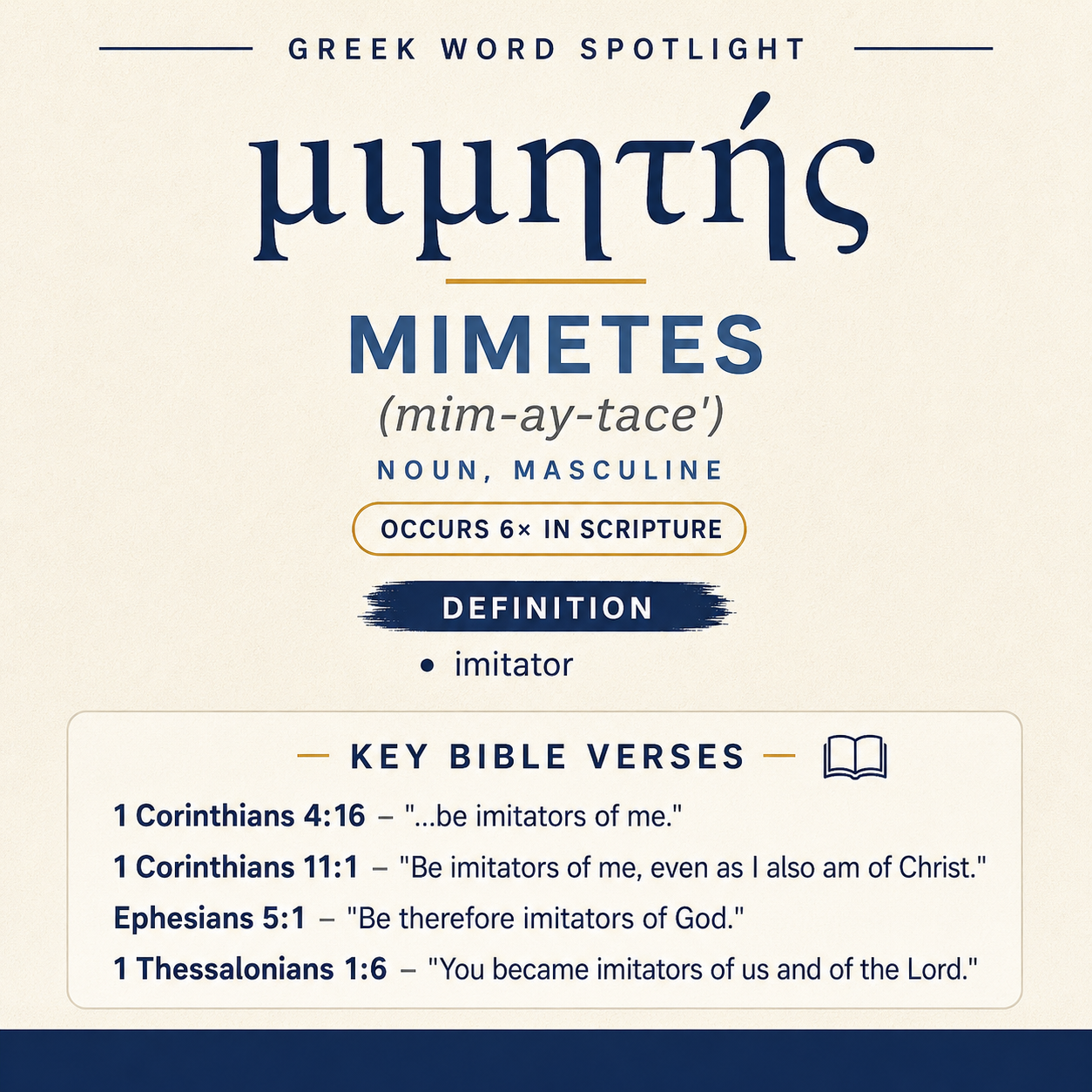
μιμητής means “imitator” and appears six times in Scripture: 1 Corinthians 4:16; 11:1; Ephesians 5:1; 1 Thessalonians 1:6; 2:14; Hebrews 6:12.
Core Meaning
μιμητής is defined as “imitator.” It is used for those who follow a model’s example.
Learn More →Calls to Imitate
Paul urges believers, “be imitators of me” (1 Corinthians 4:16) and “be imitators of me… of Christ” (1 Corinthians 11:1). Ephesians 5:1 commands, “be… imitators of God.”
Learn More →Imitators in Practice
Believers are described as imitators of Paul and the Lord while receiving the word amid affliction with joy of the Holy Spirit (1 Thessalonians 1:6). Hebrews 6:12 commends being imitators of those who inherited promises through faith and perseverance.
Learn More →μιμητής denotes an “imitator,” a person who takes another as a pattern for conduct. In the New Testament it appears in apostolic exhortation and pastoral encouragement, where imitation is urged as an active, chosen posture toward recognized models.
Occurrences
“I beg you therefore, be imitators of me.” (1 Corinthians 4:16)
Here μιμητής functions as a direct appeal, framed by “I beg you therefore,” which gives the call urgency and personal weight. The word identifies the requested response: the hearers are to align themselves with Paul’s own example. The verse is concise, so the force of μιμητής stands out as the central action requested.
“Be imitators of me, even as I also am of Christ.” (1 Corinthians 11:1)
This occurrence clarifies imitation by adding a second comparison: Paul places his own patterned life under a larger pattern, “even as I also am of Christ.” μιμητής still names the hearers’ role (“Be imitators of me”), but the clause that follows situates that imitation within a chain of modeled conduct. In this sentence, μιμητής marks a relational dynamic: the community is asked to mirror Paul’s example insofar as it mirrors Christ’s.
“Be therefore imitators of God, as beloved children.” (Ephesians 5:1)
In Ephesians, μιμητής is directed not toward an apostle but toward “God,” and the motivation is expressed by the familial phrase “as beloved children.” The word presents imitation as fitting behavior for a child toward a parent: it is not mere copying but a way of living consistent with a given relationship. The “therefore” introduces the command as the practical outworking of preceding instruction, so μιμητής signals the ethical shape that follows from identity as “beloved children.”
“You became imitators of us and of the Lord, having received the word in much affliction, with joy of the Holy Spirit,” (1 Thessalonians 1:6)
Here μιμητής is used descriptively (“You became imitators”), portraying imitation as something that has already taken place in the Thessalonian believers’ story. The verse links that imitation to concrete circumstances: “having received the word in much affliction, with joy of the Holy Spirit.” μιμητής, then, characterizes their response under pressure; it is not an abstract admiration but a lived correspondence to “us and … the Lord,” expressed in their reception of the message amid hardship and Spirit-given joy.
“For you, brothers, became imitators of the assemblies of God which are in Judea in Christ Jesus; for you also suffered the same things from your own countrymen, even as they did from the Jews” (1 Thessalonians 2:14)
This use again describes what the readers “became,” but the models are broadened from individuals (“us and … the Lord”) to communities: “the assemblies of God which are in Judea in Christ Jesus.” μιμητής is tied to shared experience: “you also suffered the same things,” and the comparison is reinforced by “even as they did.” The word thus highlights imitation as resemblance in the pattern of endurance and opposition, creating a sense of solidarity between geographically separated congregations joined by common suffering.
“that you won’t be sluggish, but imitators of those who through faith and perseverance inherited the promises.” (Hebrews 6:12)
In Hebrews, μιμητής is set in a contrast: not “sluggish,” but “imitators.” The word defines the alternative to spiritual lethargy as deliberate following of exemplary people—“those who through faith and perseverance inherited the promises.” μιμητής here points to a sustained pattern rather than a momentary act: the models are identified by enduring qualities (“faith and perseverance”) and by their outcome (“inherited the promises”), and imitation is presented as the fitting response for readers who are urged toward continued diligence.

Sense and Usage
Across these passages, μιμητής consistently marks imitation as a moral and communal practice: it is the shaping of one’s conduct by a recognized pattern embodied in a person, in God, or in a community. The word operates both as an imperative (“be imitators”) and as a description of a completed development (“you became imitators”). In the imperative uses, it functions as a pointed summons—an instruction that calls for intention and choice. In the descriptive uses, it becomes a term of commendation, a way of naming the readers’ established response to apostolic preaching and to hardship.
The targets of imitation show a widening field of exemplars. In 1 Corinthians, imitation is oriented toward Paul, with an explicit rationale that his own life is patterned “of Christ.” Ephesians directs imitation toward God, grounding the appropriateness of such imitation in the relationship of “beloved children.” Thessalonians portrays imitation as both vertical and horizontal: “of the Lord,” of apostolic missionaries (“of us”), and of other congregations (“the assemblies of God … in Judea”). Hebrews points to a broader gallery of exemplars: “those who through faith and perseverance inherited the promises.” In each case, μιμητής identifies the learner’s posture toward the exemplar: to take the other’s way of life as the template for one’s own.
Several occurrences connect imitation with endurance under pressure, showing that μιμητής is not limited to copying outward behaviors but includes the adoption of a pattern proven in testing. In 1 Thessalonians 1:6, imitation is embedded in “much affliction” coupled with “joy of the Holy Spirit,” so the imitated pattern is recognizable in how the word is received when circumstances are adverse. In 1 Thessalonians 2:14, imitation is described in terms of parallel suffering: the Thessalonians “suffered the same things” as the Judean assemblies, creating a shared profile of experience. Hebrews 6:12 similarly frames imitation as the opposite of being “sluggish,” urging readers toward the steady traits that characterize those who “inherited the promises.” Thus μιμητής regularly carries the sense of following models whose credibility is demonstrated in perseverance.
The relational language surrounding μιμητής also shapes its force. Paul’s appeal “I beg you therefore” (1 Corinthians 4:16) makes imitation a response to pastoral pleading rather than mere instruction. The phrase “as beloved children” (Ephesians 5:1) makes imitation a family-shaped act: the model is not distant, and the imitators are not merely students but children acting in a way that matches who they are called to be. In Thessalonians, calling the recipients “brothers” (2:14) frames imitation within sibling solidarity, and the communal targets (“assemblies of God”) show imitation operating at the level of shared congregational life. In Hebrews, the community is urged toward imitation so that it will not lapse into dullness; imitation is presented as a practical means of continuing in the path marked by faithful predecessors.
Within these verses, μιμητής also serves to connect teaching with embodied example. The Thessalonians “received the word” (1 Thessalonians 1:6), and their becoming imitators is narrated alongside that reception, suggesting that the message is not only heard but lived out in a recognizable pattern. Hebrews likewise places imitation alongside “faith and perseverance,” linking the desired conduct to long-term qualities rather than short-term enthusiasm. In this way, μιμητής expresses a vision of instruction in which patterns of life are transmitted through observed models and then reproduced in the community’s conduct.
Implied Imagery
The word’s imagery in these passages is that of a pattern reproduced in a life. The commands “Be imitators of me” (1 Corinthians 4:16; 11:1) and “Be therefore imitators of God” (Ephesians 5:1) evoke the picture of a community taking its bearings from a clear example. The narratives “You became imitators” (1 Thessalonians 1:6; 2:14) add the texture of lived experience—receiving the word, enduring affliction, sharing in suffering—so that imitation appears as a recognizable likeness formed over time. Hebrews adds the forward-looking angle: not sluggishness, but imitation of those who endure toward an inheritance (Hebrews 6:12), portraying imitation as a disciplined pursuit shaped by tested models.
Sources: Lexical data from Strong’s Exhaustive Concordance and the Translators Brief Lexicon of Extended Strongs for Greek (STEPBible, CC BY). Occurrence data from the Translators Amalgamated Greek New Testament (STEPBible, CC BY). Scripture quotations from the World English Bible (public domain).





