Exploring the Meaning of Miasmos in Greek
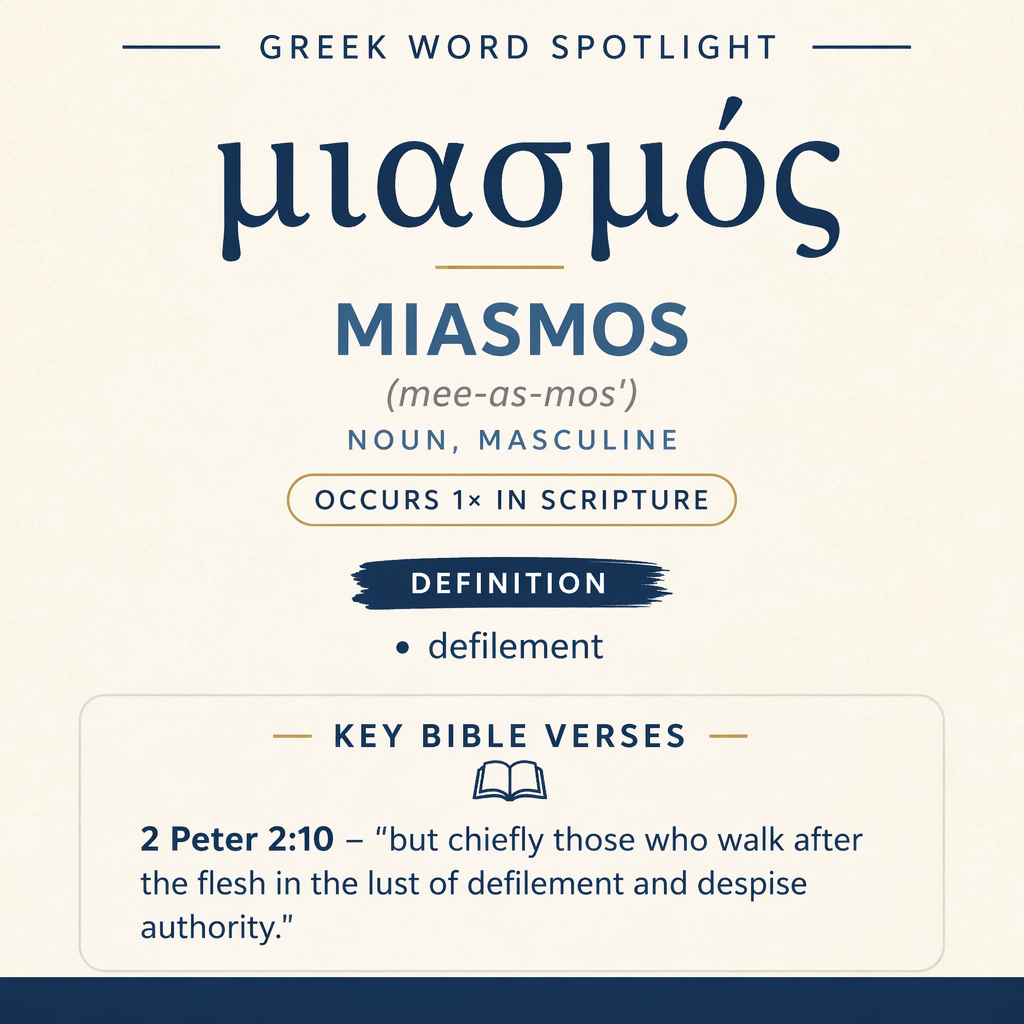
μιασμός (Miasmos) means “defilement” and appears once in Scripture, in 2 Peter 2:10.
Scripture Occurrence
This noun occurs 1 time in Scripture. Its single reference is 2 Peter 2:10.
Learn More →Context in Verse
In 2 Peter 2:10 it appears in the phrase “the lust of defilement.” The verse contrasts this with despising authority.
Learn More →μιασμός denotes “defilement” and appears once in the New Testament, in 2 Peter 2:10. In that setting it characterizes a particular kind of lust that marks a flesh-directed way of life.
Root and Related Words
μιασμός is related to the verb miainō (μιαίνω), “to stain” (Strong’s G3392). The noun’s sense of defilement fits naturally alongside a verbal idea of staining, describing the resulting condition or quality rather than the action itself.

Occurrences
“but chiefly those who walk after the flesh in the lust of defilement and despise authority. Daring, self-willed, they are not afraid to speak evil of dignitaries;” (2 Peter 2:10)
Here μιασμός occurs within a tightly packed description of a recognizable pattern of conduct. The verse begins by narrowing focus: “but chiefly those who walk after the flesh,” and then further specifies the nature of that walk as being “in the lust of defilement.” The noun therefore functions as a qualifier of “lust,” giving that desire a particular moral cast: it is not simply desire in general, but desire characterized by defilement. In the flow of the sentence, defilement is not presented as a distant outcome but as a defining feature of the craving itself.

The immediate coordination with “and despise authority” shows how the “lust of defilement” belongs to a broader posture. The verse links the inward orientation (“walk after the flesh”) with relational and social expressions (“despise authority”), then illustrates the same disposition through adjectives and behaviors: “Daring, self-willed,” and “not afraid to speak evil of dignitaries.” In this portrayal, defilement is embedded in a way of life: it accompanies a flesh-led path, aligns with contempt for authority, and sits comfortably alongside bold, self-asserting irreverence toward “dignitaries.” The word contributes a sense that the desires in view carry a contaminating quality that fits the entire cluster of vices the sentence names.
Sense and Usage
Because the word occurs only in this one context, its usage must be read from the immediate frame Peter gives it. The definition “defilement” is shaped here by its placement inside the phrase “the lust of defilement.” Lust is presented as a sphere or atmosphere in which people “walk,” and defilement supplies the moral quality of that sphere. The construction suggests that defilement is not merely an occasional lapse but something that can characterize desire so pervasively that it becomes the environment of one’s conduct.
The term also gains clarity by contrast with the other descriptors in the verse. “Walk after the flesh” sets the controlling direction; “despise authority” gives a concrete companion trait; and the final clauses supply the tone—“Daring, self-willed”—and a telling symptom—“not afraid to speak evil of dignitaries.” Within this chain, defilement does not stand isolated as a private impurity; it is integrated with disdain and audacity. The word therefore carries an interpersonal and moral weight in the passage: it describes a kind of stained desire that expresses itself in disregard and reckless speech.
The related verb miainō (“to stain”) helps highlight the imagery implicit in “defilement.” A stain is not simply a theoretical label; it is a mark that clings and changes how something is perceived. In 2 Peter 2:10, that imagery serves the author’s rhetorical aim: to portray certain people as recognizable by the quality of their desires and the pattern of life that flows from them. Defilement, in this usage, is not treated as an abstract category detached from behavior; it belongs to a walk, a lust, and a posture toward authority that can be seen in bold, self-willed actions and speech.
Imagery
The verse’s phrasing invites a vivid moral picture: a “walk” conducted “after the flesh,” within a craving marked by defilement. The image is of movement along a path where desire is already tainted, and where that taint shows itself in contempt for authority and unrestrained, irreverent speech toward “dignitaries.”
Sources: Lexical data from Strong’s Exhaustive Concordance and the Translators Brief Lexicon of Extended Strongs for Greek (STEPBible, CC BY). Occurrence data from the Translators Amalgamated Greek New Testament (STEPBible, CC BY). Scripture quotations from the World English Bible (public domain).