Exploring the Meaning of Metopon in Greek
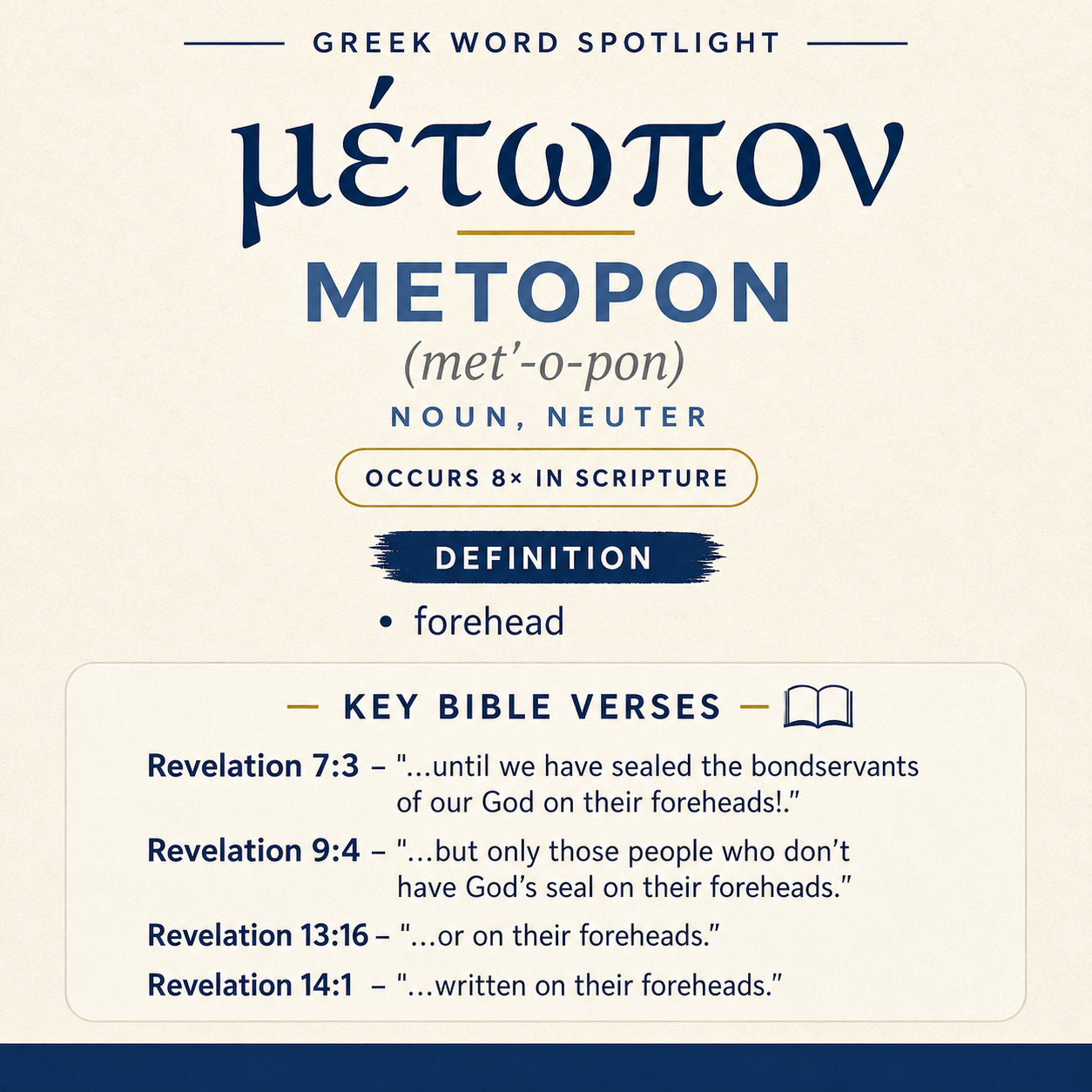
μέτωπον (Metopon) means “forehead” and occurs 8 times in Scripture, all in Revelation (7:3; 9:4; 13:16; 14:1; 14:9; 17:5; 20:4; 22:4).
Core Meaning
μέτωπον is defined as “forehead.” In Revelation it identifies where names, seals, or marks are placed or seen.
Learn More →Revelation Occurrences
The word appears eight times, all in Revelation: 7:3; 9:4; 13:16; 14:1; 14:9; 17:5; 20:4; 22:4. These contexts repeatedly mention the forehead in connection with sealing, marking, or writing.
Learn More →Marking & Identity
Revelation uses μέτωπον for visible identification, including God’s seal (7:3) and God’s name (22:4). It also appears with the beast’s mark (14:9) and a written name (17:5).
Learn More →μέτωπον refers to the forehead. In Scripture it appears exclusively in Revelation, where it functions as a visible location for sealing, marking, and written names in a series of apocalyptic scenes.
Occurrences
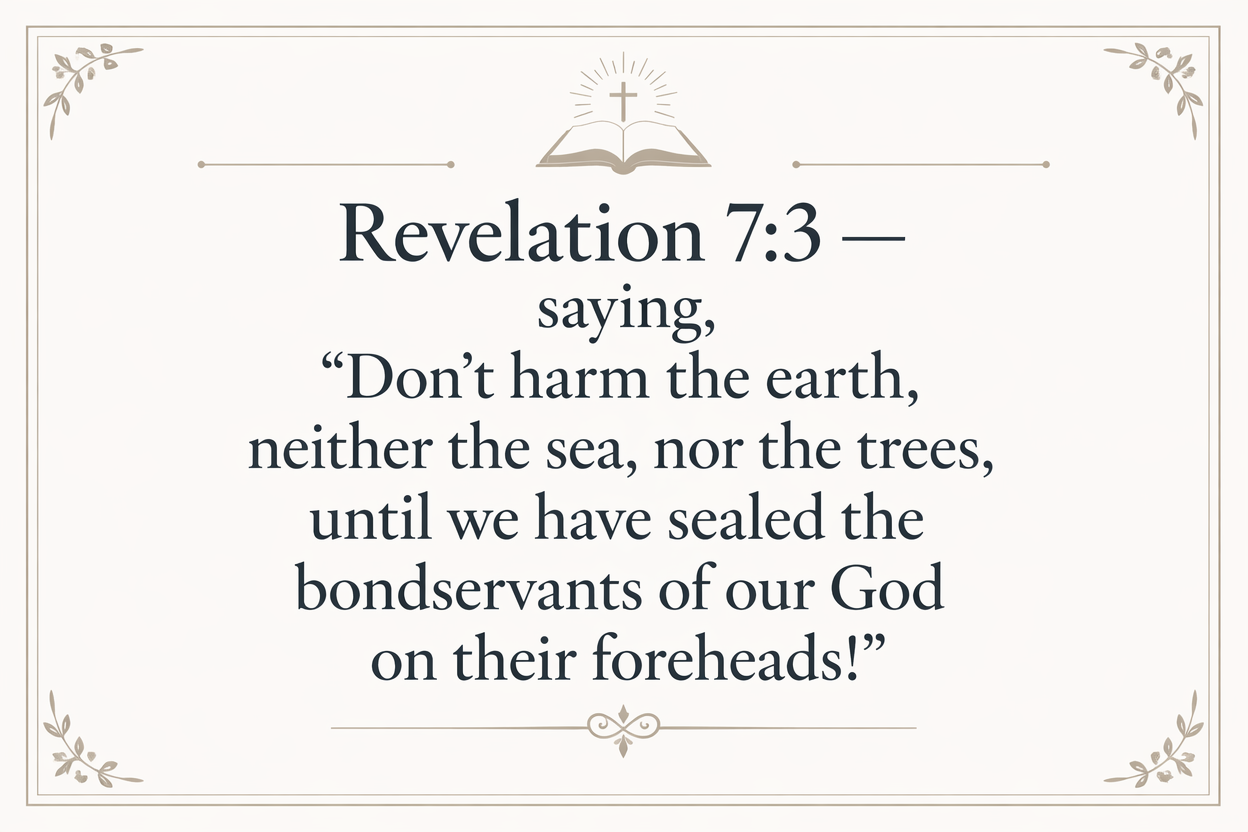
Revelation 7:3 — saying, “Don’t harm the earth, neither the sea, nor the trees, until we have sealed the bondservants of our God on their foreheads!”
Here μέτωπον names the bodily site where “the bondservants of our God” are sealed. The command delays harm to “the earth… the sea… [and] the trees” until that act is done, so the forehead becomes the designated place for an identifying seal that precedes coming judgments. The verse’s urgency (“until we have sealed”) gives the forehead a role as a boundary marker: it is where divine ownership is placed before the world is struck.
Revelation 9:4 — They were told that they should not hurt the grass of the earth, neither any green thing, neither any tree, but only those people who don’t have God’s seal on their foreheads.
μέτωπον again appears with “God’s seal,” but now the forehead is used as a criterion for who may be harmed. The instruction distinguishes vegetation (“grass… any green thing… any tree”) from “people,” and then distinguishes people by whether the seal is on their foreheads. The forehead is the observable point of differentiation: it is where the presence or absence of the seal determines exposure to the plague described in the wider scene implied by “They were told.”
Revelation 13:16 — He causes all, the small and the great, the rich and the poor, and the free and the slave, to be given marks on their right hands, or on their foreheads;
In this line μέτωπον is paired with “right hands” as an alternative location for “marks.” The sweeping list (“the small and the great… the free and the slave”) emphasizes comprehensiveness, and the forehead is one of the two standardized places where the mark is imposed. The wording “He causes… to be given” makes the forehead not merely descriptive anatomy but a contested public surface—one of the points where coercive allegiance is inscribed.
Revelation 14:1 — I saw, and behold, the Lamb standing on Mount Zion, and with him a number, one hundred forty-four thousand, having his name, and the name of his Father, written on their foreheads.
μέτωπον is the location for written names: “his name, and the name of his Father.” In contrast to the imposed “marks” of the previous chapter’s scene, this writing accompanies the Lamb and those with him on Mount Zion. The forehead thus serves as a place of open identification within a worshipful assembly—names are not hidden but “written on their foreheads,” binding the group to the Lamb and the Father in the visual language of inscription.
Revelation 14:9 — Another angel, a third, followed them, saying with a great voice, “If anyone worships the beast and his image, and receives a mark on his forehead, or on his hand,
μέτωπον is again joined to the hand as a possible site of receiving a “mark,” here directly linked with the act of worship: “If anyone worships the beast and his image, and receives a mark…” The forehead is presented as a primary, plainly visible place where that mark can be borne. The conditional framing (“If anyone…”) treats the forehead-mark as an outward sign bound up with an inward posture of worship in the scene the angel announces.
Revelation 17:5 — And on her forehead a name was written, “MYSTERY, BABYLON THE GREAT, THE MOTHER OF THE PROSTITUTES AND OF THE ABOMINATIONS OF THE EARTH.”
Here μέτωπον belongs to a symbolic female figure, and the forehead carries a written name that functions like a label or title. The content is presented as a public inscription: “on her forehead a name was written,” followed by the full name in capital letters. In this portrayal the forehead becomes a billboard-like surface for identification, making the figure’s character and associations part of her visible presentation within the vision.
Revelation 20:4 — I saw thrones, and they sat on them, and judgment was given to them. I saw the souls of those who had been beheaded for the testimony of Jesus, and for the word of God, and such as didn’t worship the beast nor his image, and didn’t receive the mark on their forehead and on their hand. They lived and reigned with Christ for a thousand years.
μέτωπον appears within a description of those vindicated and enthroned. The text defines them, in part, by what they refused: they “didn’t worship the beast nor his image,” and they “didn’t receive the mark on their forehead and on their hand.” The forehead is thus one of the decisive locations where loyalty would have been displayed; refusal to take the mark there is set alongside faithful testimony and suffering. In this scene, the forehead is implicated in judgment and reign: what was (or was not) received there is part of the description of those who “lived and reigned with Christ.”
Revelation 22:4 — They will see his face, and his name will be on their foreheads.
μέτωπον closes the book in a scene of direct vision and belonging: “They will see his face,” and “his name will be on their foreheads.” The forehead carries the name in a way that corresponds to intimate access (“see his face”) and enduring identification. The pairing of face-to-face sight with a name on the forehead makes the forehead the human point of bearing that name in the final pictured state.

Sense and Usage
Across these occurrences μέτωπον functions as the conspicuous front of the head, treated as a natural place for something to be placed “on” a person: a seal, a mark, or a written name. Revelation repeatedly uses the forehead as the bodily site where identity is made visible. This is not a private token tucked away; the consistent preposition “on” (“on their foreheads,” “on her forehead,” “on his forehead”) presents the forehead as an outward-facing surface suited to being seen.
The word’s usage also shows how the forehead becomes a point of division among people. In Revelation 7:3 and 9:4, the forehead bears “God’s seal,” and that seal is treated as decisive for protection when harm is released. In Revelation 13:16 and 14:9, the forehead is one of the two standardized locations for receiving a “mark,” and that mark is associated with worship of the beast and his image. Revelation 20:4 returns to the forehead as the place where the mark could have been received but was refused, and that refusal is woven into the description of those who participate in judgment and reign. The forehead is therefore a recurring site where allegiance is made legible in the narrative world of the visions.
A second pattern is inscription: names are “written on their foreheads” (Revelation 14:1) and “on her forehead a name was written” (Revelation 17:5), and finally “his name will be on their foreheads” (Revelation 22:4). In each case, the forehead is treated as a surface for writing that identifies the bearer. The content of what is written differs dramatically—names tied to the Lamb and the Father, a name that brands “BABYLON THE GREAT,” and “his name” in the closing promise—but μέτωπον remains the stable anatomical locus where those names are displayed.
Finally, μέτωπον is repeatedly paired with the hand as an alternative site (Revelation 13:16; 14:9; 20:4). The pairing highlights the forehead’s special role: even when another body part is mentioned, the forehead stays central as a prominent, immediately recognizable location for the mark or its refusal. This reinforces the way the visions use bodily placement to communicate public identity and belonging within the symbolic world of Revelation.
Imagery
Revelation’s imagery repeatedly places the decisive sign of identity at the forehead. Whether it is a protective seal (Revelation 7:3; 9:4), an imposed mark (Revelation 13:16; 14:9), a written name that identifies a community gathered with the Lamb (Revelation 14:1), a name that brands a symbolic figure (Revelation 17:5), or the final bearing of “his name” alongside seeing “his face” (Revelation 22:4), μέτωπον is the front-facing human surface where the visions locate what can be read about a person’s allegiance.
Sources: Lexical data from Strong’s Exhaustive Concordance and the Translators Brief Lexicon of Extended Strongs for Greek (STEPBible, CC BY). Occurrence data from the Translators Amalgamated Greek New Testament (STEPBible, CC BY). Scripture quotations from the World English Bible (public domain).