Exploring the Meaning of Metoikizo in Greek
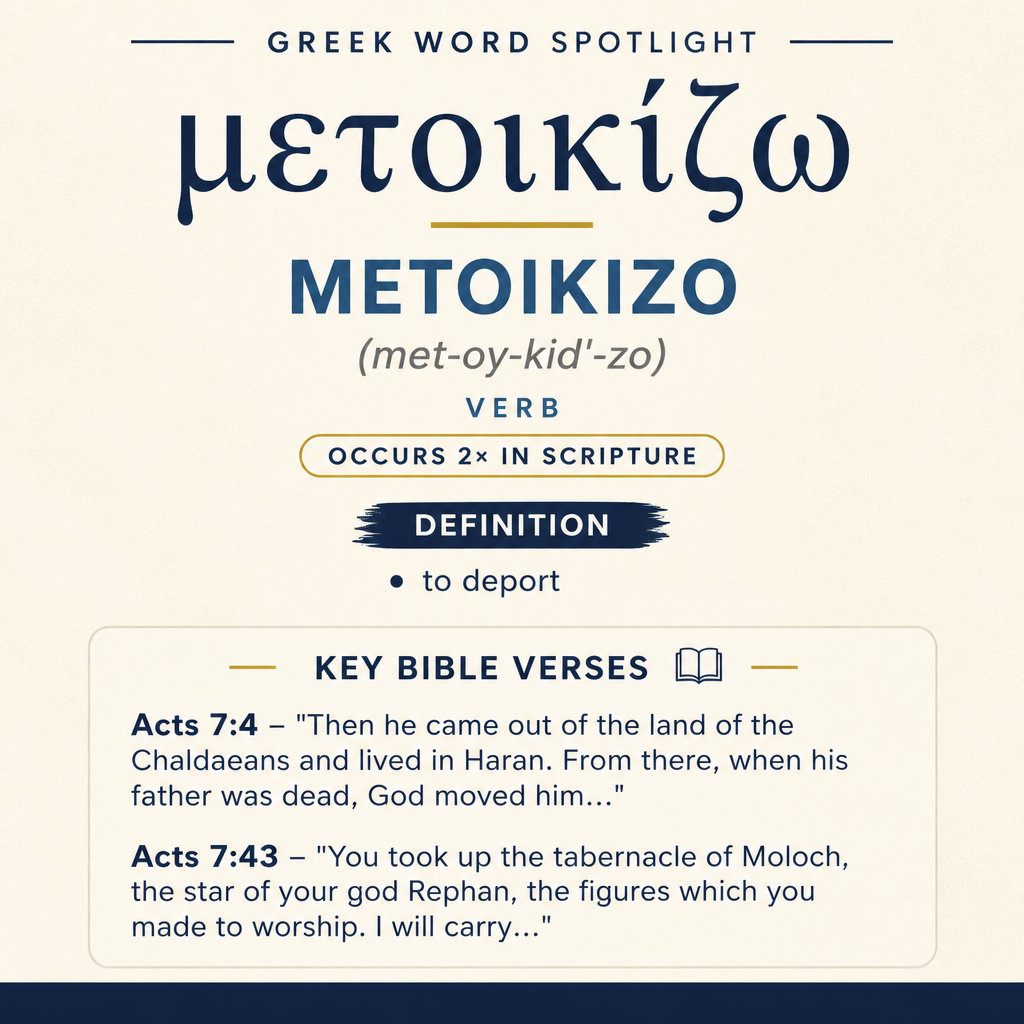
μετοικίζω (Metoikizo) means “to deport” and appears twice in Scripture, in Acts 7:4 and Acts 7:43.
Scripture Occurrences
It occurs 2 times in Scripture. The references are Acts 7:4 and Acts 7:43.
Learn More →Acts Context
In Acts 7:4, it appears within Stephen’s account of Abram moving from Chaldaea to Haran. In Acts 7:43, it appears in a warning about being carried away.
Learn More →μετοικίζω means “to deport,” and it appears twice in the New Testament, both times in Stephen’s speech in Acts. In these scenes it marks a decisive relocation imposed from outside, whether as an act attributed to God’s direction or as a judgment described in prophetic terms.
Root and Related Words
μετοικίζω corresponds to the related noun metoikesia (μετοικεσία), “deportation” (Strong’s G3350). The noun names the state or event, while the verb expresses the action that brings it about.

Occurrences
“Then he came out of the land of the Chaldaeans and lived in Haran. From there, when his father was dead, God moved him into this land, where you are now living.” (Acts 7:4)
In Acts 7:4, the verb stands within a compressed account of movement across places: “came out,” “lived,” and then a further change of residence “from there.” The clause “God moved him into this land” presents the relocation as an imposed transfer rather than a casual change of address. The emphasis falls on the agent—“God”—and on the result—“into this land, where you are now living”—so that the act of deportation functions as a turning point that connects past geography to the audience’s present location. Even in this brief form, the verb carries the weight of being carried across boundaries into a new setting, and it highlights that the destination is not incidental but purposeful: “this land” is defined as the very place the hearers inhabit.
The surrounding phrasing also frames the movement as a response to a change in family circumstances: “when his father was dead.” The relocation is narrated as happening after that moment, and the verb gives Stephen language for a decisive transfer that re-situates a person within the story of the land. Within the verse, the action is not merely travel; it is relocation into a new territory under an external mover, stated explicitly as God.
“You took up the tabernacle of Moloch, the star of your god Rephan, the figures which you made to worship. I will carry you away beyond Babylon.’” (Acts 7:43)
In Acts 7:43, the deportation is cast as a direct consequence following accusation: “You took up the tabernacle of Moloch … the figures which you made to worship.” The verse moves from describing illicit worship objects (“tabernacle,” “star,” “figures”) to a pronouncement of forced removal: “I will carry you away beyond Babylon.” Here the verb’s force is sharpened by the future orientation (“I will”) and by the distance implied in the destination phrase. The scene is not one of settlement or guidance into a home; it is the language of displacement, relocation away from a place of belonging and into a far-off region.
The phrase “carry you away” underscores compulsion: the people are not portrayed as choosing their destination, but as being acted upon. The added boundary “beyond Babylon” makes the deportation sound like an expulsion past a known limit, pushing the subjects further than they would ordinarily go. In this setting, μετοικίζω serves as an instrument of judgment, tied to the wrongdoing just named in the first sentence of the verse. The verb’s contribution is therefore both narrative and evaluative: it describes movement, but movement that signifies loss and penalty in the story Stephen is telling.
Sense and Usage
Across these two occurrences, the core idea of deportation is applied in two distinct rhetorical frames. In Acts 7:4, deportation functions as a divinely directed relocation into “this land,” the place of current residence for Stephen’s hearers. The statement focuses on the mover and the destination, making the action a hinge between ancestral history and present identity. The verb thus supports Stephen’s larger purpose in the speech: to locate his audience within a story of decisive transfers that shape where God’s people find themselves.
In Acts 7:43, the same action of deportation is framed as removal “beyond Babylon” in response to worshiping “figures which you made.” Here the verb underscores coercion and distance, pressing the image of being transported away from one’s place. The destination is not described as a new home but as a place beyond a boundary, so the movement signals severance. The juxtaposition of religious infidelity (“made to worship”) and imposed relocation (“carry you away”) makes deportation the fitting outcome within the verse’s logic: wrongful worship leads to being forcibly moved.
Read together, these uses show that μετοικίζω can be used to speak of a transfer into a land associated with the present community (Acts 7:4) and a transfer away from the community’s center of life (Acts 7:43). In both, the verb keeps the spotlight on the fact that the subjects are moved by another’s action—explicitly by “God” in one, and by the “I will” of a pronouncement in the other—so that deportation functions as a powerful narrative marker of who determines where a person or people will live.
Imagery
The word evokes the picture of being taken from one place and set down in another under an outside force. Acts 7:4 gives that image a directed, purposeful shape—moved “into this land”—whereas Acts 7:43 turns the same image into a sentence of banishment—carried away “beyond Babylon.” In Stephen’s telling, deportation becomes a way of describing how location itself can express either a guided placement or a punitive displacement.
Sources: Lexical data from Strong’s Exhaustive Concordance and the Translators Brief Lexicon of Extended Strongs for Greek (STEPBible, CC BY). Occurrence data from the Translators Amalgamated Greek New Testament (STEPBible, CC BY). Scripture quotations from the World English Bible (public domain).