
Exploring the Meaning of Metoikesia in Greek
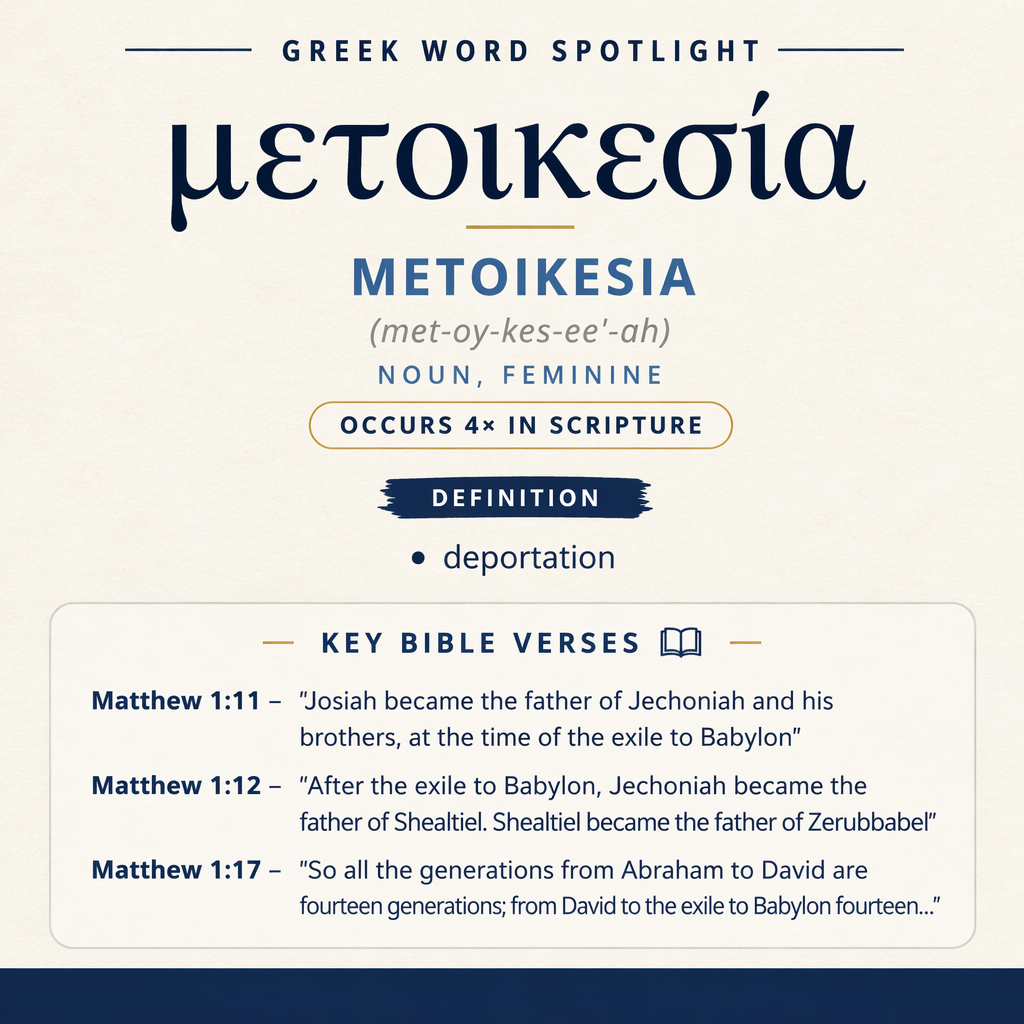
μετοικεσία means “deportation” and occurs four times in Scripture, including Matthew 1:11–12 and 1:17 in reference to Babylon.
Core Meaning
μετοικεσία is defined as “deportation.” In Matthew 1, it is linked to Babylon.
Learn More →Biblical Usage
It appears in Matthew 1:11, 1:12, and 1:17 in the phrase “the exile to Babylon.” These verses place the event within Jesus’ genealogy.
Learn More →Genealogy Marker
Matthew 1:17 counts generations from David to “the exile to Babylon.” The word marks a major historical turning point in the genealogy.
Learn More →Metoikesia refers to deportation and appears in Matthew’s opening genealogy as a time-marker tied specifically to Babylon. In these verses it functions as a hinge-point in Israel’s story, dividing generations into before and after a decisive displacement.
Root and Related Words
Metoikesia is connected with meta (μετά), “with/after,” and oikos (οἶκος), “house: home.” In Matthew’s genealogy, those associations fit the way the term anchors family lines to a historical “after” and to the idea of home as something that can be lost, relocated, or re-situated by force.

Occurrences
“Josiah became the father of Jechoniah and his brothers, at the time of the exile to Babylon.” (Matthew 1:11)
Here metoikesia locates Josiah, Jechoniah, and “his brothers” within a particular moment: “the exile to Babylon.” In a list dominated by births (“became the father of…”), the word introduces an event rather than another generation. It gives the genealogy a historical contour, reminding the reader that this family line is traced through disruption as well as descent. The phrase “at the time of” makes deportation the defining context for that segment of the lineage, not merely a background detail.

“After the exile to Babylon, Jechoniah became the father of Shealtiel. Shealtiel became the father of Zerubbabel.” (Matthew 1:12)
In this verse metoikesia again frames the genealogy, now as a boundary that distinguishes what comes “after.” The verse resumes the regular rhythm of fathering (“became the father of…”), but it does so explicitly on the far side of deportation: “After the exile to Babylon.” The word functions like a chronological dividing line that resets the narrative space of the family list. The movement from Jechoniah to Shealtiel to Zerubbabel is presented as lineage that proceeds under the shadow of that displacement, with deportation standing between earlier generations and these later ones.
“So all the generations from Abraham to David are fourteen generations; from David to the exile to Babylon fourteen generations; and from the carrying away to Babylon to the Christ, fourteen generations.” (Matthew 1:17)
Here metoikesia is placed into a deliberate summary structure: three counted eras measured by “fourteen generations.” The term is used to define the endpoint of the second era (“from David to the exile to Babylon”), and then the summary speaks again of Babylon with “the carrying away to Babylon to the Christ.” In this setting, deportation is not simply an incident during the line; it is one of the major organizing milestones by which Matthew segments the whole genealogy. The word therefore contributes a sense of ordered history: the family line is counted and interpreted in relation to deportation as a pivotal event, standing alongside Abraham and David as a key reference point in the outline.
Sense and Usage
Across these occurrences, metoikesia names deportation as a public event that redefines how time is spoken of. Matthew uses it as a temporal marker (“at the time of…,” “After…,” “from…to…”) rather than as a standalone description, so the word’s force lies in the way it divides the genealogy into periods. It turns a list of fathers and sons into a history with a rupture: births continue, but the line is understood in relation to a removal “to Babylon.”
Because the term appears in the fixed phrase “to Babylon” in each citation, deportation is presented with a clear directional orientation. The genealogy is not merely saying that hardship occurred; it consistently points to a specific destination, and that destination becomes a label for an era. The term therefore carries chronological weight: it is treated as something that can be “the time” of a generation, something after which generations are counted, and something to which an entire span can be measured (“from David to…”). In Matthew 1:17 the effect is especially strong: deportation is both a terminus (“to the exile”) and a reference point for the subsequent span that leads “to the Christ.”
Within a family record, metoikesia also has a narrative effect on the names surrounding it. In Matthew 1:11 it gathers “Jechoniah and his brothers” under the umbrella of one decisive historical moment; in Matthew 1:12 it places Shealtiel and Zerubbabel explicitly on the far side of that same moment. In other words, the word does not replace the genealogy’s generational logic; it qualifies it. The line is still traced by fatherhood, but its course is interpreted through the lens of deportation as a defining transition.
Imagery
Even in a text that is mostly a sequence of names, metoikesia evokes movement away from home: a “carrying away” and an “exile to Babylon.” The repeated attachment to “Babylon” gives the word a geographical concreteness, so that the genealogy’s structure feels shaped by a journey imposed on the people it traces. Matthew’s opening thus presents deportation as an event that leaves an imprint on generations—an imprint strong enough to be counted, dated, and used to orient the story that culminates “to the Christ.”
Sources: Lexical data from Strong’s Exhaustive Concordance and the Translators Brief Lexicon of Extended Strongs for Greek (STEPBible, CC BY). Occurrence data from the Translators Amalgamated Greek New Testament (STEPBible, CC BY). Scripture quotations from the World English Bible (public domain).





