Exploring the Meaning of Metathesis in Greek
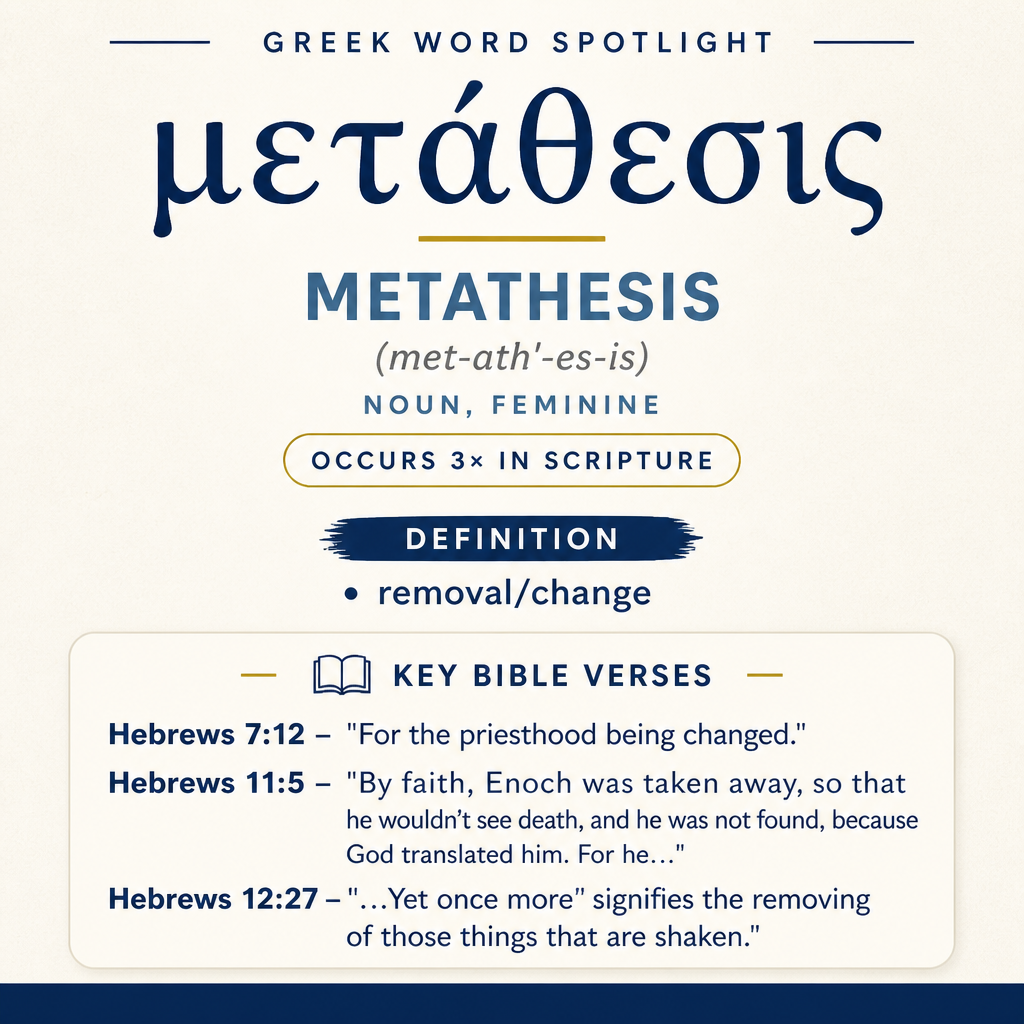
μετάθεσις means “removal/change” and occurs three times in Hebrews (7:12; 11:5; 12:27).
Hebrews 7:12
In Hebrews 7:12 it describes the priesthood being changed, with a necessary change in the law.
Learn More →Other Occurrences
Hebrews 11:5 uses it for Enoch being taken away so he would not see death. Hebrews 12:27 uses it for the removing of things that are shaken.
Learn More →μετάθεσις expresses “removal/change” and is used in Hebrews to describe both a legal shift and a cosmic displacement. It appears in three passages that speak of what is altered, taken away, or removed so that something else may stand.
Root and Related Words
μετάθεσις is related to the verb metatithemi (μετατίθημι), “to transport” (Strong’s G3346). This relationship points to a conceptual link between an action of transferring and the noun’s focus on the resulting removal or change.

Occurrences
Hebrews 7:12: “For the priesthood being changed, there is of necessity a change made also in the law.”
Here μετάθεσις belongs to a tightly reasoned statement: once “the priesthood” is “changed,” a corresponding “change” in “the law” follows “of necessity.” The word marks a transition with consequences. It is not a vague adjustment but a decisive re-ordering: a change in one sphere (priesthood) requires a matching change in another (law). Within the sentence, the term helps frame the claim as an unavoidable outcome rather than an optional development—change is presented as demanded by the new situation described.

Hebrews 11:5: “By faith, Enoch was taken away, so that he wouldn’t see death, and he was not found, because God translated him. For he has had testimony given to him that before his translation he had been well pleasing to God.”
In this narrative note, μετάθεσις refers to Enoch’s “translation,” set alongside concrete results: he was “taken away,” he “wouldn’t see death,” and afterward “he was not found.” The word functions as a label for the event that explains those effects. It is a change of state and situation: Enoch’s presence among people is altered (“not found”), and his expected end is altered (“wouldn’t see death”). The verse also places the term within a sequence of cause and testimony: “because God translated him,” and “before his translation he had been well pleasing to God.” In this context, the word carries the weight of a divine action that removes a person from ordinary human visibility and the ordinary course toward death.
Hebrews 12:27: “This phrase, “Yet once more” signifies the removing of those things that are shaken, as of things that have been made, that those things which are not shaken may remain.”
Here μετάθεσις is rendered as “the removing,” and the sentence gives it a large, structural scope. The word is tied to the idea of things being “shaken” and then “removed,” specifically “things that have been made,” with the stated purpose “that those things which are not shaken may remain.” The term thus marks a decisive clearing-away: what is unstable under shaking is displaced so that what endures is left standing. The verse’s contrast between what is removed and what remains places the noun in a setting of separation and outcome—removal is not merely destructive but serves the goal of leaving an unshaken remainder.
Sense and Usage
Across these three uses, μετάθεσις consistently names a “removal/change” that can be traced by its effects. In Hebrews 7:12 it is a juridical and institutional shift: a change in priesthood triggers a necessary change in law. In Hebrews 11:5 it is personal and concrete: an individual is taken away, no longer found, and does not see death, with the translation described as God’s act. In Hebrews 12:27 it is cosmic in scale and selective in result: the removal of what is shaken so that what is not shaken remains.
The word’s range in these passages is held together by the idea of displacement that alters what is present and what is operative. In one setting, the “change” is argued as required by an altered order; in another, it explains an absence (“he was not found”); in another, it explains why certain “things” do not remain after shaking. In each case, μετάθεσις points to a decisive transition from one condition to another—whether the condition is legal arrangement, human location, or the status of created things under shaking.
Imagery in Hebrews
The term gathers vivid images in its surrounding language: a priesthood and law reconfigured (Hebrews 7:12), a man taken away so completely that he is not found (Hebrews 11:5), and a shaken world in which what can be moved is removed so that what cannot be shaken remains (Hebrews 12:27). Together these scenes portray removal/change not as an abstract concept but as an event that leaves observable outcomes—necessity in an argument, absence in a search, and permanence after upheaval.
Sources: Lexical data from Strong’s Exhaustive Concordance and the Translators Brief Lexicon of Extended Strongs for Greek (STEPBible, CC BY). Occurrence data from the Translators Amalgamated Greek New Testament (STEPBible, CC BY). Scripture quotations from the World English Bible (public domain).