Exploring the Meaning of Methistemi in Greek
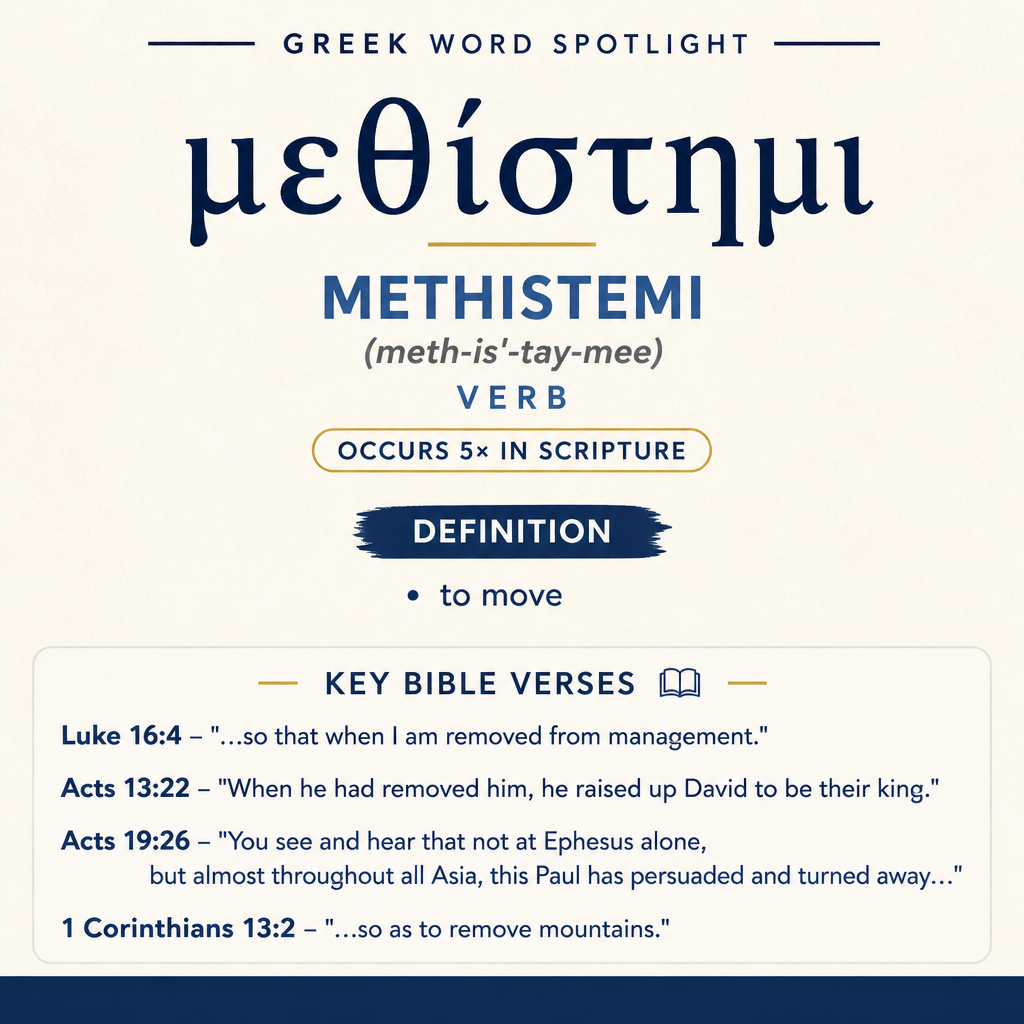
μεθίστημι means “to move” and appears five times in Scripture: Luke 16:4; Acts 13:22; Acts 19:26; 1 Corinthians 13:2; Colossians 1:13.
Core Meaning
μεθίστημι is defined as “to move.” In its listed occurrences, it is used for removal and transfer.
Learn More →Scripture Occurrences
It occurs 5 times in Scripture: Luke 16:4; Acts 13:22; Acts 19:26; 1 Corinthians 13:2; Colossians 1:13.
Learn More →Usage Snapshots
Luke 16:4 and Acts 13:22 use it for being “removed.” Colossians 1:13 uses it for being “translated” into the Kingdom.
Learn More →μεθίστημι appears in five New Testament passages where “to move” describes a change of position, role, or realm. Its uses range from an administrator’s removal from office, to the replacement of a king, to a sweeping shift in religious allegiance, to the imagined relocation of mountains, and to a decisive transfer into a kingdom.
Root and Related Words
μεθίστημι is formed from meta (μετά), “with/after” (Strong’s G3326), and histemi (ἵστημι), “to stand” (Strong’s G2476). This pairing frames movement as a change in where something stands in relation to something else—an altered placement that can be personal, political, social, or spiritual in the contexts where the verb is used.

Occurrences
“I know what I will do, so that when I am removed from management, they may receive me into their houses.’” (Luke 16:4)
Here “to move” is cast as removal from a position: the speaker anticipates being “removed from management.” The action envisioned is not self-directed travel but a change in status—he is shifted out of a role that had access and authority. The rest of the sentence shows the practical consequence of that movement: once displaced from management, he will need others to “receive” him, and so he plans ahead for a new place among “their houses.” The verb thus carries the sense of being moved out from one set of standing relationships (manager over accounts) into another (dependent on hospitality).
“When he had removed him, he raised up David to be their king, to whom he also testified, ‘I have found David the son of Jesse, a man after my heart, who will do all my will.’” (Acts 13:22)
In this narrative of kingship, “to move” describes the removal of one ruler so that another may be installed: “When he had removed him, he raised up David.” The verb marks a decisive transition at the level of leadership. The sentence places the removal alongside the raising up of David, showing the movement as an act that clears space for a new standing order. The testimony about David that follows underscores that this movement is not random; it is connected with the establishment of a king characterized by obedience (“who will do all my will”).
“You see and hear that not at Ephesus alone, but almost throughout all Asia, this Paul has persuaded and turned away many people, saying that they are no gods that are made with hands.” (Acts 19:26)
In the report about Paul’s influence, the verb is used for mass movement of people in their religious commitments: he has “persuaded and turned away many people.” The movement is portrayed as widespread (“almost throughout all Asia”) and social in scale (“many people”). What they are moved away from is defined in the clause that follows: the claim that “they are no gods that are made with hands.” The verb therefore contributes the idea of relocation in allegiance—people are shifted off one stance toward hand-made gods by persuasion, resulting in an altered public orientation that is visible and audible (“You see and hear”).
“If I have the gift of prophecy, and know all mysteries and all knowledge; and if I have all faith, so as to remove mountains, but don’t have love, I am nothing.” (1 Corinthians 13:2)
Here “to move” is attached to an extreme image: faith “so as to remove mountains.” The mountain is the clearest concrete object in the set of occurrences, and the verb sharpens the picture of relocation—something massive is moved from where it stands. Yet the verse places this dramatic movement within a larger argument about value: extraordinary capacities (prophecy, mysteries, knowledge, faith of this magnitude) still amount to “nothing” without love. The verb thus intensifies the hypothetical scenario: even the most striking movement imaginable does not establish true worth on its own within the logic of the sentence.
“who delivered us out of the power of darkness, and translated us into the Kingdom of the Son of his love,” (Colossians 1:13)
In this confession-like statement, “to move” describes a transfer between realms: “delivered us out of the power of darkness, and translated us into the Kingdom of the Son of his love.” The movement is directional and relational—out of one sphere of power and into a kingdom. The parallel phrasing (“out of… and into…”) makes the motion vivid as a crossing from one domain to another. The verb’s contribution is to present salvation as a relocation of standing: those acted upon are no longer positioned under the “power of darkness” but are placed within a different rule, the “Kingdom of the Son of his love.”
Sense and Usage
Across these passages, “to move” consistently signals a change in where someone or something stands—sometimes by removal, sometimes by transfer, sometimes by turning away, and sometimes by imagined displacement on a grand physical scale. Luke 16:4 and Acts 13:22 show movement as an administrative or political act: one is moved out of management, and a king is moved aside so another can be raised up. The subject is not an object drifting on its own; the movement is framed as something that happens to a person within an order of roles and authority.
Acts 19:26 expands the scope from individual office to communal reorientation. Movement there is bound to persuasion and public consequence: people are moved away from a claim about gods “made with hands.” The verb participates in describing a shift of stance that becomes visible in civic life (“You see and hear”), suggesting that “to move” can describe an observable re-siting of convictions, not merely a private internal adjustment.
In 1 Corinthians 13:2, “to move” is pushed into hyperbole for rhetorical force: mountains are the sort of thing that does not normally change place. The verb helps make the statement absolute in feel—if even that kind of movement were possible by faith, it would still be insufficient without love. Finally, Colossians 1:13 uses “to move” for the most encompassing relocation in these occurrences: a transfer from one power-domain into a kingdom. The movement is pictured as deliverance plus placement, so that “to move” functions as the hinge between two contrasting spheres.
Imagery
The imagery attached to “to move” in these verses ranges from the ordinary to the immense. A manager foresees being shifted out of his post (Luke 16:4); a ruler is removed and another raised up (Acts 13:22); crowds are moved away from a long-standing religious claim (Acts 19:26). At the far end, mountains are imagined as movable (1 Corinthians 13:2), and people are portrayed as relocated from darkness’s power into a kingdom (Colossians 1:13). Taken together, the verb’s imagery traces movement from social standing, to public allegiance, to the borders of realms—each scene depicting a new place to stand.
Sources: Lexical data from Strong’s Exhaustive Concordance and the Translators Brief Lexicon of Extended Strongs for Greek (STEPBible, CC BY). Occurrence data from the Translators Amalgamated Greek New Testament (STEPBible, CC BY). Scripture quotations from the World English Bible (public domain).