
Exploring the Meaning of Massaomai in Greek
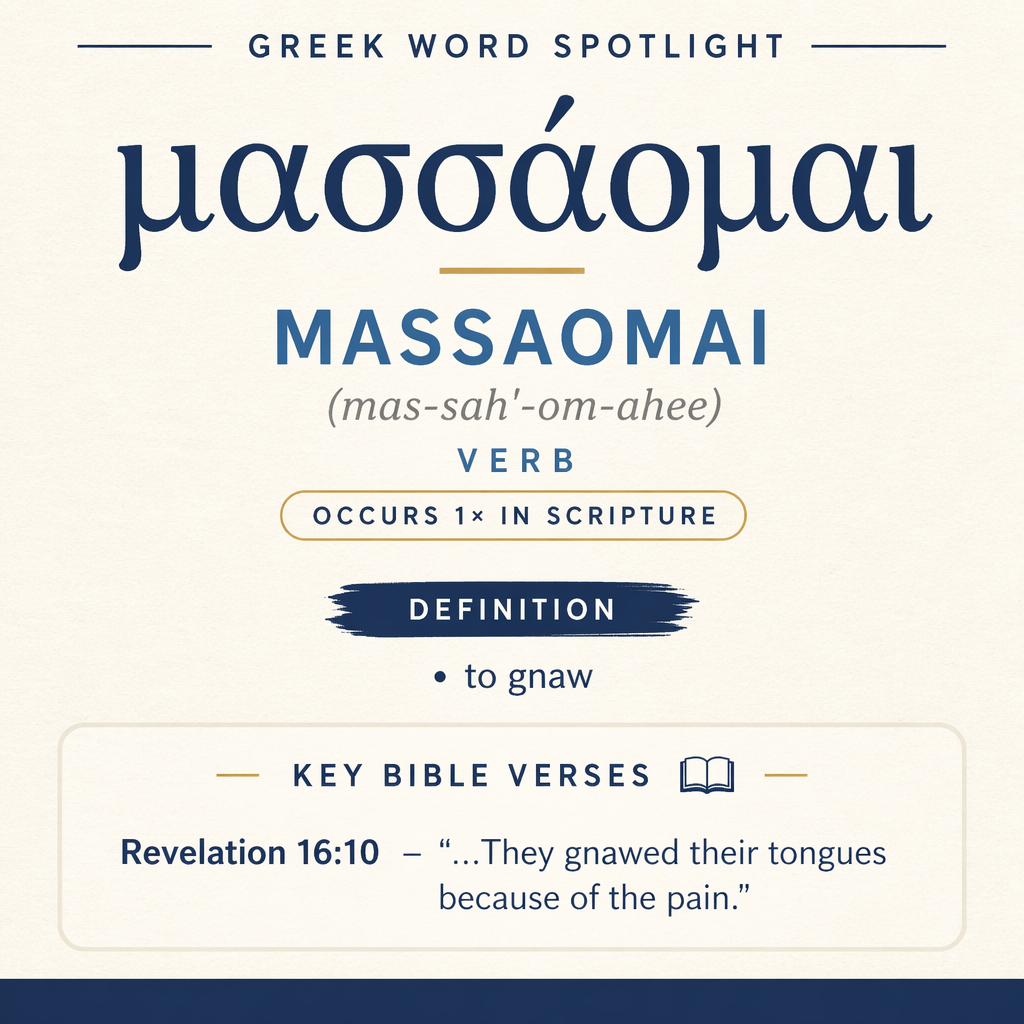
μασσάομαι means “to gnaw” and appears once in Scripture, in Revelation 16:10.
Scripture Occurrence
This verb occurs 1 time in Scripture. Its sole reference is Revelation 16:10.
Learn More →Verse Context
In Revelation 16:10, they “gnawed their tongues” as the kingdom of the beast was darkened.
Learn More →Massaomai means “to gnaw.” It appears in Revelation 16:10, describing a physical reaction to intense pain within a scene of judgment.
Occurrences
“The fifth poured out his bowl on the throne of the beast, and his kingdom was darkened. They gnawed their tongues because of the pain,” (Revelation 16:10)
In this verse the action of gnawing is narrated as a direct, bodily response to suffering: “They gnawed their tongues because of the pain.” The verb presents pain not merely as something felt inwardly but as something that drives people to an extreme, self-directed act. The object (“their tongues”) locates the action in the mouth, emphasizing a reaction that is intimate and involuntary in the sense that it springs from acute distress.
The immediate setting heightens the force of the verb. A bowl is poured “on the throne of the beast,” and the result is that “his kingdom was darkened.” Against this darkening of a kingdom, the gnawing of tongues functions as a concrete sign that the judgment has landed on persons who belong to, or are caught up in, that realm. The verb therefore contributes more than a report of injury: it supplies a vivid, observable symptom of misery within the broader description of the kingdom’s collapse into darkness.
The clause “because of the pain” ties the gnawing tightly to causation. The verse does not present gnawing as speech, protest, or deliberation, but as an action driven by pain itself. In narrative terms, the verb becomes a kind of punctuation: the scene moves from the pouring of the bowl, to the darkening of the kingdom, to the immediate human reaction that pain produces. The gnawing gives the reader an image of severity—pain so intense that the mouth turns on itself.
Sense and Usage
“To gnaw” describes a repeated, grinding action, typically associated with the teeth and mouth. In Revelation 16:10 that basic sense is applied to the tongue, a striking choice because the tongue is soft tissue and not an ordinary object of chewing. The usage therefore presses the verb into an unusually harsh image: the motion of gnawing is redirected from food to one’s own body, and the result is an embodied portrayal of agony.
The verb’s force lies in its concreteness. Rather than naming an emotion or offering an abstract measure of suffering, it depicts a specific physical act. This makes the pain communicable to the imagination: readers can picture the bodily contortion implied by “gnawed their tongues.” The action also implies duration or persistence within the moment; gnawing is not a single bite but a continuing motion, which fits the portrayal of pain as something that overwhelms normal restraint.
Within the verse’s sequence, the gnawing is not isolated but integrated into a chain of effects. The bowl is poured; the kingdom is darkened; the people respond. The verb serves as the human-side counterpart to the cosmic or political-side description (“his kingdom was darkened”). Darkness envelops the kingdom; agony grips its inhabitants. Gnawing thus becomes part of the scene’s texture, matching the external condition (darkened kingdom) with an internal, bodily torment (gnawed tongues).
The object “their tongues” also steers the sense of the verb toward the mouth as a site of suffering. The verse does not describe gnawing of hands, clothing, or the ground, but a self-inflicted act centered on the organ associated with speech. Even without adding any extra implied meaning, the selection of the tongue as the object contributes to the scene’s intensity: the pain reaches into the very instrument of ordinary human expression, turning it into the focus of torment.
Imagery
Revelation 16:10 pairs a darkened kingdom with a visceral human reaction. Massaomai supplies the tactile image: in the gloom that follows the bowl poured on the beast’s throne, people respond not with a calm description of their suffering but with the desperate act of gnawing their tongues. The result is an image of judgment felt in the body, rendered in a single, stark motion.
Sources: Lexical data from Strong’s Exhaustive Concordance and the Translators Brief Lexicon of Extended Strongs for Greek (STEPBible, CC BY). Occurrence data from the Translators Amalgamated Greek New Testament (STEPBible, CC BY). Scripture quotations from the World English Bible (public domain).





