Exploring the Meaning of Lusitelei in Greek
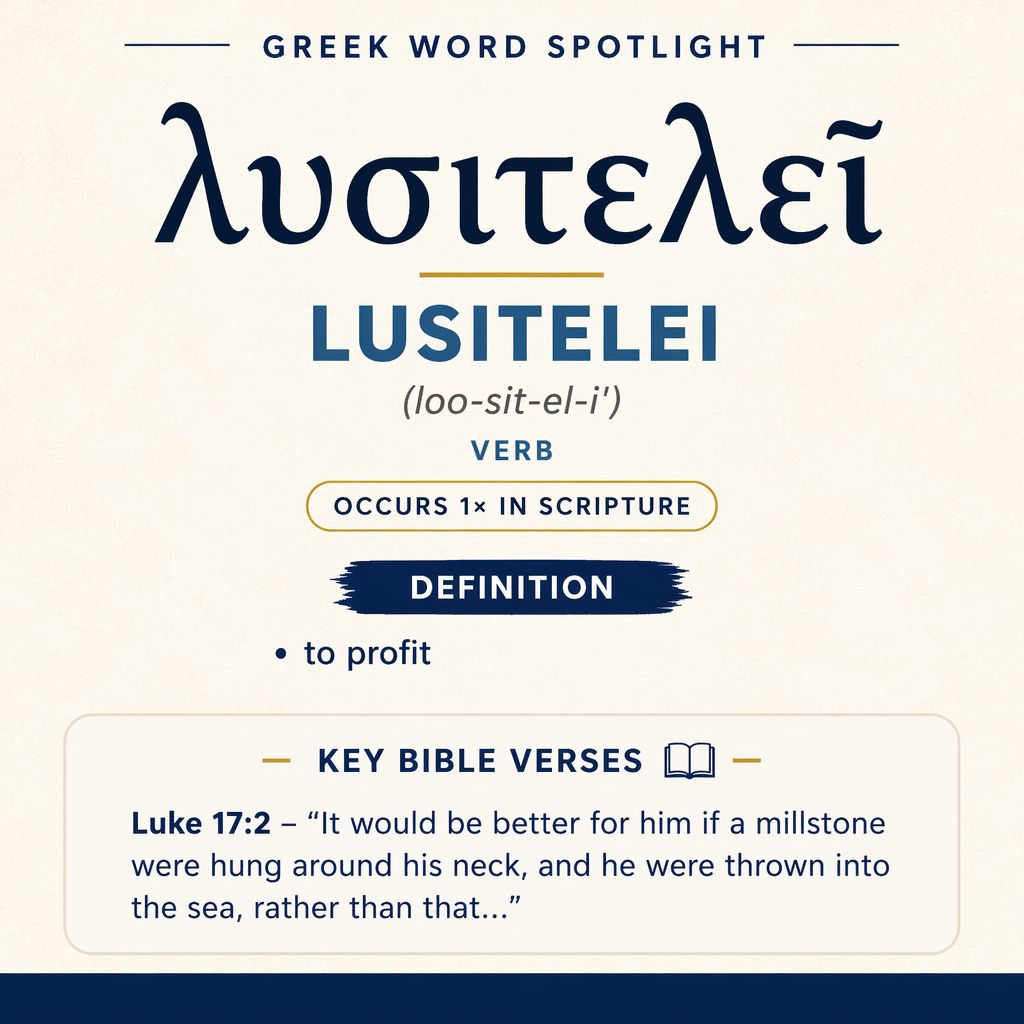
λυσιτελεῖ means “to profit” and appears once in Scripture, in Luke 17:2.
Scripture Occurrence
This word occurs 1 time in Scripture. Its occurrence is in Luke 17:2.
Learn More →Verse Context
In Luke 17:2, it appears in a statement contrasting what would be “better for him.”
Learn More →λυσιτελεῖ means “to profit,” and it appears once in the New Testament, in Jesus’ warning about causing “little ones” to stumble (Luke 17:2). In that saying, the verb helps frame the comparison in terms of what is truly advantageous for the offender.
Root and Related Words
λυσιτελεῖ is related (per Strong’s) to the noun λύσις (lysis, “divorce”; Strong’s G3080) and to τέλος (telos, “goal/tax”; Strong’s G5056). These related terms supply the broader lexical neighborhood in which λυσιτελεῖ is placed.

Occurrences
“It would be better for him if a millstone were hung around his neck, and he were thrown into the sea, rather than that he should cause one of these little ones to stumble.” (Luke 17:2)
In Luke 17:2, the saying sets up a stark comparison: one outcome is pictured with chilling physical concreteness—“a millstone … hung around his neck” and being “thrown into the sea.” The other outcome is moral and relational—“that he should cause one of these little ones to stumble.” Within that structure, λυσιτελεῖ functions as the pivot word that turns the statement into a calculation of advantage: what would “profit” the person addressed, what would be “better for him,” when two dire alternatives are placed side by side.
The verb’s contribution is not to soften the warning but to sharpen it. The imagery of the millstone and the sea evokes an irreversible, catastrophic end; yet the saying asserts that even such an end is “better” than becoming the agent of another’s stumbling. By using the language of benefit, the sentence forces the listener to weigh outcomes not by comfort or immediate self-preservation but by the severe moral gravity of harming “one of these little ones.” The profit-language presses the point that the offender’s supposed gain in acting without restraint is illusory; in this comparison, the only “better” option is the one that avoids making another fall.
Also, the wording “for him” places the assessment directly on the offender’s own interest. The statement is not framed first as what benefits the “little ones,” though they are the endangered party; it is framed as what benefits the one tempted to disregard them. λυσιτελεῖ therefore serves the rhetorical strategy of confronting self-interest head on: even if someone thinks in terms of what helps himself, he must admit that causing a vulnerable person to stumble is the worst bargain imaginable in this saying’s moral arithmetic.
Sense and Usage
With the sense “to profit,” λυσιτελεῖ belongs to the sphere of advantage, benefit, and what comes out well for someone. In Luke 17:2, that sense is expressed through comparative language: “It would be better for him … rather than …” The statement does not invite a detached reflection on profit; it uses the concept to deliver a warning that reframes what “profit” can mean when moral responsibility is in view.
The comparison is constructed to overturn ordinary assumptions about what benefits a person. A millstone hung around the neck and being cast into the sea is presented as the “better” alternative—better in the sense of what “profits” the person—when set against the act of causing a “little one” to stumble. In other words, “profit” is not attached to a pleasant or successful outcome in the common sense. Instead, the verb’s sense is employed to declare that some actions are so destructive that even a horrifying fate could be considered more advantageous than being guilty of them.
The language of profit also gives the saying a judicial flavor without turning it into a technical courtroom scene: the person’s “better” outcome is weighed in light of the consequence implied by the moral harm described. The word helps make the warning personal and immediate. The offender is not merely told that the act is wrong; he is confronted with the claim that, from the standpoint of his own well-being, he gains nothing by it. The act cannot be defended as “worth it.”
Finally, λυσιτελεῖ in this context is tethered to a relational harm: “cause one of these little ones to stumble.” The profit that is being evaluated is not profit from business or achievement but profit as the net outcome of one’s treatment of others. By placing profit-language alongside the protection of “little ones,” the saying makes moral responsibility the decisive factor in what counts as truly beneficial for the self.
Imagery
The only occurrence pairs λυσιτελεῖ with a vivid image: the weight of a “millstone” and the finality of being “thrown into the sea” (Luke 17:2). That imagery supplies the emotional force behind the comparison of what “profits” a person. The verb draws the listener into measuring advantage against an unbearable picture, so that the mind feels the disproportion: the physical horror described is treated as the lesser evil when weighed against the moral act of making a “little one” fall.
Sources: Lexical data from Strong’s Exhaustive Concordance and the Translators Brief Lexicon of Extended Strongs for Greek (STEPBible, CC BY). Occurrence data from the Translators Amalgamated Greek New Testament (STEPBible, CC BY). Scripture quotations from the World English Bible (public domain).