Exploring the Meaning of Lusis in Greek
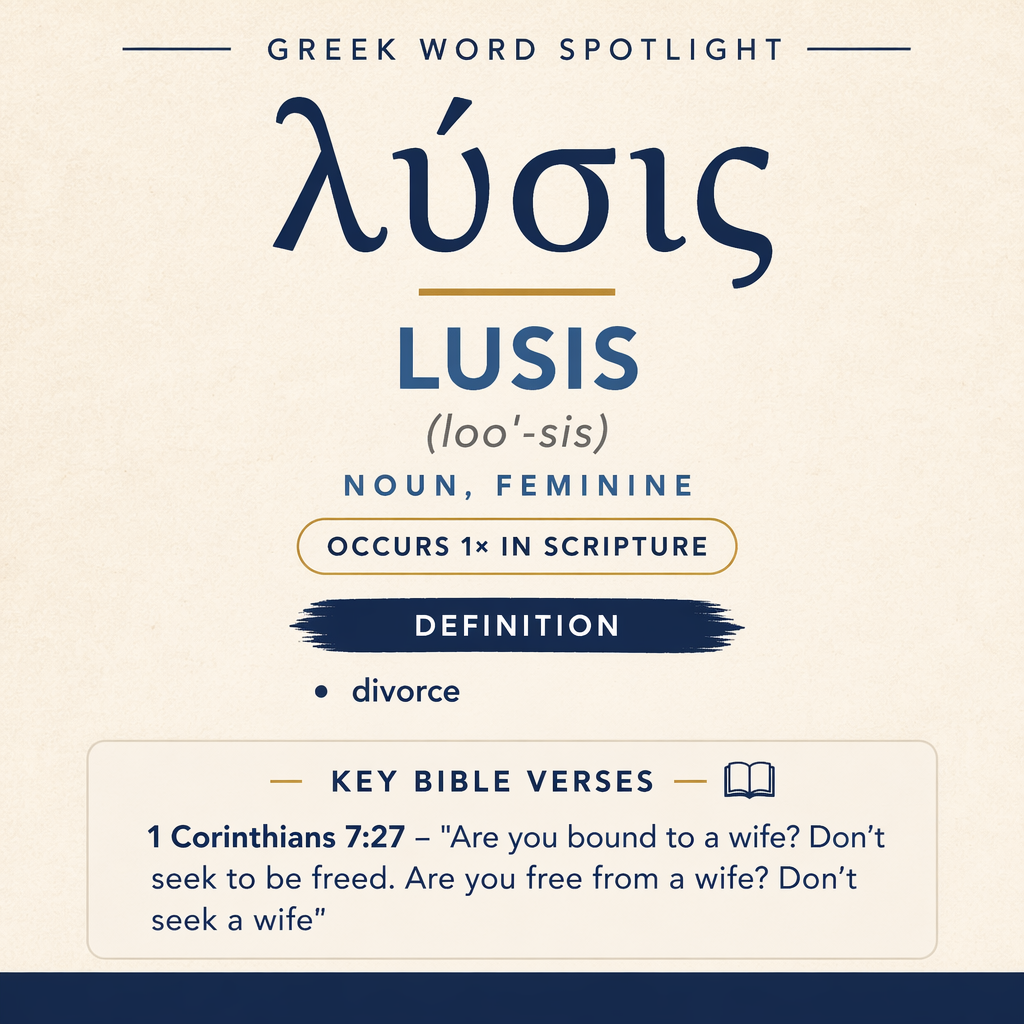
λύσις means “divorce” and appears once in Scripture, in 1 Corinthians 7:27.
Verse Context
In 1 Corinthians 7:27, it is used with the idea of being “freed” from a wife.
Learn More →λύσις means “divorce,” and it appears once in the New Testament, in Paul’s counsel about marital status in 1 Corinthians 7:27. In that single setting, it functions as a key term in a pair of parallel questions that frame what a person should and should not pursue.
Root and Related Words
λύσις is related to the verb lyo (λύω), “to loose” (Strong’s G3089). The connection to “loosing” supplies the verbal picture behind the noun: a state described in terms of release or untying, which in this entry’s usage is specified as divorce.

Occurrences
Are you bound to a wife? Don’t seek to be freed. Are you free from a wife? Don’t seek a wife. (1 Corinthians 7:27)
In this verse, λύσις stands behind the idea expressed in English as being “free from a wife” and contrasts with being “bound to a wife.” The line is built as a mirrored pair: first, a person is addressed in a condition of being “bound,” and the instruction is, “Don’t seek to be freed.” Second, a person is addressed in the opposite condition of being “free,” and the instruction is, “Don’t seek a wife.” Within that balanced structure, λύσις names the condition in view when someone is “free from a wife”—a condition Paul treats as a real, recognized status, not merely a passing feeling or private preference. The vocabulary of binding and freeing presents marriage and its dissolution in relational terms of attachment and release, and λύσις supplies the concrete category of that release: divorce.
The verse also shows how λύσις is used within moral exhortation. The questions are not information-seeking; they are rhetorical prompts that place the reader into one of two states and then give a corresponding directive. In that context, λύσις helps define what the directive is about. Paul does not instruct a person who is “bound to a wife” to pursue the status that λύσις denotes (“Don’t seek to be freed”). Likewise, he does not instruct a person who already has that status (“free from a wife”) to pursue the opposite relational state (“Don’t seek a wife”). The term thus carries weight as a social and relational condition that could be sought or not sought, and Paul’s counsel addresses the pursuit of that condition rather than merely naming it.
Sense and Usage
The sense “divorce” in this passage is framed by a relational contrast: “bound to a wife” versus “free from a wife.” That framing matters for how the word functions. λύσις is not introduced in isolation, but as the counterpart to binding; it is the named state of being released from the marital bond. As a noun, it describes a situation a person may already be in (“Are you free from a wife?”) and a situation a person might attempt to bring about (“Don’t seek to be freed”). In other words, the verse treats divorce not only as a past event but as an ongoing condition in which someone can be found.
The immediate grammar of the verse communicates that λύσις is considered a definable status with practical implications. The two halves of the verse are parallel in both their questions and their imperatives. That parallelism does not merely create style; it organizes the moral reasoning. By pairing “bound” with “do not seek to be freed” and “free” with “do not seek a wife,” the verse treats both states as points from which a person can live without a new quest to reverse the state. In that setting, λύσις works as the label for one of those states—the state that stands opposite being bound to a wife.
Because λύσις occurs here only once, its usage is best understood by attending closely to the way Paul places it within a symmetrical counsel. The verse is not a general dictionary statement about divorce; it is an application of pastoral direction to two life conditions. λύσις therefore carries a pragmatic force: it names a condition that can tempt a person either to pursue it (“be freed”) or to immediately move beyond it (“seek a wife”). Paul’s counsel, as expressed here, discourages both kinds of pursuit: the person bound should not chase release, and the person released should not chase a new marriage. Within the logic of the verse, λύσις is the pivot point that distinguishes those two audiences.
The wording also implies that λύσις is understood socially as “from a wife.” The phrase “free from a wife” describes the divorce condition with a relational complement, not as an abstract legal category detached from persons. That keeps the meaning anchored to the marital relationship itself: it is freedom with respect to one’s tie to a wife. Thus, even while the term denotes divorce, the verse presents it through the interpersonal reality it affects—bond and release in relation to a spouse.
Imagery
1 Corinthians 7:27 casts λύσις in the imagery of fastening and unfastening. A person is either “bound” or “free,” and the counsel addresses whether one should actively pursue a change in that binding. In that single line, divorce is pictured not by courtroom language or documentation but by the simple, tangible contrast between being tied and being loosed—language that makes the relational change feel concrete and weighty within everyday life.
Sources: Lexical data from Strong’s Exhaustive Concordance and the Translators Brief Lexicon of Extended Strongs for Greek (STEPBible, CC BY). Occurrence data from the Translators Amalgamated Greek New Testament (STEPBible, CC BY). Scripture quotations from the World English Bible (public domain).