Exploring the Meaning of Lusanias in Greek
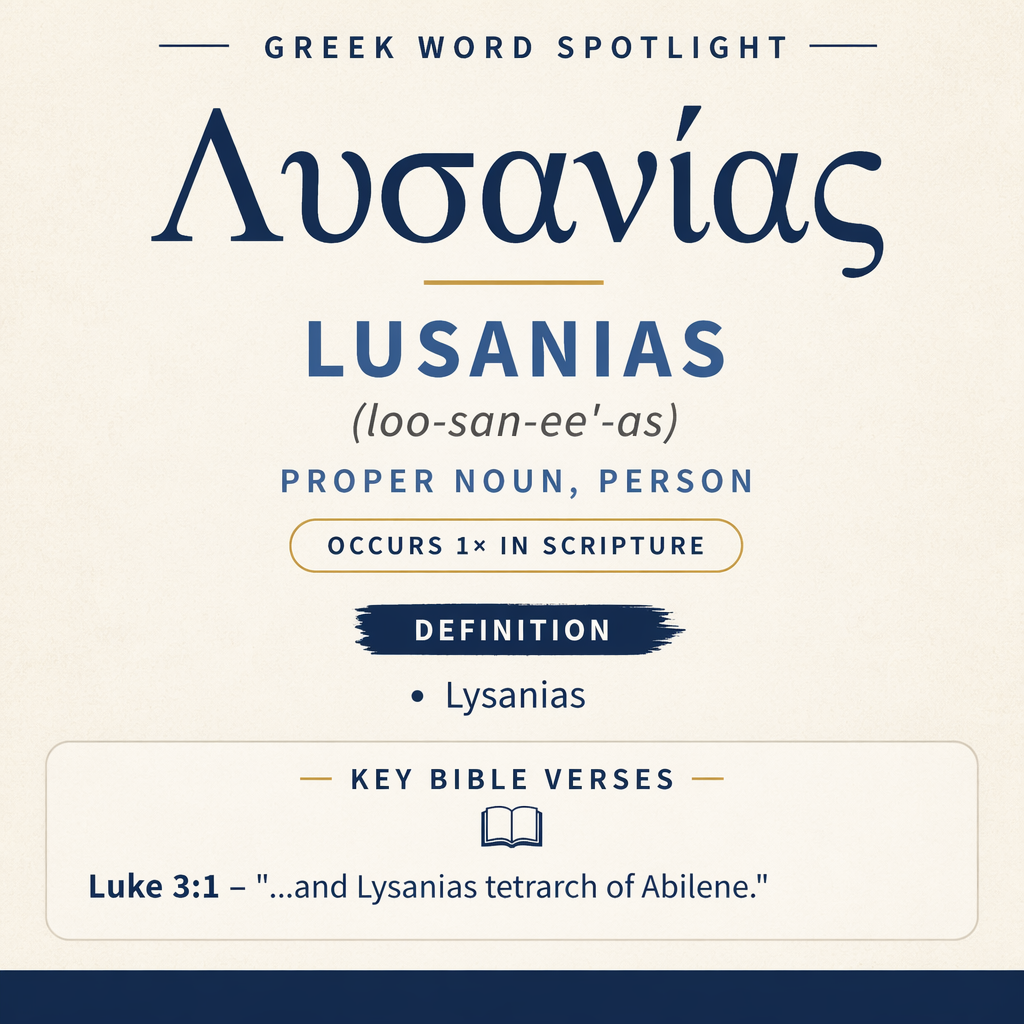
Λυσανίας means “Lysanias” and appears once in Scripture in Luke 3:1.
Biblical Occurrence
This word occurs 1 time in Scripture. The occurrence is in Luke 3:1.
Learn More →Verse Context
In Luke 3:1, Λυσανίας appears within a listing of rulers and officials. The verse begins, “Now in the fifteenth year of the reign of Tiberius Caesar...”
Learn More →Λυσανίας refers to Lysanias and appears in a single New Testament setting: a formal dating notice that situates John’s public emergence within a wider political landscape. In that sentence, the name functions as one item in a structured list of rulers and jurisdictions.
Root and Related Words
Λυσανίας is presented in relation to λύσις (lysis), “divorce” (Strong’s G3080).

Occurrences
“Now in the fifteenth year of the reign of Tiberius Caesar, Pontius Pilate being governor of Judea, and Herod being tetrarch of Galilee, and his brother Philip tetrarch of the region of Ituraea and Trachonitis, and Lysanias tetrarch of Abilene,” (Luke 3:1)
In Luke 3:1, “Lysanias” is introduced with an official title and a defined territory: “tetrarch of Abilene.” The name does not stand alone as a personal identifier; it is embedded in an administrative description that links person, office, and region. Luke places Lysanias alongside figures named with comparable specificity—Tiberius Caesar with his “reign,” Pontius Pilate as “governor of Judea,” Herod as “tetrarch of Galilee,” and Philip as “tetrarch of the region of Ituraea and Trachonitis.” Within that rhythm, “Lysanias tetrarch of Abilene” supplies one more coordinate on the map of authority that frames the narrative moment.
The list is constructed by a repeated pattern (“being governor… being tetrarch… tetrarch of…”), which makes Lysanias part of a synchronized catalog of contemporary leadership. The effect is to situate the coming events in a recognizably public world: multiple jurisdictions, multiple officeholders, and a patchwork of regions. By naming Lysanias and attaching him to Abilene, the verse narrows from imperial (“Tiberius Caesar”) through provincial (“Judea,” “Galilee”) into additional regional domains. Lysanias, therefore, contributes to the verse’s purpose as a time-and-place marker, adding another layer of geographic and governmental context to the date line.
Sense and Usage
As a proper name, Λυσανίας functions to identify a specific person without carrying its own descriptive content in the sentence. Luke’s usage is not casual; it is formal and documentary in tone, pairing the name with a role (“tetrarch”) and a locality (“Abilene”). The definition “Lysanias” fits this use precisely: the word’s contribution is referential, anchoring the narrative to a named ruler who belongs to the wider set of rulers enumerated in the same breath.

The placement of Lysanias at the end of the verse is also significant for how the name is heard. Luke’s sentence accumulates authority figures in descending or branching scope—emperor, governor, tetrarchs—so that each added name tightens the chronological and geographical frame. Lysanias is not introduced with family connections (as Philip is identified as “his brother” in relation to Herod) but with jurisdictional definition. In that way the name is presented through office rather than lineage: Lysanias is known here by the public responsibility that situates him among other rulers.
Because the word occurs only in this setting, its semantic footprint in Scripture is concentrated: it serves Luke’s opening historical scaffold. The narrative energy of Luke 3:1 lies in its coordinated naming of authorities; within that coordination, Λυσανίας carries the same kind of weight as the other names—an official point of reference. The verse is built to be read as a calendar-and-map statement, and Lysanias is one of the fixed points that makes the statement concrete and accountable to the world of rulers and regions.
Imagery
The single use of Λυσανίας evokes the imagery of governance arranged across territories: named officials set over named places, each connected to a defined sphere. In Luke 3:1, Lysanias is pictured not through personal actions but through the administrative landscape implied by “tetrarch of Abilene,” a reminder that the story is introduced against a backdrop of structured public authority.
Sources: Lexical data from Strong’s Exhaustive Concordance and the Translators Brief Lexicon of Extended Strongs for Greek (STEPBible, CC BY). Occurrence data from the Translators Amalgamated Greek New Testament (STEPBible, CC BY). Scripture quotations from the World English Bible (public domain).