
Exploring the Meaning of Lepsis in Greek
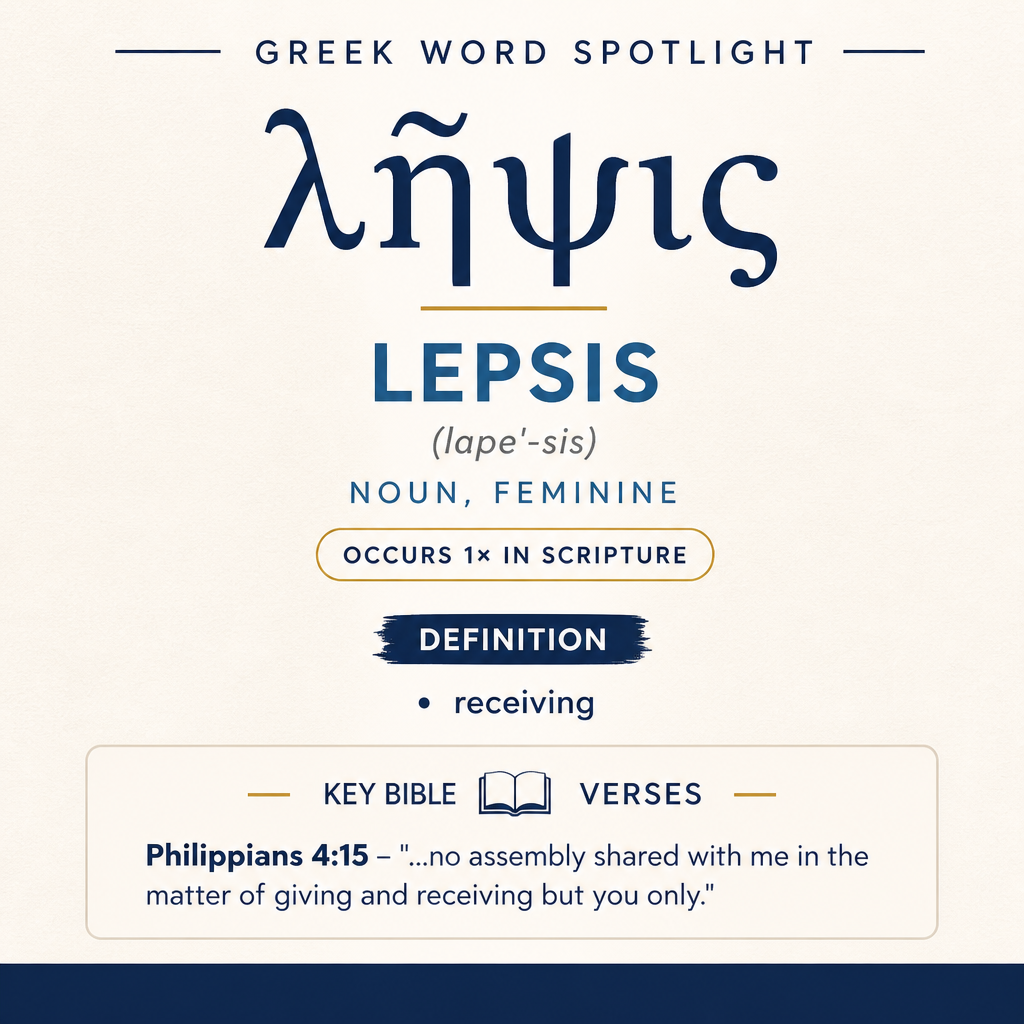
λῆψις (Lepsis) means “receiving” and appears once in Scripture, in Philippians 4:15.
Scripture Occurrence
This word occurs 1 time in Scripture. Its occurrence is in Philippians 4:15.
Learn More →Verse Context
In Philippians 4:15, it appears in Paul’s address to the Philippians. The verse begins, “You yourselves also know, you Philippians…”
Learn More →λῆψις means “receiving” and appears once in the New Testament, in Paul’s closing remarks to the Philippian assembly. In that setting it belongs to a paired expression that frames their support in terms of an exchange.
Root and Related Words
λῆψις derives from the verb lambano (λαμβάνω), “to take” (Strong’s G2983). The noun form presents the idea in a nominal way, focusing attention on the act or matter described rather than on a specific action carried out by a particular subject.

Occurrences
“You yourselves also know, you Philippians, that in the beginning of the Good News, when I departed from Macedonia, no assembly shared with me in the matter of giving and receiving but you only.” (Philippians 4:15)
Here λῆψις stands in a deliberately balanced pair: “giving and receiving.” The phrase “shared with me” places the relationship in a concrete, mutual frame. Paul is not describing a one-sided transfer that leaves only a donor and a beneficiary; he describes a shared “matter” in which two complementary sides are named. Within that shared matter, λῆψις marks the “receiving” side of the relationship, set alongside “giving” as the other side of the same exchange.
The surrounding details sharpen how the word functions. Paul points to a known historical moment—“in the beginning of the Good News, when I departed from Macedonia”—and he compares the Philippians’ conduct with that of “no assembly” other than them. In that contrast, λῆψις helps specify what kind of participation is in view: not mere interest, not mere agreement, but tangible involvement describable in paired terms. The Philippians are singled out as the only assembly that “shared with me” in that particular “matter,” so “receiving” belongs to a relationship that is recognizable, discussable, and remembered by both parties (“You yourselves also know”).

The verse also frames this participation as something that can be discussed almost like an account or category of interaction: “the matter of giving and receiving.” In that construction, λῆψις contributes a defined side of the “matter,” naming the receiving aspect as a recognizable component of the shared exchange. The point is not to dwell on the mechanics of how that receiving occurred, but to identify that the relationship included it—and that this kind of shareable exchange was distinctive to the Philippians at that stage.
Sense and Usage
The single New Testament use of λῆψις places “receiving” in a relational, paired construction rather than as an isolated act. The word functions as a counterpart to “giving,” and together the two terms describe a structured kind of participation. In Philippians 4:15, “receiving” is not presented as an accident or a private event; it is part of a named “matter” in which an assembly can “share” with an apostolic worker. The sentence structure treats this “matter” as something that characterizes a community’s pattern of support: it is remembered, it can be compared across assemblies, and it can be singled out as distinctive (“but you only”).
Because λῆψις appears joined to its counterpart, it helps mark the reciprocity implied in “sharing.” Paul’s wording does not reduce the relationship to one direction; instead, the “matter” has two sides that belong together. Within the verse, that pairing allows Paul to speak about the Philippians’ unique participation without narrating every specific instance of what was given or what was received. The noun “receiving” serves as a compact label for one half of a relationship that can be invoked with a single phrase.
The immediate context also places “receiving” within the timeline of gospel mission: “in the beginning of the Good News, when I departed from Macedonia.” This anchors the term in the concrete realities of movement and ministry. λῆψις thus names the receiving side of a partnership that took place at a particular stage (“in the beginning”) and during a transition (“when I departed”). The noun provides a way to speak about how material or practical support intersected with mission activity, without shifting the verse into a detailed report; it remains a remembered and acknowledged category of shared action.
Finally, the contrast “no assembly … but you only” shows that for Paul this “receiving” belonged to a discernible pattern of ecclesial behavior. λῆψις is not merely personal; it is the kind of thing that can be attributed to an “assembly” as a body. In this use, the term is socially located: it operates in the space between giver and receiver, between Paul and the Philippian assembly, and between one assembly and another in the comparison Paul draws.
Imagery
Philippians 4:15 evokes the picture of a partnership carried out through concrete exchange: “sharing” in a “matter” that has two named sides. λῆψις contributes the receiving side of that picture, set beside giving to express a relationship remembered from the earliest days of the Philippians’ involvement in the gospel work.
Sources: Lexical data from Strong’s Exhaustive Concordance and the Translators Brief Lexicon of Extended Strongs for Greek (STEPBible, CC BY). Occurrence data from the Translators Amalgamated Greek New Testament (STEPBible, CC BY). Scripture quotations from the World English Bible (public domain).





