Exploring the Meaning of Lepra in Greek
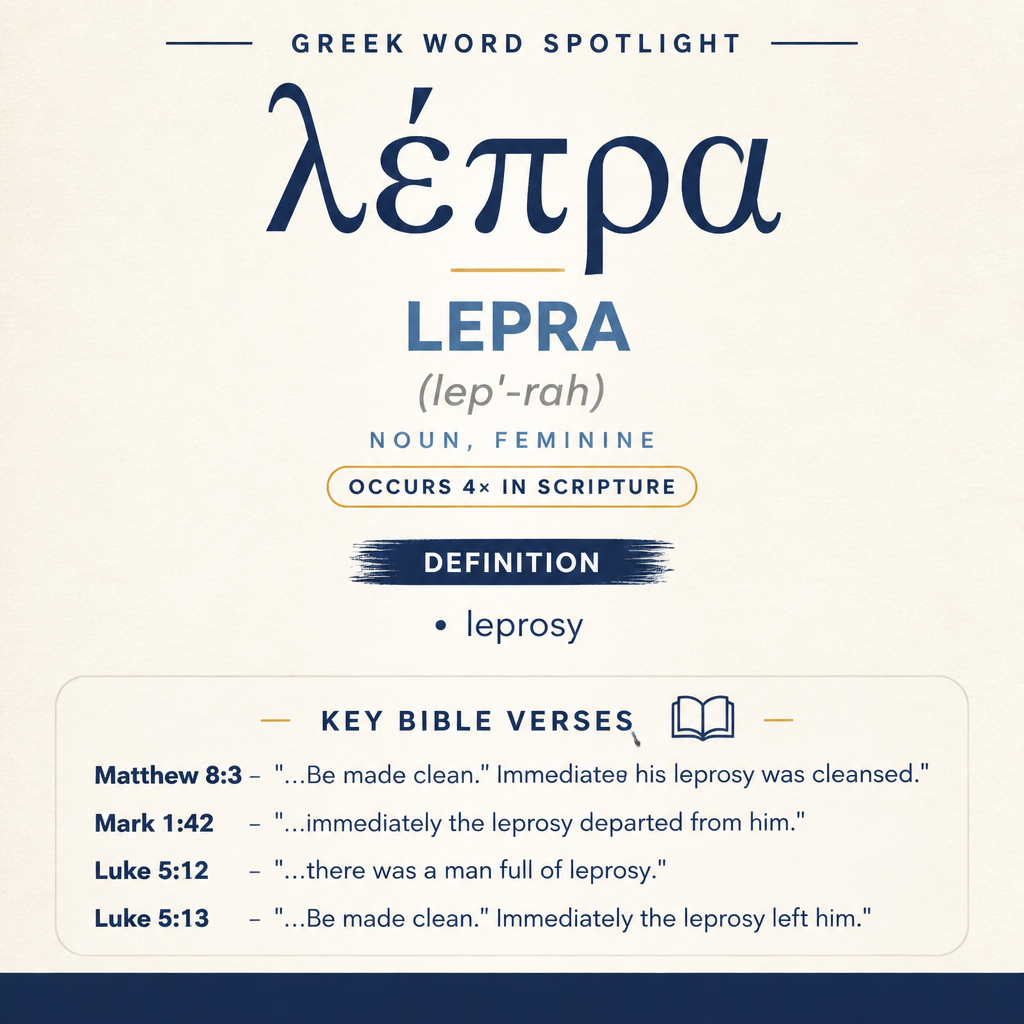
λέπρα means “leprosy” and appears four times in the New Testament: Matthew 8:3, Mark 1:42, and Luke 5:12–13.
Gospel Occurrences
It occurs 4 times in Scripture in Matthew 8:3, Mark 1:42, and Luke 5:12–13.
Learn More →Narrative Context
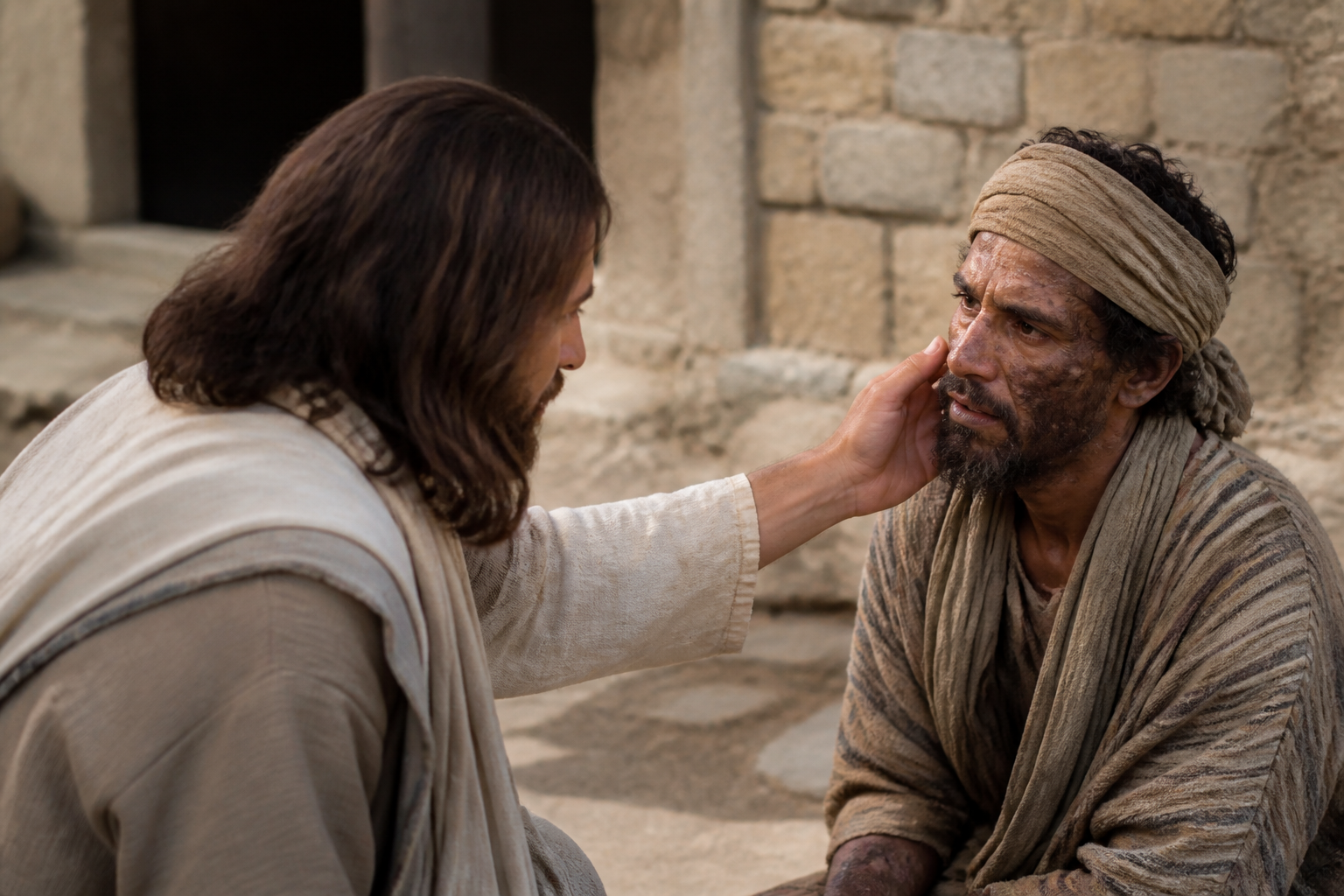
In Matthew 8:3, Mark 1:42, and Luke 5:13, Jesus’ touch is followed by the leprosy being cleansed or leaving immediately.
Learn More →λέπρα refers to leprosy, named in Gospel scenes where Jesus responds to a sufferer’s plea and the condition is removed. In its four appearances, the word is bound to the moment of cleansing and to the visible change described as immediate.
Root and Related Words
λεπίς (lepis), “scale” (Strong’s G3013), stands in lexical relation to λέπρα.
Occurrences
“Jesus stretched out his hand, and touched him, saying, “I want to. Be made clean.” Immediately his leprosy was cleansed.” (Matthew 8:3)
Here λέπρα is the named condition that is directly acted upon in the same breath as Jesus’ touch and command. The narrative places the word at the climax of the encounter: the hand is stretched out, the man is touched, and the result is that “his leprosy was cleansed.” The phrasing ties the condition closely to uncleanness and to a reversal described in clean/cleansed terms, making λέπρα the concrete marker of what changes in the man’s body and social state in that instant. The adverb “Immediately” further frames the condition as something that can depart at once under Jesus’ word.

“When he had said this, immediately the leprosy departed from him, and he was made clean.” (Mark 1:42)
Mark presents λέπρα as something that can “depart,” portraying the condition almost as a tangible presence that can leave a person. The clause pairs two descriptions of the result: the leprosy’s departure and the man being “made clean.” In this scene the word functions as the identifiable burden that lifts, while the accompanying statement (“he was made clean”) tells what that departure means for the person as a whole. The repetition of “immediately” keeps λέπρα within the narrative pattern of swift transformation: speech, then change, without delay.
“While he was in one of the cities, behold, there was a man full of leprosy. When he saw Jesus, he fell on his face, and begged him, saying, “Lord, if you want to, you can make me clean.”” (Luke 5:12)
Luke’s introduction foregrounds the severity by describing “a man full of leprosy,” using the word to characterize the man’s condition as extensive rather than incidental. The description sets the emotional and physical stakes before any action occurs: the man’s response—falling on his face and begging—matches the gravity implied by being “full of leprosy.” The man’s request does not name λέπρα again but expresses its consequence through the language of cleansing: “you can make me clean.” In this way λέπρα anchors the scene’s problem, while “clean” provides the hoped-for outcome. The conditional “if you want to” places emphasis on Jesus’ will, but the man’s confidence is stated in terms of ability: Jesus “can” bring the condition’s opposite.
“He stretched out his hand, and touched him, saying, “I want to. Be made clean.” Immediately the leprosy left him.” (Luke 5:13)
This verse completes the movement begun in the previous one. λέπρα is the condition that “left him,” again expressed as something removable, and it is linked tightly to Jesus’ touch and command. Luke narrates the sequence with minimal distance between command and outcome: Jesus states willingness (“I want to”), issues the imperative (“Be made clean”), and then “Immediately the leprosy left him.” By naming λέπρα at the end, Luke makes the departure of the disease the visible proof that the cleansing command has taken effect. The scene’s language turns the abstract request for cleanness into a concrete description: what cleanness looks like is the leaving of leprosy.
Sense and Usage
Across these four passages, λέπρα functions as a plainly identified affliction whose presence defines a person’s need and whose removal signals restoration. The word is never treated as a distant diagnosis; it is the condition that can be “cleansed,” “depart,” or “leave,” each verb giving a slightly different narrative angle on the same reality. “Cleansed” highlights the result as purification language, while “departed” and “left” depict the condition’s disappearance in spatial terms, as though it withdraws from the body it has occupied.
The narratives also consistently bind λέπρα to immediate change. Matthew and Luke both place “Immediately” alongside the healing outcome, and Mark repeats the same temporal emphasis. This repeated framing does more than indicate speed; it makes the disappearance of λέπρα the decisive moment by which the reader recognizes that Jesus’ touch and speech have accomplished what the sufferer sought.
Another repeated feature is the coupling of λέπρα with the vocabulary of cleanness. Mark explicitly adds, “and he was made clean,” and the plea in Luke 5:12 is framed as “make me clean,” which the next verse answers. Matthew likewise concludes with “his leprosy was cleansed.” The effect is that λέπρα is presented not only as a physical condition but as one that is naturally spoken of in relation to being clean. In these scenes, the word draws the reader’s attention to a condition that affects how a person is regarded and approached, and the cleansing language emphasizes that the change is not merely private relief but a transition into a state described as clean.
Finally, Luke’s phrase “full of leprosy” shows that λέπρα can be used to describe extent and intensity. It is not merely that the man has the condition; the condition pervades him. This sets up the later statement that it “left him” as a complete reversal: what filled him is now gone.
Imagery
In these passages λέπρα carries the imagery of something clinging to a person and then suddenly releasing its hold. The repeated picture is bodily and immediate: a hand stretched out, contact made, a brief spoken command, and then leprosy described as cleansed or as leaving. The word thus sits at the intersection of touch, speech, and visible change, marking the moment when the sufferer’s condition is reversed in front of others.
Sources: Lexical data from Strong’s Exhaustive Concordance and the Translators Brief Lexicon of Extended Strongs for Greek (STEPBible, CC BY). Occurrence data from the Translators Amalgamated Greek New Testament (STEPBible, CC BY). Scripture quotations from the World English Bible (public domain).