Exploring the Meaning of Lepis in Greek
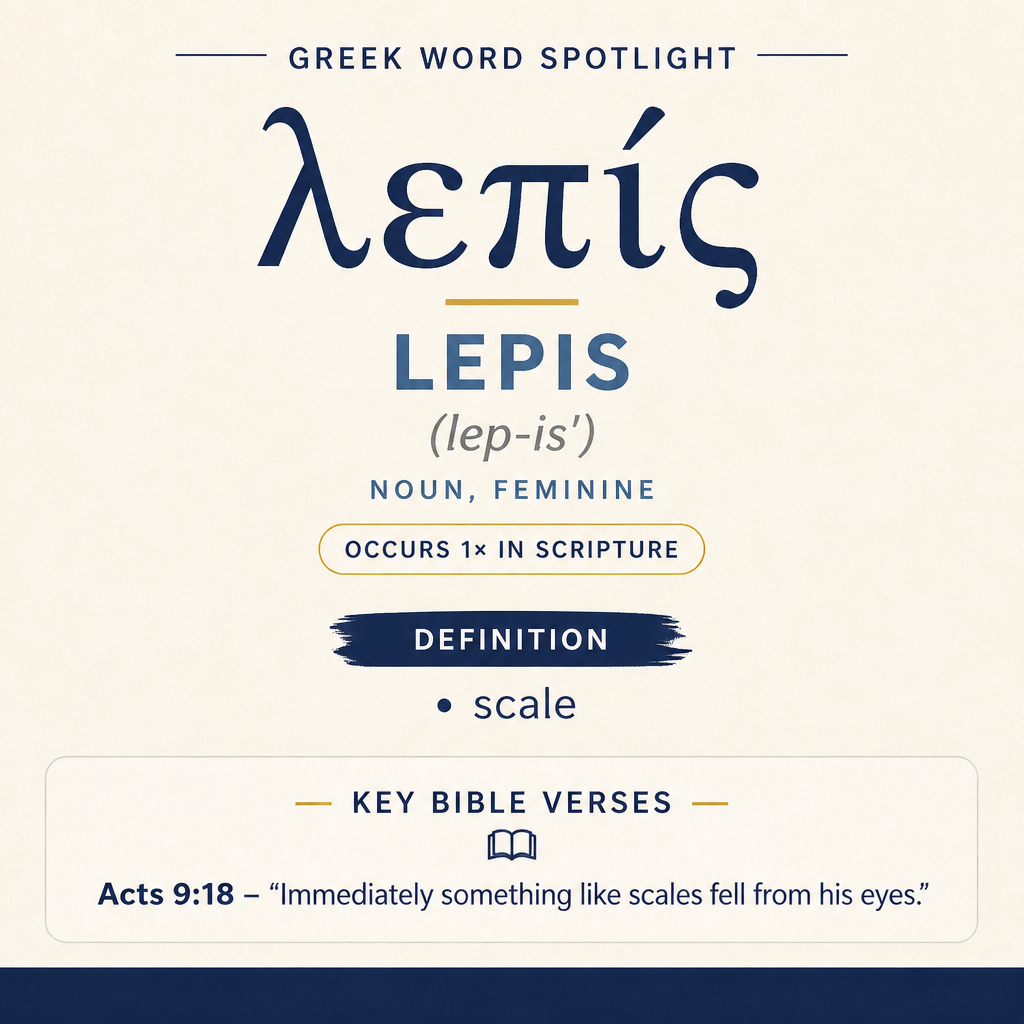
λεπίς means “scale” and appears once in Scripture, in Acts 9:18.
Context in Acts
In Acts 9:18, “something like scales” fell from his eyes. He received his sight, arose, and was baptized.
Learn More →λεπίς means “scale,” and it appears in the account of Saul’s recovery of sight after Ananias’s visit. The word is used to describe what fell away from his eyes in the moment his sight returned.
Occurrences
“Immediately something like scales fell from his eyes, and he received his sight. He arose and was baptized.” (Acts 9:18)
In Acts 9:18, λεπίς supplies the concrete image that makes the restoration of sight both vivid and bodily. The sentence opens with urgency—“Immediately”—and then describes the change with a comparison: “something like scales fell from his eyes.” The noun gives a tangible shape to what is removed: not merely an undefined obstruction, but a detachable layer pictured as “scales.” The action assigned to this obstruction is equally physical: it “fell,” implying separation and downward movement away from the eyes. That description frames the next clause—“and he received his sight”—as the direct consequence of the falling away. By choosing this noun, the verse depicts the healing as an event that can be narrated in terms of visible, material change (a removal) rather than only an internal or invisible shift.
The word also functions within a sequence of linked actions. First comes the falling of the “scales,” then the reception of sight; next, “He arose,” and finally “was baptized.” λεπίς therefore stands at the threshold of a new set of actions by marking the moment when the former limitation is lifted. The narrative does not pause to explain the nature of the “scales”; it simply uses the image to anchor the turning point in a single sensory detail. Within the verse’s tight progression, that detail signals that the obstacle to seeing is treated as something that can come off, not something permanent.

Sense and Usage
The sense “scale” is activated here through a simile: “something like scales.” Even while the verse compares rather than directly equates, the image works because “scales” are readily imagined as small, layered pieces that can cover a surface. In this verse, the “scales” belong to the area of the eyes, so the noun’s concrete meaning is recruited to portray a covering that interferes with sight. The emphasis falls on removal: what matters is not the detailed appearance of the “scales,” but the fact that they are a kind of covering that can detach and drop away.
Because λεπίς is used in a comparison (“something like”), the word carries descriptive force without requiring the reader to treat the “scales” as a precise anatomical claim in the sentence itself. The comparison allows the narrator to express the event in accessible, pictorial language: the return of sight is narrated as though a thin, scale-like layer had been on the eyes and then came off. The resulting effect is clarity of sequence and impact—obstruction removed, sight restored—using a noun that belongs to ordinary physical description.
Within Acts 9:18, the noun’s concreteness also makes the restoration of sight narratively decisive. The verse does not say only that Saul “received his sight”; it shows the transition by describing something that “fell from his eyes.” λεπίς contributes to that “before-and-after” structure. Before: an eye-covering pictured as “scales.” After: “he received his sight.” The noun thus serves as a hinge term: it names (by image) what is taken away, and by doing so it strengthens the causal link between the removal and the regained ability to see.
In addition, the placement of the phrase “fell from his eyes” attaches the imagery tightly to the body. The word is not used in isolation but embedded in a description of eyes, falling, and receiving sight. That linkage keeps the sense grounded in the immediate physical scene. At the same time, the verse moves straight on to standing up and baptism, so the word’s role is brief but weighty: it marks the moment of change that precedes the next actions. In the economy of the sentence, “scales” is the single image that the reader can picture, and it carries the transition from impairment to restored sight.
Imagery
Acts 9:18 places the reader in a moment where healing is pictured as the shedding of a covering. “Scales” falling from eyes evokes the sensation of release—something that had clung now drops away—and the narrative immediately ties that release to the ability to see: “and he received his sight.” The image is short, domestic, and physical, and its simplicity supports the verse’s swift movement into the next steps: rising and baptism.
Sources: Lexical data from Strong’s Exhaustive Concordance and the Translators Brief Lexicon of Extended Strongs for Greek (STEPBible, CC BY). Occurrence data from the Translators Amalgamated Greek New Testament (STEPBible, CC BY). Scripture quotations from the World English Bible (public domain).