Exploring the Meaning of Lention in Greek
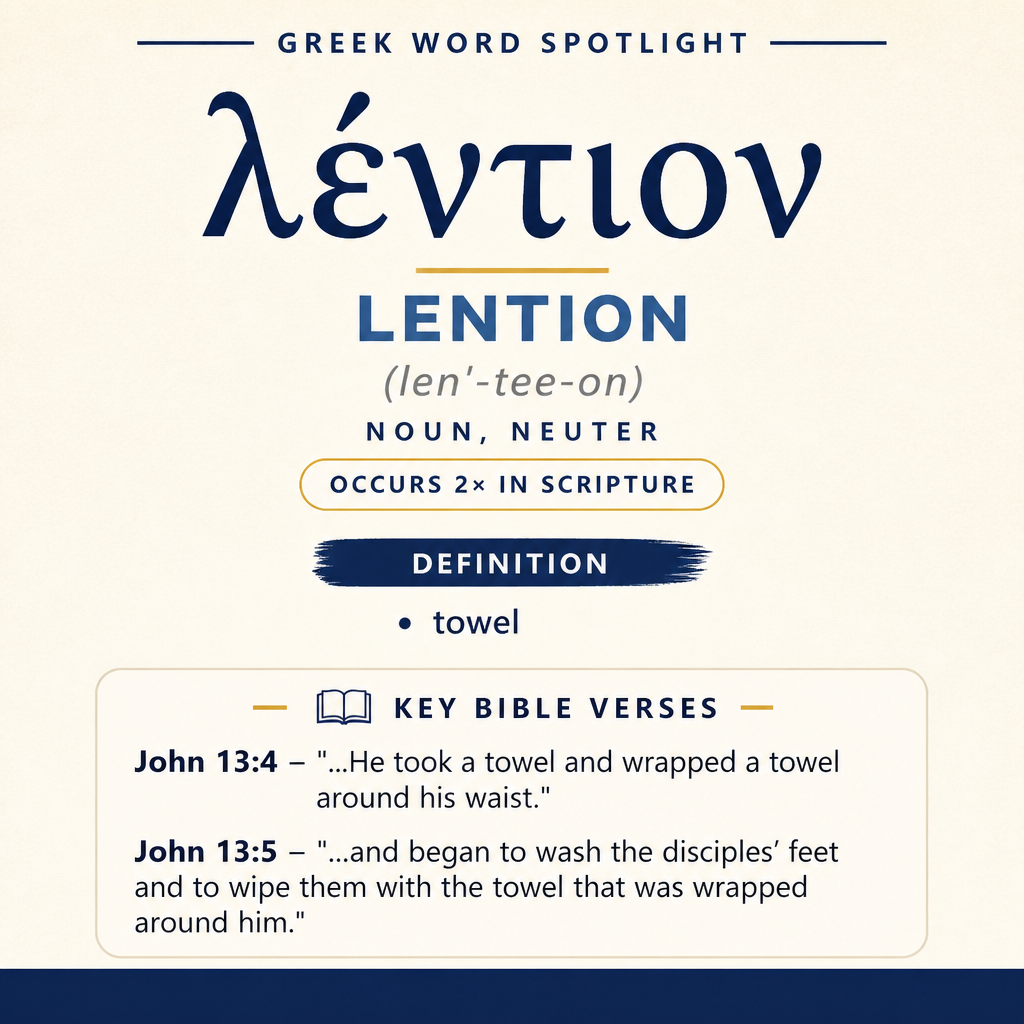
λέντιον (Lention) means “towel” and appears twice in Scripture, both in John 13:4–5.
Action With Towel
In John 13:5, He washes the disciples’ feet and wipes them with the towel.
Learn More →λέντιον refers to a towel, and it appears in the foot-washing narrative in John 13:4–5. In these verses it is both worn and used, functioning as a concrete tool within a deliberate sequence of actions.
Occurrences
“arose from supper, and laid aside his outer garments. He took a towel and wrapped a towel around his waist.” (John 13:4)
Here λέντιον enters the scene as part of a purposeful change from table fellowship to service. The verse moves by short, linked actions: rising, laying aside outer garments, taking a towel, and wrapping it around the waist. The towel is not merely present in the room; it is handled (“He took a towel”) and then worn (“wrapped a towel around his waist”). By being wrapped around the waist, the towel becomes part of the actor’s readiness for the task that follows. The repeated mention within the same sentence (“took a towel” … “wrapped a towel”) keeps the object in the reader’s view and marks it as essential equipment for what is about to happen.
The towel also plays a role in the contrast created by the movements of clothing. “Laid aside his outer garments” is immediately followed by taking and wrapping the towel. The towel belongs to a different mode of activity than the outer garments. It is associated with a practical, hands-on action that requires free movement, closeness to the feet, and contact with water. In the narrative’s pacing, λέντιον signals the shift: the meal setting remains (“from supper”), yet the posture and tools change. The towel thus helps the text transition from an ordinary social moment to an enacted gesture carried out in front of the disciples.
“Then he poured water into the basin, and began to wash the disciples’ feet and to wipe them with the towel that was wrapped around him.” (John 13:5)
In this verse λέντιον is no longer simply worn; it is used. The towel appears at the end of a chain of preparations: water is poured into a basin, washing begins, and then the washed feet are wiped. The towel’s role is defined by its placement in the action: it is the means by which washing is completed (“to wipe them with the towel”). The verse ties the towel used for wiping to the towel previously wrapped around him (“the towel that was wrapped around him”), connecting preparation (John 13:4) with execution (John 13:5). What was put on becomes what is applied.
The text also situates the towel alongside other concrete items—water and basin—so that the service is portrayed as materially specific and bodily. The towel serves the immediate, physical necessity that follows washing: drying or wiping what has been washed. Because the towel is the one “wrapped around him,” the narrative emphasizes continuity: the same towel that marked readiness now marks ongoing involvement, staying with the actor through the whole procedure. This keeps the scene from feeling abstract; λέντιον anchors the act of washing in an object that touches both the servant and the served.
By specifying wiping “them” (the disciples’ feet) “with the towel,” the verse uses λέντιον to underscore care and thoroughness. Washing alone could be left as a single action, but the addition of wiping highlights attention to completion and comfort. The towel is therefore integral to the gesture’s full shape: the basin and water begin the action, and the towel finishes it. In narrative terms, λέντιον is the instrument that makes the act both practical and intimate, since wiping requires proximity and direct handling after the washing.

Sense and Usage
Across these two verses, λέντιον functions as a towel in two closely linked ways: it is first worn and then employed. John 13:4 presents it as something taken up and wrapped around the waist, which depicts it as part of a servant-like working outfit. John 13:5 presents it as the tool for wiping after washing, showing its practical purpose in direct contact with the disciples’ feet.
The usage in these lines places the towel at the intersection of clothing and implement. It is not described as part of the “outer garments” that are laid aside, yet it is put on the body in a specific manner (“wrapped … around his waist”). At the same time it is not a mere accessory; it is used for an action that follows immediately (“to wipe them with the towel”). This dual role gives λέντιον a distinctive narrative weight: it belongs to the wearer’s preparation and to the recipients’ experience. It touches the actor’s waist and the disciples’ feet, bridging the one who serves and those who are served.
The repetition of the towel in John 13:4 (“took a towel and wrapped a towel around his waist”) and its further specification in John 13:5 (“the towel that was wrapped around him”) also shows that the term is being tracked carefully through the scene. The towel is introduced, positioned, and then reintroduced as the same item now functioning in action. This kind of continuity creates a tight, almost procedural clarity: the reader knows exactly where the towel came from, how it was carried, and how it was used. Within the narrative, λέντιον thus helps organize the sequence from preparation to practice, marking the transition points and keeping the service concrete.
Because the towel is mentioned in connection with “wash” and “wipe,” its sense is inseparable from the physical needs created by water. The basin enables washing; the towel enables wiping. In that paired relationship, λέντιον is the object that completes the act and prevents it from being only a symbolic washing. Wiping is not a separate scene but part of the same motion: he “began to wash” and also “to wipe them with the towel.” The towel’s presence ensures that what is begun is carried through in a finished manner, shaping the action into a full cycle rather than a partial gesture.
The fact that the towel is “wrapped around him” while being used suggests readiness and immediacy: it is not fetched later or replaced. It remains on the body as the work proceeds, serving as a readily available tool. This keeps the focus on the act itself, not on interruptions or additional preparations. λέντιον therefore contributes to the portrayal of steady, continuous service, where the necessary item is already in place and brought into use as the need arises.
Imagery in John 13
In John 13:4–5 the towel stands out as an ordinary household object placed at the center of a solemn, attentive action. Wrapped at the waist and then used to wipe washed feet, λέντιον carries the imagery of service that is hands-on, close, and deliberate. The towel’s movement—from being taken up, to being worn, to being applied—gives the scene a grounded realism: water in a basin, feet being washed, and the towel completing the care through wiping.
Sources: Lexical data from Strong’s Exhaustive Concordance and the Translators Brief Lexicon of Extended Strongs for Greek (STEPBible, CC BY). Occurrence data from the Translators Amalgamated Greek New Testament (STEPBible, CC BY). Scripture quotations from the World English Bible (public domain).