
Exploring the Meaning of Lamprotes in Greek
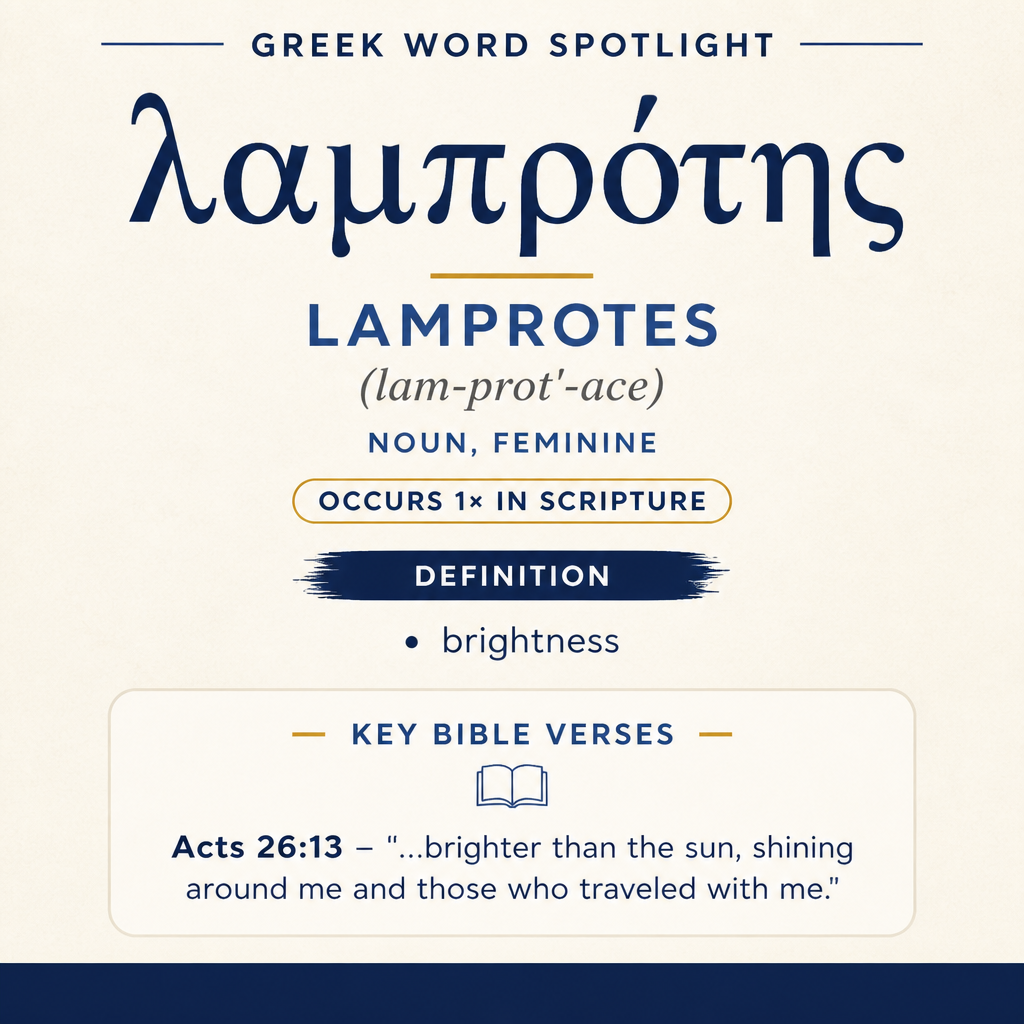
λαμπρότης (Lamprotes) means “brightness” and appears once in Scripture, in Acts 26:13.
Context in Acts
In Acts 26:13, it describes a light from the sky, brighter than the sun. The light shone around Paul and those traveling with him.
Learn More →λαμπρότης means “brightness,” and it appears in Paul’s account of a heavenly light encountered on the road, as told in Acts 26. In that scene, the word serves to describe the striking intensity of what he saw.
Root and Related Words
λαμπρότης derives from the adjective lampros (λαμπρός), “shining” (Strong’s G2986). The noun form turns the quality expressed by the adjective into an expressed attribute, treating “shining” as a describable property that can be compared and spoken of in degrees.

Occurrences
“at noon, O king, I saw on the way a light from the sky, brighter than the sun, shining around me and those who traveled with me.” (Acts 26:13)
In Acts 26:13 Paul recounts the moment with careful attention to the light itself: it is seen “at noon,” it comes “from the sky,” it is “brighter than the sun,” and it is “shining around” more than one person. λαμπρότης belongs to that cluster of descriptions by naming the phenomenon as a kind of perceptible radiance—an objective brightness that can be observed and compared. The narrative does not treat the light as a vague impression; it is a visible, spatially present reality that surrounds Paul and “those who traveled with” him.

The setting detail “at noon” sharpens the contribution of λαμπρότης. Noon is the time when ordinary daylight is at its strongest, and the text anchors the comparison at the highest common point of natural brightness: “the sun.” By describing the light as “brighter than the sun,” Paul frames its λαμπρότης as surpassing what would typically overwhelm the eye even in full daylight. The point is not merely that there was light, but that the brightness was so great that it could be measured against the strongest familiar standard in that moment.
The verse also ties this brightness to direction and origin: the light is “from the sky.” That phrase locates the brightness as descending or emanating from above, distinguishing it from ordinary sources along “the way.” λαμπρότης therefore characterizes a light whose intensity is not explained by the surroundings; it is a brightness associated with the sky and therefore with an origin beyond the road itself.
Finally, “shining around me and those who traveled with me” shows how the brightness functions in the scene. It is not confined to a point in the distance; it envelops. The light’s radiance occupies space, creating an environment of brightness that includes multiple witnesses. In that way, λαμπρότης contributes to the public, shared nature of the experience: Paul presents it to “O king” as an event that occurred in the presence of companions, with a brightness that reached all of them.
Sense and Usage
As “brightness,” λαμπρότης expresses an observable quality of light—its intensity as experienced by those who see it. In Acts 26:13 it is not treated as a minor detail but as a defining characteristic of the event. The verse stacks descriptors (“at noon,” “from the sky,” “brighter than the sun,” “shining around”) so that the brightness is not simply present; it is exceeding, originating from above, and expansive in reach.
The comparison “brighter than the sun” reveals one of the main ways “brightness” is communicated here: by relative measure. The text does not assign a numeric value; it uses a known, universal reference point available to any listener. This shows how λαμπρότης can function rhetorically in narrative: it gives weight to testimony by appealing to shared experience. Everyone knows what the sun is like at noon, so the word “brightness” in this line is not abstract; it is anchored to a sensory benchmark.
In addition, “brightness” here is bound tightly to motion and spatial effect. The light is seen “on the way,” and it is “shining around” travelers. λαμπρότης therefore operates as more than an internal sensation; it describes a real illumination that situates the travelers within it. The word’s force in this usage lies in its ability to make the scene concrete: a brightness that interrupts a journey, surrounds people, and outshines the daylight in which it appears.
Imagery
Acts 26:13 presents brightness not as gentle glow but as overwhelming daylight-transcending radiance: a sky-sent light that exceeds the sun at its strongest and floods the travelers’ surroundings. The imagery carried by λαμπρότης is therefore of a brightness that dominates the scene, leaving the listener with the impression of a light so intense that ordinary categories of daytime illumination are surpassed.
Sources: Lexical data from Strong’s Exhaustive Concordance and the Translators Brief Lexicon of Extended Strongs for Greek (STEPBible, CC BY). Occurrence data from the Translators Amalgamated Greek New Testament (STEPBible, CC BY). Scripture quotations from the World English Bible (public domain).





