
Exploring the Meaning of Lampros in Greek
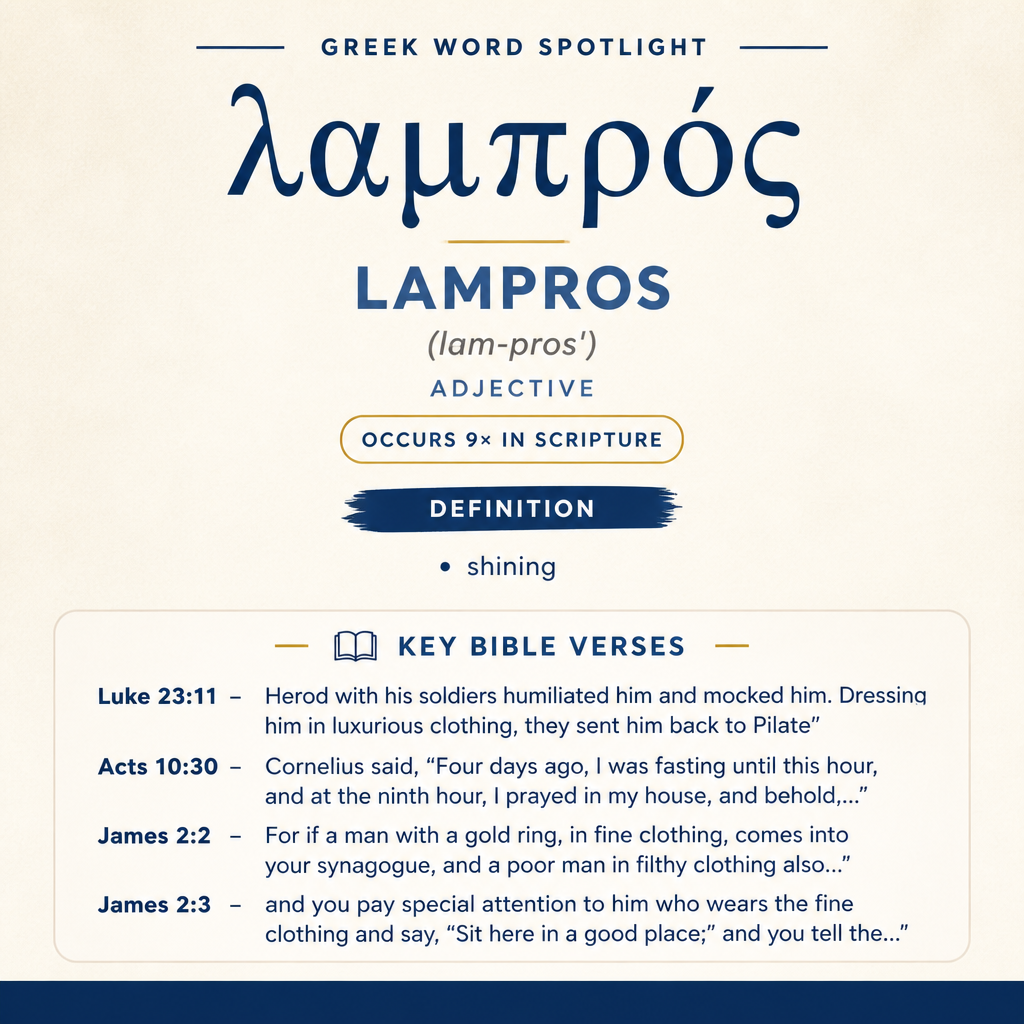
λαμπρός (Lampros) means “shining” and appears 9 times in Scripture, including Luke 23:11, Acts 10:30, James 2:2–3, and Revelation.
Core Meaning
λαμπρός means “shining.” In the listed passages it is associated with brightness and fine clothing.
Learn More →Gospel & Acts
In Luke 23:11, Jesus is mocked and dressed in luxurious clothing. In Acts 10:30, Cornelius describes his prayer and a sudden appearance (“behold”).
Learn More →James & Revelation
In James 2:2–3 it describes fine clothing contrasted with filthy clothing. In Revelation it appears with bright linen (15:6; 19:8) and crystal clarity (22:1).
Learn More →λαμπρός describes what is shining, and in the New Testament it repeatedly marks clothing and other vivid sights as conspicuously bright. It appears in narratives (Luke, Acts), ethical instruction (James), and apocalyptic visions (Revelation), where “brightness” becomes a visible feature that sets persons and things apart within the scene.
Root and Related Words
λαμπρός is related to lampas (λαμπάς), glossed “window” (Strong’s G2985).

Occurrences
Luke 23:11 — “Herod with his soldiers humiliated him and mocked him. Dressing him in luxurious clothing, they sent him back to Pilate.”
In the mockery of Jesus before Herod, λαμπρός characterizes the clothing used as a prop for humiliation. The verse frames the outfit as part of a hostile performance—soldiers ridicule, then send him back—so the shining quality functions as a visible, outward costume set against the injustice of the moment.
Acts 10:30 — “Cornelius said, “Four days ago, I was fasting until this hour, and at the ninth hour, I prayed in my house, and behold, a man stood before me in bright clothing,”
In Cornelius’s recounting, λαμπρός marks the messenger’s clothing as bright in a way that arrests attention: “behold” introduces a sudden presence, and the clothing’s shining quality belongs to what Cornelius noticed and remembers. The brightness is not presented as an ornament for display to others in society, but as a striking feature of an encounter that interrupts prayer.
James 2:2 — “For if a man with a gold ring, in fine clothing, comes into your synagogue, and a poor man in filthy clothing also comes in,”
James uses λαμπρός for the “fine clothing” that accompanies a gold ring, setting up a contrast within the gathered community. The shining quality helps create an immediate visual divide between the two arrivals: one conspicuously well-presented, the other marked by “filthy clothing.” The brightness is part of the surface cues by which people are tempted to rank one person over another.
James 2:3 — “and you pay special attention to him who wears the fine clothing and say, “Sit here in a good place;” and you tell the poor man, “Stand there,” or “Sit by my footstool””
Here λαμπρός appears again in the phrase “fine clothing,” now tied directly to the community’s response. The shining garment becomes the trigger for “special attention” and preferential seating. In the scene, brightness does not merely describe fabric; it is embedded in a social dynamic where external shine influences speech (“Sit here in a good place”) and reinforces humiliation for the poor (“Stand there”).
Revelation 15:6 — “The seven angels who had the seven plagues came out, clothed with pure, bright linen, and wearing golden sashes around their breasts.”
In the vision, λαμπρός qualifies linen that is already called “pure,” intensifying the visual impression of the angels who bear “the seven plagues.” The brightness of their linen is part of a formal, ordered appearance: they “came out” clothed and sashed. The shining fabric functions as a conspicuous element of the heavenly scene, matching the solemnity of what they carry.
Revelation 18:14 — “The fruits which your soul lusted after have been lost to you. All things that were dainty and sumptuous have perished from you, and you will find them no more at all.”
In this lament over loss, λαμπρός contributes to the description of “things” once desired, paired with “dainty and sumptuous.” The shining quality belongs to the world of coveted goods that the text declares gone: “lost,” “perished,” “no more at all.” Brightness here is associated with what people crave and collect, now presented as fragile and passing.
Revelation 19:8 — “It was given to her that she would array herself in bright, pure, fine linen: for the fine linen is the righteous acts of the saints.”
In this portrayal of being “array[ed],” λαμπρός again modifies linen, joined with “pure” and “fine.” The text itself interprets the linen—“for the fine linen is the righteous acts of the saints”—so the brightness of the clothing is integrated into the passage’s own explanation. The shining garment is not self-chosen status; “It was given to her,” and the radiance belongs to what is granted and what is named in the verse.
Revelation 22:1 — “He showed me a river of water of life, clear as crystal, proceeding out of the throne of God and of the Lamb,”
Although the verse focuses on a river “clear as crystal,” λαμπρός contributes to the portrayal of vivid clarity and brilliance within the final vision’s imagery. The river is “shown” and described with a quality that evokes a shining transparency; the scene’s brightness is part of how the vision communicates the river’s striking, unmistakable appearance as it proceeds from the throne.
Revelation 22:16 — “I, Jesus, have sent my angel to testify these things to you for the assemblies. I am the root and the offspring of David, the Bright and Morning Star.”
Here λαμπρός functions as a title descriptor: “the Bright and Morning Star.” The shining quality is attached directly to Jesus’ self-identification in the closing testimony to “the assemblies.” In this line, brightness is not clothing or merchandise but a defining descriptor within a formal declaration of identity.
Sense and Usage
Across these passages, λαμπρός consistently signals a visible brilliance—something that catches the eye and stands out in a crowd or vision. The most frequent concrete setting is clothing: Herod’s humiliating outfit, the messenger’s bright apparel before Cornelius, the rich man’s fine garments in James, and the angels’ and bride’s bright linen in Revelation. In each case, “shining” is not an abstract quality floating free of context; it is attached to objects that can be seen and that shape perception within the scene.
The word’s effect varies with the moral or narrative frame. In Luke 23:11, shining clothing is pressed into ridicule, its outward splendor serving mockery. In James 2:2–3, shining clothing becomes the social signal that tempts a congregation toward partiality, showing how brightness can function as a cue for deference. In Acts 10:30, brightness belongs to the remembered appearance of a man who “stood before” Cornelius during prayer, where the shining quality heightens the scene’s immediacy and distinctiveness.
Revelation gathers the term into visionary imagery where brightness contributes to the portrayal of purity, order, and eschatological contrast. The angels’ “pure, bright linen” (Revelation 15:6) and the granted “bright, pure, fine linen” (Revelation 19:8) place shining garments within scenes of solemn action and interpreted symbolism. By contrast, Revelation 18:14 links shining desirables with what “have perished,” using the attractiveness of such goods to underline the completeness of their loss. Finally, Revelation 22 places brightness alongside the vision’s crystalline clarity (22:1) and crowns it in the title “the Bright and Morning Star” (22:16), where shining becomes part of a closing self-presentation.
Imagery
λαμπρός carries the imagery of things that gleam—fabric that looks radiant, goods that look desirable, a scene that looks crystalline, and a title that asserts shining prominence. In these texts, brightness is never merely decorative: it can be used to mock (Luke 23:11), to tempt toward favoritism (James 2:2–3), to mark a startling encounter (Acts 10:30), to adorn figures in visions (Revelation 15:6; 19:8), and to sharpen the sense of final loss or final testimony (Revelation 18:14; 22:16).
Sources: Lexical data from Strong’s Exhaustive Concordance and the Translators Brief Lexicon of Extended Strongs for Greek (STEPBible, CC BY). Occurrence data from the Translators Amalgamated Greek New Testament (STEPBible, CC BY). Scripture quotations from the World English Bible (public domain).





