
Exploring the Meaning of Lamech in Greek
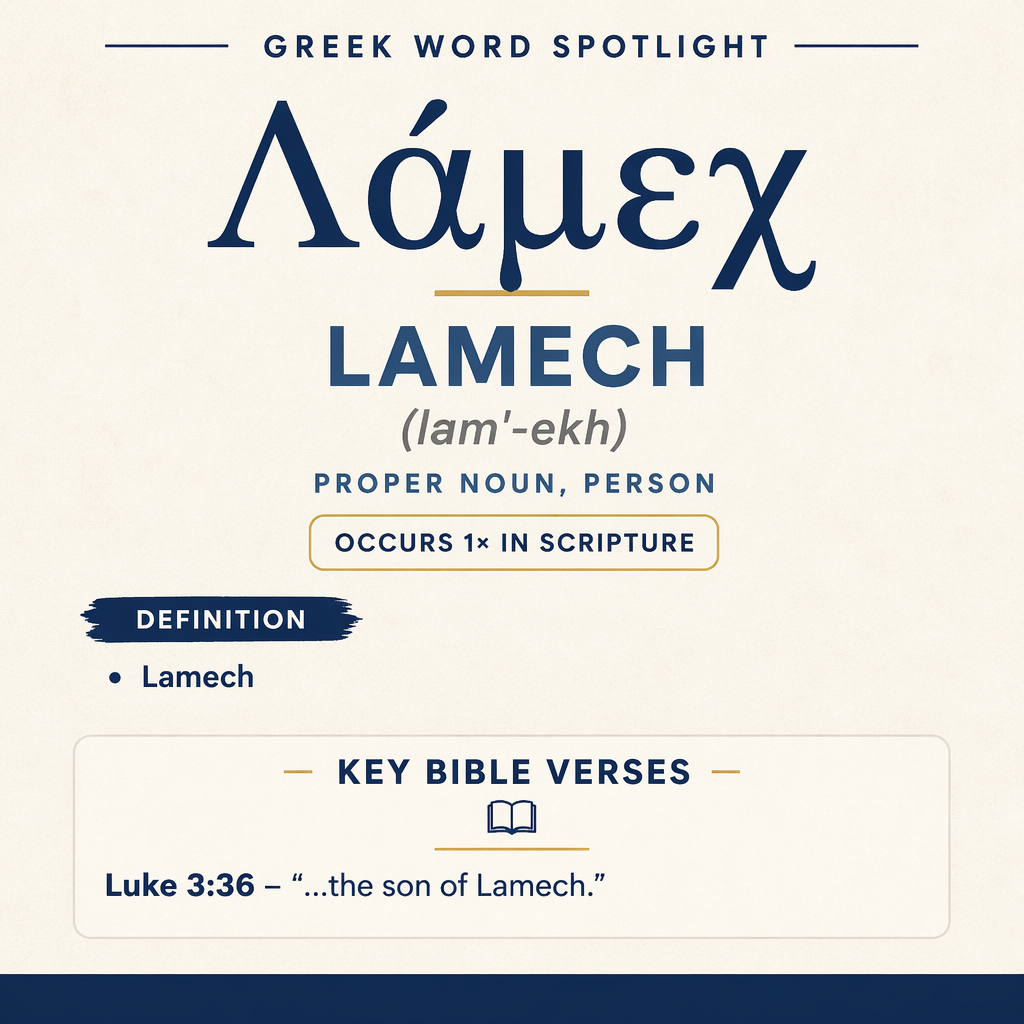
Λάμεχ means “Lamech” and appears once in Scripture in Luke 3:36.
Verse Context
In Luke 3:36, it appears in a genealogy: “the son of Noah, the son of Lamech.”
Learn More →Λάμεχ refers to Lamech, appearing in a single New Testament context within a genealogy. In Luke’s ordered lineage, the name functions as one link in a chain of descent reaching back to Noah.
Occurrences
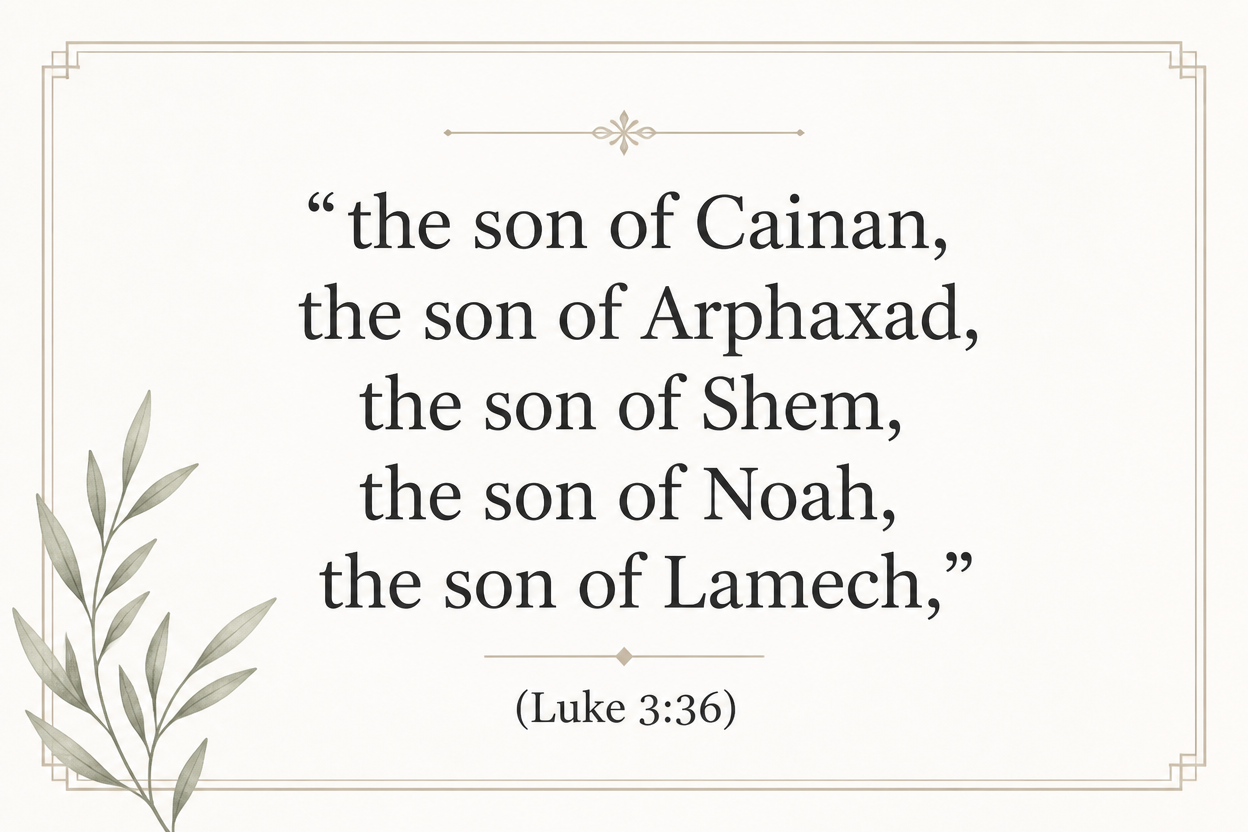
“the son of Cainan, the son of Arphaxad, the son of Shem, the son of Noah, the son of Lamech,” (Luke 3:36)
Here Λάμεχ is placed at the end of a short run of “the son of …” clauses, where each name serves to anchor the next. Within this sequence, Lamech is the named father of Noah: the line reads “the son of Noah, the son of Lamech,” presenting Noah as descending from Lamech and, by the same patterned wording, positioning Lamech as the immediate predecessor who connects Noah to the earlier figures listed (“Shem,” “Arphaxad,” “Cainan”). The verse does not narrate any episode involving Lamech; instead, the name does genealogical work—marking a concrete point of ancestry and keeping the chain intact from one generation to the next.
The syntax of Luke 3:36 also gives the name a particular prominence. The verse moves steadily backward through successive ancestors and then pauses the segment on “the son of Lamech,” leaving Lamech as the final anchor-name in this verse’s portion of the pedigree. That placement makes the name function as a hinge between Noah—explicitly mentioned—and the earlier line traced through Shem and beyond in the same sentence structure. In this way, Λάμεχ contributes continuity: the genealogy’s credibility and coherence depend on each named figure occupying a specific relational slot, and Lamech is the slot that directly supports the mention of Noah in the sequence.

Sense and Usage
As a personal name, Λάμεχ operates as an identifier rather than as a descriptive term. In Luke 3:36 it contributes meaning by specifying which “Lamech” is intended: the one defined by his relationship to Noah (“the son of Noah, the son of Lamech”). The verse’s repeated formula reduces each name to a relational function—each person is introduced through descent, not through actions, titles, locations, or character traits. Within that framework, “Lamech” is meaningful precisely because it is fixed and singular: it is the stable label that allows the genealogical line to be followed without ambiguity inside the list.
Luke’s genealogy is built from a series of linked genitives (“the son of X”), and a proper name in this structure does more than fill space; it marks a node in an ordered family network. Λάμεχ is one of those nodes. In the immediate local context, its primary semantic force comes from the way it frames Noah’s parentage. Noah is not presented in isolation; he is explicitly placed within a lineage by attaching him to Lamech, and then Lamech is implicitly attached to the earlier ancestors named in the same flow of descent. The name therefore functions as a connector that keeps the ancestry from becoming a set of disconnected famous figures; it preserves the list’s step-by-step character.
The placement of Λάμεχ after “Noah” also shows how Luke’s arrangement uses well-known ancestral points as reference markers while still requiring the intermediate generation. The sequence does not jump from Shem directly to Noah; it includes “the son of Noah, the son of Lamech,” inserting Lamech to maintain an unbroken chain. In genealogical discourse, this is a key way names carry significance: they establish adjacency—who stands immediately before whom—so that the reader can see the line’s progression (or, here, regression) one generation at a time. Thus, the sense “Lamech” is realized not by any narrative about him but by the name’s capacity to locate a person precisely within an ancestry and to transmit identity across the list.
Because Λάμεχ appears only within this list, its usage is tightly constrained by the genre of genealogy. Genealogies tend to present persons under a single aspect: their place in a chain of descent. Luke 3:36 exemplifies that economy. Each name is introduced in the same simple, repetitive form, and the repetition itself shapes how the reader encounters Λάμεχ: not as a character to be evaluated, but as a genealogical reference point. The name’s contribution is therefore relational and structural—supporting the larger statement that the line being traced is continuous and specific, generation by generation.
Imagery
Although Λάμεχ is a name rather than a visual term, Luke 3:36 carries a quiet kind of imagery through its repeated cadence: a chain of ancestry extending backward from one figure to the next. In that verbal “chain,” Lamech stands as the link immediately behind Noah, a single named connection that holds Noah to the earlier ancestors listed in the same breath.
Sources: Lexical data from Strong’s Exhaustive Concordance and the Translators Brief Lexicon of Extended Strongs for Greek (STEPBible, CC BY). Occurrence data from the Translators Amalgamated Greek New Testament (STEPBible, CC BY). Scripture quotations from the World English Bible (public domain).




