Exploring the Meaning of Lailaps in Greek
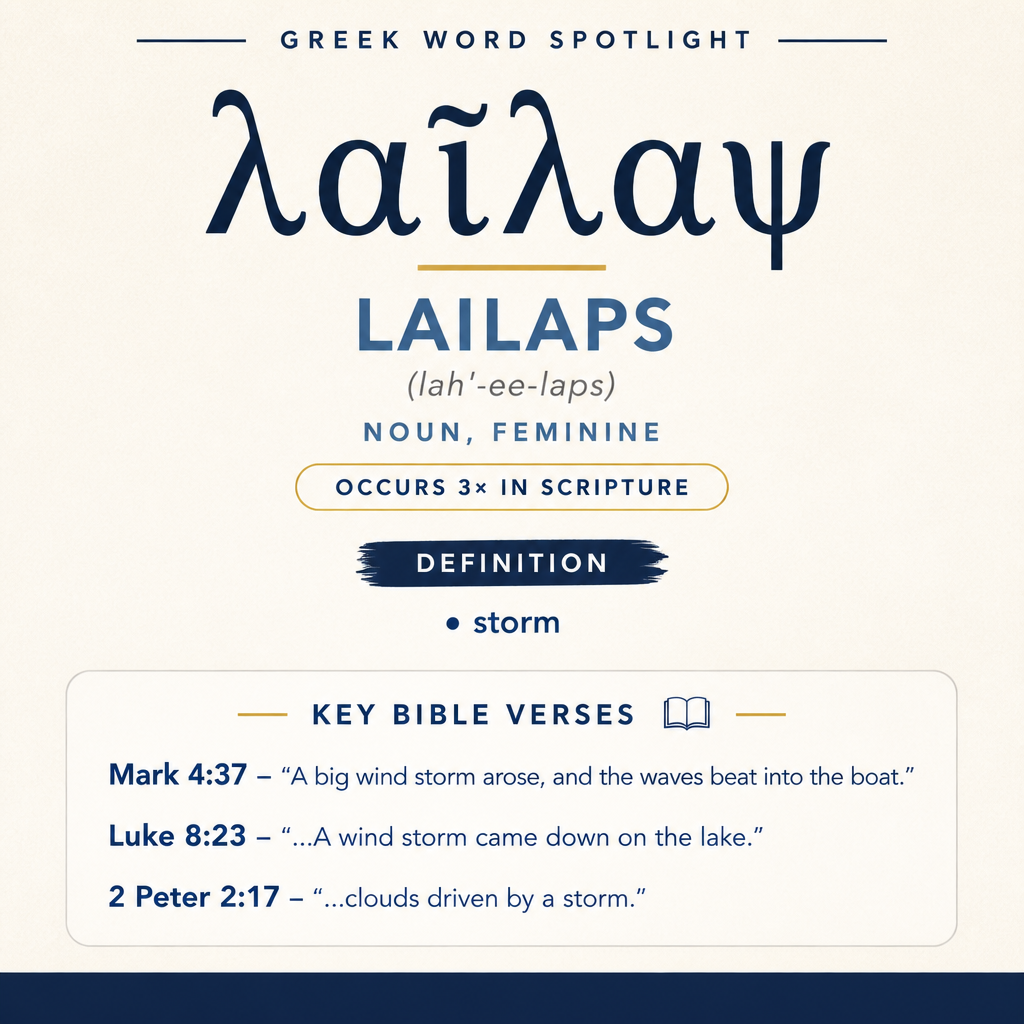
λαῖλαψ means “storm” and appears three times in Scripture: Mark 4:37, Luke 8:23, and 2 Peter 2:17.
Core Meaning
λαῖλαψ is defined as “storm.” In the listed passages, it describes wind-driven, dangerous conditions.
Learn More →Gospel Narratives
In Mark 4:37, a big wind storm arises and waves fill the boat. In Luke 8:23, a wind storm comes down on the lake during sailing.
Learn More →Petrine Imagery
In 2 Peter 2:17, clouds are driven by a storm. The verse also speaks of “the blackness of darkness” reserved forever.
Learn More →Lailaps means “storm,” appearing in two Gospel narratives of a sudden lake gale and once in a figurative description of destructive instability. In each setting it evokes a force that moves swiftly and overwhelms what is exposed to it.
Occurrences
Mark 4:37: “A big wind storm arose, and the waves beat into the boat, so much that the boat was already filled.”
Here lailaps belongs to an emergency at sea. The verse frames the storm as both wind-driven and wave-driven: it “arose,” and the result is immediate physical impact—“the waves beat into the boat.” The boat is not merely rocked; it is actively struck and then flooded: “the boat was already filled.” In this scene, lailaps functions as the catalyst that turns ordinary sailing into imminent danger, compressing cause (a “wind storm”) and effect (waves and water filling the vessel) into one rapid sequence. The term gathers the elements—wind, waves, and rising water—into a single event that threatens to overpower human control and the craft’s ability to remain buoyant.
Luke 8:23: “But as they sailed, he fell asleep. A wind storm came down on the lake, and they were taking on dangerous amounts of water.”
Luke places lailaps in a narrative contrast: calm enough for sleep, then sudden peril. The storm “came down on the lake,” a description that emphasizes abrupt arrival and downward sweep into the sailing space. Its effects are described in terms of accumulation and threat: “they were taking on dangerous amounts of water.” The word sits between the quiet of travel (“as they sailed”) and the onset of danger, marking the turning point from routine motion to crisis. Lailaps here is not an abstract idea of bad weather but an event with measurable consequences—water entering the boat to a “dangerous” degree—so that the storm is experienced as an overwhelming intrusion into the vessel’s safety.
2 Peter 2:17: “These are wells without water, clouds driven by a storm; for whom the blackness of darkness has been reserved forever.”
In this epistolary context, lailaps is used to characterize movement and instability rather than to narrate a nautical incident. The image is of “clouds driven by a storm,” where the storm supplies the driving force that pushes clouds along. The broader sentence pairs emptiness with danger: “wells without water” and storm-driven clouds, followed by the pronouncement that “the blackness of darkness has been reserved forever.” Lailaps contributes the sense of an external, forceful power that carries things along without direction from within. The clouds are not gently carried; they are “driven,” and the storm is the agent that propels them. This picture supports the passage’s severe tone by associating the subjects with turbulence and with an atmosphere of foreboding that culminates in “blackness of darkness.”

Sense and Usage
Across these three occurrences, lailaps consistently denotes a storm as an event that overwhelms a setting and imposes its force on what is present. In Mark and Luke, the storm is explicitly a “wind storm,” and its defining feature is not simply that wind exists, but that the wind produces immediate, dangerous results on the water’s surface: waves “beat into the boat,” and the occupants “were taking on dangerous amounts of water.” The term thus occupies the space between meteorological cause and lived consequence; it names the storm in a way that naturally includes its violent effects, as shown by the rapid progression from its arrival to the boat’s filling with water.
The two Gospel scenes share a tight cluster of details: the storm’s arising/descending, the waves or water entering the boat, and the escalation toward peril. In Mark, the stress falls on the boat’s condition—“already filled”—as if the storm’s power has advanced quickly beyond manageable splashing. In Luke, the stress falls on the storm’s sudden descent and the growing danger—“taking on dangerous amounts of water”—as the situation develops. In both, lailaps fits a context where the environment becomes hostile and where the boundary between safety and disaster is breached by water entering the vessel. The storm is therefore not background scenery; it is the active pressure that turns the lake into a threat.
In 2 Peter, lailaps shifts from literal weather endangering a boat to an image describing people through natural phenomena. The storm remains the same kind of thing—a storm—but now its salient feature is its capacity to drive. The clouds are moved by the storm’s force, not by their own purpose. The phrase “clouds driven by a storm” highlights the storm as an overpowering impulse that makes what it touches unstable and carried along. Within the sentence’s pairing of images—“wells without water” and storm-driven clouds—lailaps helps paint a picture of promise without substance and motion without stability. Even though the reference is figurative, the word’s force remains concrete: storms drive, push, and sweep along whatever is exposed to them.
Taken together, these uses show lailaps as a word for storm that naturally conveys suddenness, force, and the threat of being overwhelmed. On the lake, the storm produces waves and flooding; in the metaphor, it produces driven movement and a darkened horizon. The same word can therefore speak of physical danger on water and of a destructive, uncontrolled momentum in a moral warning, because in each case the storm is the dominating power in the scene.
Imagery
The imagery attached to lailaps in these passages is dominated by motion and pressure. In Mark and Luke, the storm is felt in the boat as water climbs from outside to inside—waves beating in, water being taken on—until the vessel itself becomes a measure of danger. In 2 Peter, the storm is felt in the sky as a driving force that pushes clouds along, reinforcing an atmosphere that ends in “the blackness of darkness.” Whether on lake or in sky, lailaps evokes a world where stability is lost under a force that arrives, drives, and threatens to engulf.
Sources: Lexical data from Strong’s Exhaustive Concordance and the Translators Brief Lexicon of Extended Strongs for Greek (STEPBible, CC BY). Occurrence data from the Translators Amalgamated Greek New Testament (STEPBible, CC BY). Scripture quotations from the World English Bible (public domain).