
Exploring the Meaning of Kremannumi in Greek
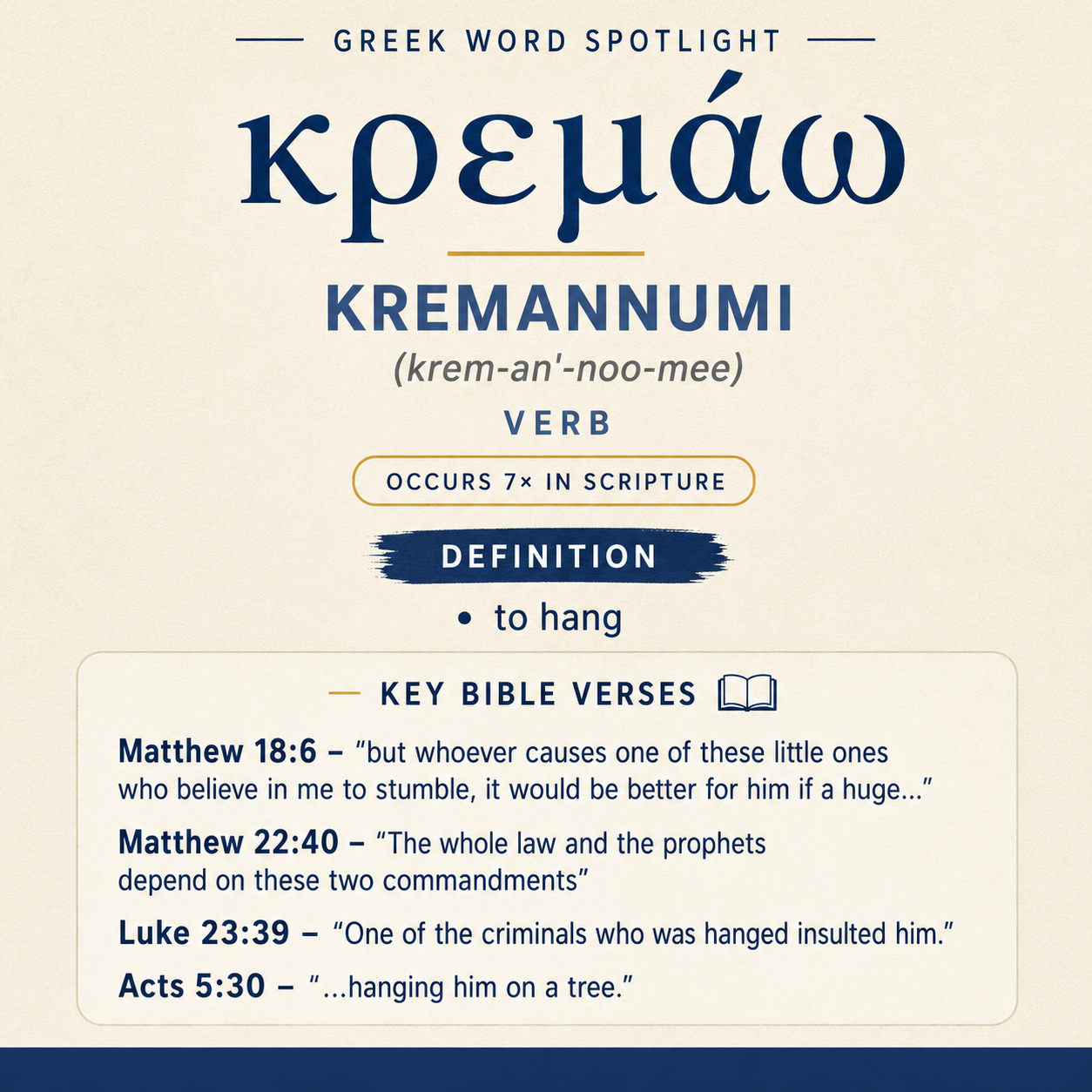
κρεμάω means “to hang” and occurs 7 times in Scripture in Matthew, Luke, Acts, and Galatians.
Core Meaning
κρεμάω is defined as “to hang.” It describes people, objects, and events involving hanging.
Learn More →Gospel Occurrences
It appears in Matthew 18:6 and 22:40, and in Luke 23:39. These passages include a millstone, the law and prophets, and a hanged criminal.
Learn More →Acts and Galatians
In Acts 5:30 and 10:39 it refers to Jesus being killed, “hanging him on a tree.” In Acts 28:4 a creature is hanging from a hand, and Galatians 3:13 quotes, “Cursed is everyone who h…”.
Learn More →κρεμάω expresses the action “to hang,” and in Scripture it appears in scenes of execution, warning, and even a creature suspended from a person’s body. Across its occurrences it can describe something attached to someone, someone suspended on a tree, or an image of dependence that ties other matters to a central point.
Occurrences
Matthew 18:6: “but whoever causes one of these little ones who believe in me to stumble, it would be better for him if a huge millstone were hung around his neck, and that he were sunk in the depths of the sea.”
Here κρεμάω supplies the physical picture that intensifies the warning: a “huge millstone” is “hung around his neck.” The hanging is not the final outcome by itself; it is the means of fastening a weight to a person in preparation for being “sunk in the depths of the sea.” The verb underscores attachment—something placed on the body in a way that cannot be shrugged off—making the threat concrete and bodily.
Matthew 22:40: “The whole law and the prophets depend on these two commandments.”
In this saying, κρεμάω is used for “depend.” The image is not of an object tied to a neck or a body on a tree, but of an entire body of teaching held up by “these two commandments.” The verb frames the relationship as one of suspension: what follows is portrayed as hanging from, and thus being supported by, what precedes. The force of the line is that “the whole law and the prophets” are not presented as separate from the two commandments but as connected to them in a way that suggests reliance and cohesion.
Luke 23:39: “One of the criminals who was hanged insulted him, saying, “If you are the Christ, save yourself and us!””
κρεμάω here characterizes the criminal’s condition: he “was hanged.” The verb places the speaker in a setting of public punishment and physical suspension. Within the verse, the hanging does not mute speech; the man “insulted him” and demanded rescue. The verb thus sets the grim scene from which the taunt is delivered, heightening the irony of a condemned man speaking as though he can evaluate and challenge deliverance.
Acts 5:30: “The God of our fathers raised up Jesus, whom you killed, hanging him on a tree.”
In Peter’s confrontation, κρεμάω names a specific act of violence: “you killed, hanging him on a tree.” The hanging is presented as the manner by which the killing took place, and “on a tree” locates the suspension publicly and visibly. The clause stands in sharp contrast with “raised up Jesus,” so the verb contributes to the rhetorical collision between human action (killing by hanging) and divine action (raising up).
Acts 10:39: “We are witnesses of everything he did both in the country of the Jews, and in Jerusalem; whom they also killed, hanging him on a tree.”
In this witness statement, κρεμάω again depicts the method and display of Jesus’ death: “killed, hanging him on a tree.” The line is framed by testimony—“We are witnesses”—so the hanging is not merely reported as a detail but offered as part of what the witnesses publicly attest. As in Acts 5:30, the phrase “on a tree” keeps the imagery concrete: a body suspended on wood, presented as the culminating act of rejection.
Acts 28:4: “When the natives saw the creature hanging from his hand, they said to one another, “No doubt this man is a murderer, whom, though he has escaped from the sea, yet Justice has not allowed to live.””
Here κρεμάω describes a “creature hanging from his hand.” The verb focuses on attachment and visible persistence: something clings in a way that onlookers can immediately interpret. The hanging becomes evidence in the natives’ reasoning; seeing the creature suspended from Paul’s hand, they draw conclusions about his character and fate. The verb serves the narrative by turning a physical detail into a public sign that prompts spoken judgment.
Galatians 3:13: “Christ redeemed us from the curse of the law, having become a curse for us. For it is written, “Cursed is everyone who hangs on a tree,””
In Paul’s argument, κρεμάω appears within a quoted line: “hangs on a tree.” The hanging functions as the defining condition named by the citation, and it is linked in the verse to the language of “curse.” In this setting the verb contributes stark, bodily imagery that anchors the theological claim in a publicly recognizable mode of death—being suspended “on a tree”—and then connects that image to the stated consequence in the quotation.

Sense and Usage
Across these passages, κρεμάω consistently portrays suspension or attachment in a way that can be seen and that often carries public meaning. In Matthew 18:6, the hanging is instrumental: a weight is affixed to the neck so that sinking becomes inevitable. The verb marks a binding action—something hung is not simply near a person but placed upon them, attached with consequence.
In Luke 23:39 the hanging describes a person’s state under punishment, while in Acts 5:30 and Acts 10:39 the hanging is the active means by which killing is carried out, specified with the locative phrase “on a tree.” The repeated wording in Acts shows how κρεμάω can function in concise narration: it states not only that death occurred but how it was enacted and displayed. Galatians 3:13 then draws the verb into a citation that links the condition “hangs on a tree” with the category “cursed,” using the physical scenario as a basis for the argument’s next step.
Matthew 22:40 demonstrates a distinct, figurative extension that still fits the core picture of hanging. “The whole law and the prophets depend on these two commandments” portrays a structure held up by a supporting point. The choice of κρεμάω allows the relationship to be pictured as suspended: if what is above is the support, what is below hangs from it. Even without describing a literal object or body, the verb gives the line a concrete metaphor of load-bearing dependence.
Acts 28:4 illustrates another direction of usage: not an execution scene, but an immediate observation of something attached—“the creature hanging from his hand.” The hanging is temporary but striking, and it triggers interpretation by those who see it. In this narrative, κρεμάω highlights how hanging creates an interpretable display: the suspended creature becomes a visible factor in a moral judgment spoken aloud.
Imagery
The imagery carried by κρεμάω in these texts is weighty and often public. A millstone “hung around his neck” (Matthew 18:6) evokes an imposed burden tied to irreversible outcome; a criminal “who was hanged” (Luke 23:39) speaks from the posture of condemnation; Jesus is described as killed by “hanging him on a tree” (Acts 5:30; Acts 10:39), an image later echoed in the quotation “everyone who hangs on a tree” (Galatians 3:13). Alongside these, the verb can also depict dependence—“The whole law and the prophets depend” (Matthew 22:40)—and a startling physical attachment—“the creature hanging from his hand” (Acts 28:4). In each case, hanging is not neutral; it creates a visible relation between what is suspended and what bears it, and that relation shapes how the scene is understood.
Sources: Lexical data from Strong’s Exhaustive Concordance and the Translators Brief Lexicon of Extended Strongs for Greek (STEPBible, CC BY). Occurrence data from the Translators Amalgamated Greek New Testament (STEPBible, CC BY). Scripture quotations from the World English Bible (public domain).





