Exploring the Meaning of Kornelios in Greek
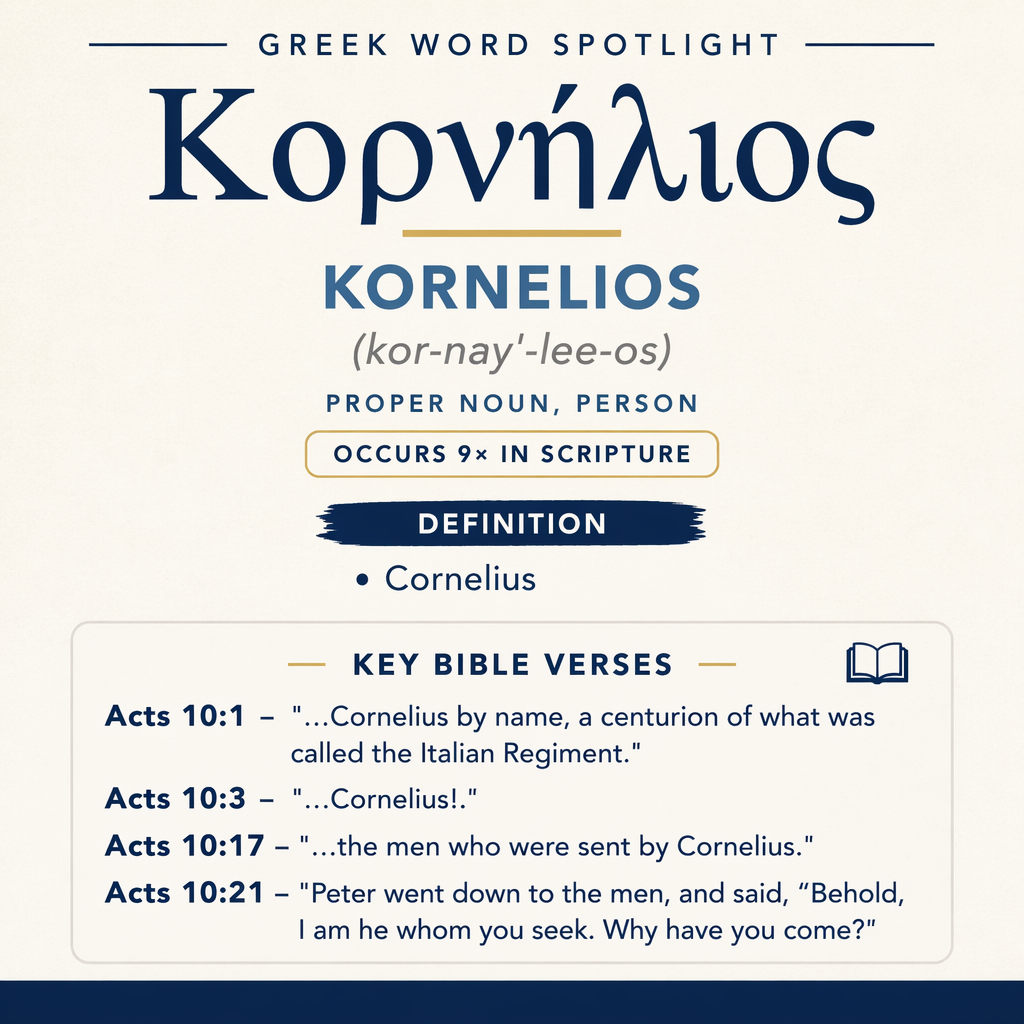
Κορνήλιος (Kornelios) means “Cornelius” and appears 9 times in Scripture, all in Acts 10.
Acts Narrative
In Acts 10:1, Cornelius is in Caesarea and is a centurion of the Italian Regiment. He sees a vision and later speaks with Peter (Acts 10:3, 10:21–22).
Learn More →Key Scenes
Cornelius gathers relatives and others while waiting for Peter (Acts 10:24). When Peter enters, Cornelius falls at his feet and worships him (Acts 10:25).
Learn More →Κορνήλιος refers to Cornelius, a named individual who appears in Acts 10 in connection with events in Caesarea and with Peter’s arrival and message. In these scenes the name functions as a fixed personal identifier, marking the same man through visions, messengers, hospitality, and testimony.
Occurrences
Acts 10:1: “Now there was a certain man in Caesarea, Cornelius by name, a centurion of what was called the Italian Regiment,”
Here the name anchors the narrative to a particular person located “in Caesarea” and described in public, official terms: he is “a centurion” attached to “the Italian Regiment.” The use of the personal name alongside rank and unit sets Cornelius in a recognizably structured social world, where his identity includes both personal name and military office.
Acts 10:3: “At about the ninth hour of the day, he clearly saw in a vision an angel of God coming to him, and saying to him, “Cornelius!””
The name is spoken directly as address. In the vision, the angel’s call “Cornelius!” singles him out as the intended recipient and focuses the moment on a personal summons rather than a general message. The scene also places him within a rhythm of time (“about the ninth hour of the day”), tying the named individual to a particular hour when this vision occurs.
Acts 10:17: “Now while Peter was very perplexed in himself what the vision which he had seen might mean, behold, the men who were sent by Cornelius, having made inquiry for Simon’s house, stood before the gate,”
Cornelius is not physically present in the sentence, but his name identifies the source behind the men at the gate: they are “sent by Cornelius.” The name thus functions as a pointer of agency, connecting activity in Caesarea to activity at “Simon’s house.” It also helps explain why Peter’s inner perplexity about his own vision is being met by an external arrival: messengers tied to Cornelius appear at a decisive moment.
Acts 10:21: “Peter went down to the men, and said, “Behold, I am he whom you seek. Why have you come?””
This verse contains Peter’s direct engagement with the visitors introduced as connected to Cornelius. Though Cornelius is not named in the quoted words, the prior identification of these men as “sent by Cornelius” frames Peter’s question “Why have you come?” as the first spoken step in a chain of communication initiated by Cornelius.
Acts 10:22: “They said, “Cornelius, a centurion, a righteous man and one who fears God, and well spoken of by all the nation of the Jews, was directed by a holy angel to invite you to his house, and to listen to what you say.””
The messengers present Cornelius by name and then expand the identification with a cluster of descriptors: “a centurion,” “a righteous man and one who fears God,” and “well spoken of by all the nation of the Jews.” In their report, the name introduces both character and reputation, and it also serves as the grammatical subject of the divine direction: Cornelius “was directed by a holy angel” to do two concrete things—“invite you to his house” and “listen to what you say.” The name thus links moral description, social standing, and obedience to an instruction that aims at hearing Peter’s message.
Acts 10:24: “On the next day they entered into Caesarea. Cornelius was waiting for them, having called together his relatives and his near friends.”
Cornelius is portrayed as expectant and prepared: “waiting for them.” The name marks the host at the destination (“Caesarea”) and highlights his initiative in gathering an audience—“his relatives and his near friends.” In this scene the name carries the weight of household and social network: Cornelius is not merely an individual but the one who convenes others for what is about to be heard.
Acts 10:25: “When Peter entered, Cornelius met him, fell down at his feet, and worshiped him.”
The name is attached to an immediate bodily response to Peter’s arrival. Cornelius “met him,” then “fell down at his feet,” and “worshiped him.” The personal name keeps the focus on the actor of these gestures, presenting Cornelius as someone who responds with pronounced reverence in the encounter. The sequence of verbs—met, fell, worshiped—gives the name a vivid narrative profile in the doorway moment.
Acts 10:30: “Cornelius said, “Four days ago, I was fasting until this hour, and at the ninth hour, I prayed in my house, and behold, a man stood before me in bright clothing,”
With “Cornelius said,” the name introduces first-person testimony. Cornelius recounts a timeline (“Four days ago”) and practices described as “fasting” and praying “in my house,” again tied to “the ninth hour.” The name here serves to authenticate the narration as his own account of the encounter with “a man…in bright clothing,” setting up continuity with the earlier vision scene and grounding it in a personal memory.
Acts 10:31: “and said, ‘Cornelius, your prayer is heard, and your gifts to the needy are remembered in the sight of God.”
The name appears again as direct address inside the reported speech, now paired with evaluation: “your prayer is heard” and “your gifts to the needy are remembered in the sight of God.” Cornelius’ name functions as the anchor for these two items—prayer and charitable giving—linking them to divine notice. The address personalizes the assurance; it is not an abstract claim but a word spoken to Cornelius by name.

Sense and Usage
Across these passages, Κορνήλιος operates as a stable personal name that keeps the reader oriented as the narrative moves between places (Caesarea; Simon’s house; Cornelius’ house), participants (Cornelius, Peter, the messengers), and modes of communication (vision, sending, invitation, face-to-face meeting, spoken report). The name first locates Cornelius within civic and military structures—“a centurion of what was called the Italian Regiment”—and then carries him into explicitly religious actions and evaluations: he sees a vision, is addressed by an angel, is described to Peter as “a righteous man and one who fears God,” gathers “relatives and…near friends,” and speaks of fasting, praying, and “gifts to the needy.”
The occurrences show Cornelius as both initiator and respondent. He initiates by sending men and by assembling a group in expectation; he responds by receiving a vision, by welcoming Peter, and by recounting the experience in detail. The repeated direct address—“Cornelius!” in the vision and again in the remembered message—marks the name as a point of personal summons: Cornelius is called, instructed, and reassured in ways that depend on his being individually identified. The messengers’ speech further shows how the name functions in public report: they can summarize his standing (“well spoken of by all the nation of the Jews”) and the purpose of the invitation (“to listen to what you say”) while keeping Cornelius himself at the center as the one who was directed to act.
In narrative flow, the name also binds together two visions without conflating them: Peter is “very perplexed” about what his vision might mean at the moment Cornelius’ men arrive, and the name “Cornelius” supplies the human link that moves the story from Peter’s internal puzzlement to an external meeting and message. Cornelius’ own later speech (“Cornelius said…”) reinforces that link by providing his perspective on the timing and setting of his experience (“at the ninth hour…in my house”), so the name becomes the label under which two strands of divine guidance and human response intersect in a single meeting.
Imagery and Narrative Color
The name Cornelius carries the imagery of a household doorway and a gathered room: men standing “before the gate,” a host “waiting,” “relatives and…near friends” assembled, and a visitor being met with dramatic reverence. It is also tied to the imagery of an announced hour—“the ninth hour”—and to a remembered scene of brightness: “a man stood before me in bright clothing.” In these snapshots, Cornelius is the named point where prayer, generosity, invitation, and encounter converge into a single, concrete story set in ordinary spaces—house, gate, and city—punctuated by a vision and a spoken name.
Sources: Lexical data from Strong’s Exhaustive Concordance and the Translators Brief Lexicon of Extended Strongs for Greek (STEPBible, CC BY). Occurrence data from the Translators Amalgamated Greek New Testament (STEPBible, CC BY). Scripture quotations from the World English Bible (public domain).