
Exploring the Meaning of Korennumi in Greek
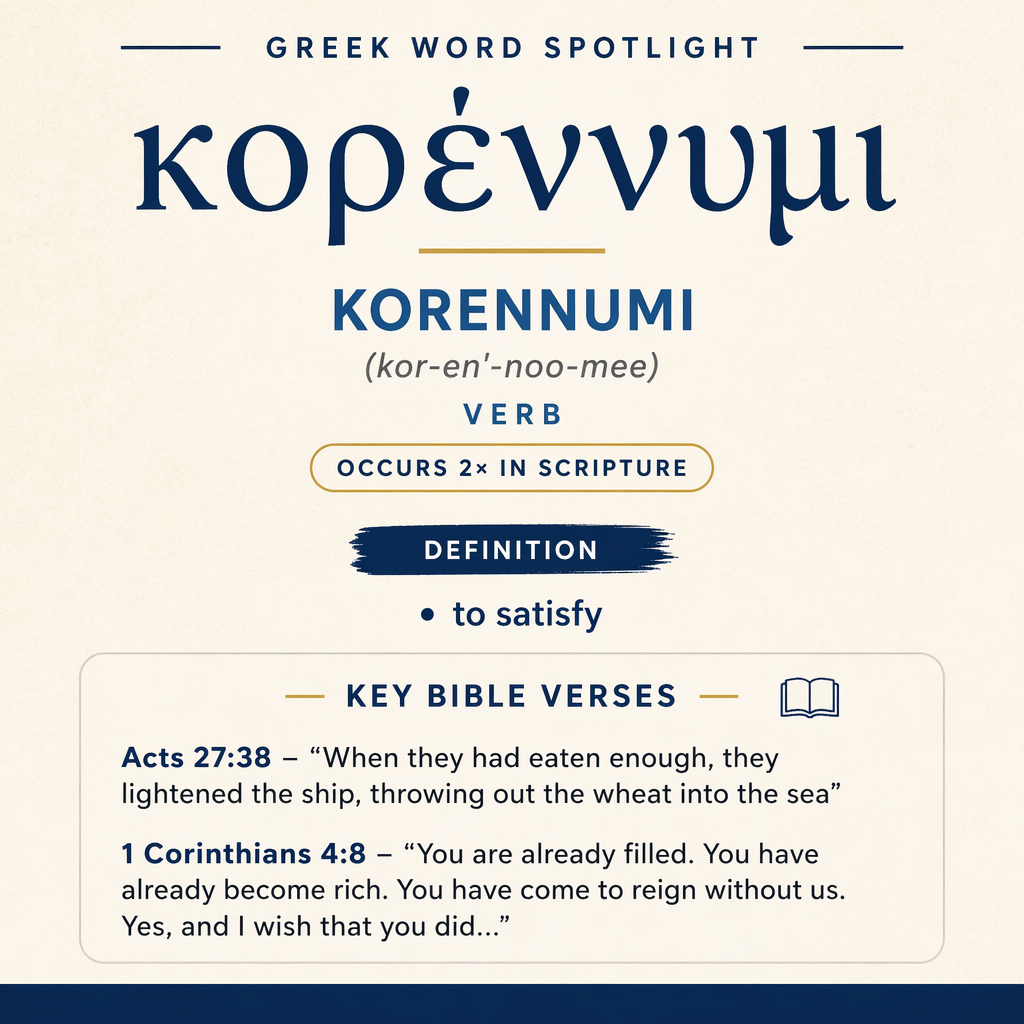
κορέννυμι means “to satisfy” and occurs twice in Scripture: Acts 27:38 and 1 Corinthians 4:8.
Scripture Occurrences
It appears 2 times in Scripture. The references are Acts 27:38 and 1 Corinthians 4:8.
Learn More →Context Snapshot
In Acts 27:38 it is used of eating enough. In 1 Corinthians 4:8 it is used of being already filled.
Learn More →κορέννυμι expresses the idea of being satisfied, and it appears in two New Testament scenes: a ship’s crew eating to the point of sufficiency, and a pointed statement about a community that considers itself already “filled.” In both contexts, the word belongs to the language of having enough, with the surrounding details supplying either physical or figurative coloring.
Occurrences
“When they had eaten enough, they lightened the ship, throwing out the wheat into the sea.” (Acts 27:38)
Here κορέννυμι marks the completion of a necessary act: the people on board reach the point where hunger has been met—“they had eaten enough.” The clause does more than report that food was consumed; it signals sufficiency, a state in which further eating is not required for the immediate purpose at hand. That sufficiency becomes the pivot into the next action: “they lightened the ship.” The narrative moves from meeting bodily need to taking survival measures, and the satisfaction implied by the word helps set the order and logic of the moment. They do not merely snack or eat in passing; they eat to the point of being satisfied, and then they are ready for decisive, costly steps.
The follow-up action—“throwing out the wheat into the sea”—frames the satisfaction as temporary and subordinate to the larger crisis. Wheat is valuable cargo and, in ordinary circumstances, would be carefully preserved. Yet once the crew has eaten to sufficiency, the remaining grain can be treated as expendable ballast. In this way, the word contributes to the narrative’s realism: the meal is not an indulgence but an act of attaining enough strength and steadiness to proceed. The satisfaction of hunger is presented as a practical threshold that enables the next stage of response.
“You are already filled. You have already become rich. You have come to reign without us. Yes, and I wish that you did reign, that we also might reign with you.” (1 Corinthians 4:8)
In this sentence, κορέννυμι appears in a sharply rhetorical setting. “You are already filled” places the readers in a posture of perceived completion: they regard themselves as having reached a state where needs are met and nothing remains to be supplied. The word works with the surrounding clauses—“already become rich,” “come to reign”—to paint an attitude of arrival and self-sufficiency. Satisfaction here is not about a completed meal but about a settled self-assessment.
The repeated “already” intensifies the effect. The community is portrayed as claiming present fullness rather than waiting, learning, or receiving. Within the flow of the sentence, being “filled” functions like the first step in a progression: fullness, then wealth, then reign. The verb thus helps build the irony of the statement: the speaker describes them as though they have reached a mature, triumphant state “without us.” The closing wish—“I wish that you did reign, that we also might reign with you”—keeps the tone tense and layered. The word for being satisfied contributes to this tension by naming the claimed condition of sufficiency that sets the rest of the critique in motion.

Sense and Usage
The two occurrences show κορέννυμι functioning as a marker of sufficiency, but the sufficiency is framed differently by each context. In Acts 27:38 it is bodily and immediate: hunger is met, and the narrative treats that satisfaction as a prerequisite for further action. The word sits close to tangible necessities—food, a ship, cargo, the sea—and the satisfaction it expresses is observable in what follows. The crew’s being “enough”-fed is not left abstract; it is confirmed by the practical decision to reduce weight by jettisoning wheat. Satisfaction here is tied to a threshold: once reached, a new set of decisions becomes possible.
In 1 Corinthians 4:8 the same idea of sufficiency is lifted into the realm of evaluation and status. “Filled” becomes a claim about having enough in a broader sense—enough standing, enough success, enough completeness to regard oneself as already rich and already reigning. The satisfaction is not presented as a quiet state but as something asserted, and the surrounding language highlights how that assertion affects relationships (“without us”) and the speaker’s response (a wish that the reign were real and shared). Thus, the verb’s core sense supports two kinds of “enough”: enough food to act in crisis, and enough perceived attainment to speak as though nothing remains lacking.
Across both passages, the satisfaction indicated by κορέννυμι has a boundary-setting function. It draws a line between need and sufficiency—before and after. In Acts, “eaten enough” divides fasting or weakness from readiness to execute a difficult plan. In 1 Corinthians, “already filled” divides a posture of dependence from a posture of self-congratulation. The word itself does not supply the moral evaluation; that comes from the way each author frames the satisfied state. The narrative in Acts treats sufficiency as a practical good that enables survival. The rhetoric in 1 Corinthians treats claimed sufficiency as a stance that invites correction.
The pairing of these contexts also shows how a single verb of satisfaction can carry either a concrete or figurative weight without changing its basic force. In one setting, the satisfaction is anchored to eating; in the other, it is anchored to the metaphor of being “filled” as a way of speaking about completion. In both, the term signals that a limit has been reached: the eater stops because enough has been taken in; the self-satisfied person speaks as though nothing more needs to be received. The surrounding clauses determine whether that limit is portrayed as wise readiness or premature triumph.
Imagery and Resonance
Acts 27:38 leaves the reader with a stark image: people on a ship eat until satisfied and then throw wheat into the sea. The satisfaction is immediately set against loss and urgency, making “enough” feel like a brief island of stability in a dangerous situation. In 1 Corinthians 4:8, the image of being “filled” stands at the head of a cluster of triumphal claims—filled, rich, reigning—so that satisfaction becomes part of a portrait of self-assured completion. Together, these passages show κορέννυμι as a word that can describe a necessary sufficiency that steadies action, or an asserted sufficiency that shapes how a community imagines its own condition.
Sources: Lexical data from Strong’s Exhaustive Concordance and the Translators Brief Lexicon of Extended Strongs for Greek (STEPBible, CC BY). Occurrence data from the Translators Amalgamated Greek New Testament (STEPBible, CC BY). Scripture quotations from the World English Bible (public domain).





