
Who was Zophai in the bible?
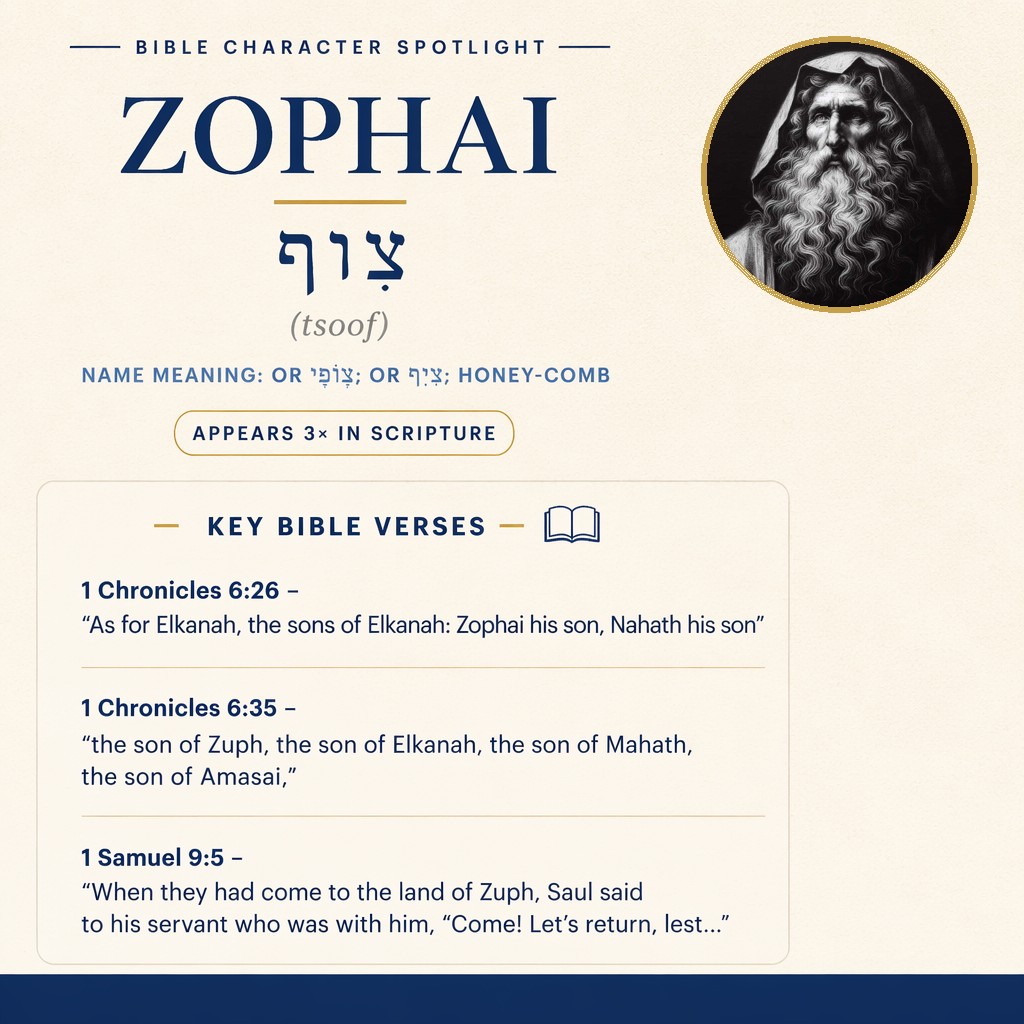
Zophai is named in a genealogical list in 1 Chronicles 6:26, and the related name Zuph appears in 1 Chronicles 6:35 and in “the land of Zuph” in 1 Samuel 9:5.
Genealogy Mention
Within the genealogy, another spelling appears: “the son of Zuph, the son of Elkanah” (1 Chronicles 6:35).
Learn More →Land of Zuph
Saul and his servant traveled until “they had come to the land of Zuph” (1 Samuel 9:5), where Saul proposed returning home.
Learn More →Zophai is presented as the name of an Israelite in a genealogical line, and the same Hebrew name is also used for a place (“the land of Zuph”) mentioned in Saul’s travels. The lexicon gloss associates the name with forms such as Tsuph/Tsophai/Tsiph and links it to the idea of a honeycomb.
Zophai in Scripture
Zophai appears in 1 Chronicles within a list tracing descent lines connected with Levitical service. In that genealogical setting, Zophai is identified as a son of Elkanah and as the father of Nahath.
“As for Elkanah, the sons of Elkanah: Zophai his son, Nahath his son,” (1 Chronicles 6:26)
The immediate context continues the same line of descent beyond Zophai and Nahath, placing them within a longer sequence that proceeds through Eliab, Jeroham, and another Elkanah, and then extends to Samuel’s sons.
“Eliab his son, Jeroham his son, and Elkanah his son. The sons of Samuel: the firstborn, Joel, and the second, Abijah.” (1 Chronicles 6:27–28)
Later in the chapter, Zophai’s name appears in a parallel genealogical chain where the form is given as “Zuph.” In the list, one person is described as “the son of Zuph,” followed by Elkanah and additional ancestors. This placement again situates the name within a recorded lineage.
“the son of Zuph, the son of Elkanah, the son of Mahath, the son of Amasai,” (1 Chronicles 6:35)
The broader passage around these lines describes worship leadership in connection with the tabernacle and later the temple, framing the genealogies as tied to assigned musical service. The text says of those named that “They ministered with song before the tabernacle of the Tent of Meeting, until Solomon had built Yahweh’s house in Jerusalem. They performed the duties of their office according to their order.” (1 Chronicles 6:32) It then introduces the listed servants and their sons among “the sons of the Kohathites,” naming “Heman the singer” and tracing his line back through Joel and Samuel, and further through Elkanah and other ancestors (1 Chronicles 6:33–38). Within that structure, Zophai/Zuph functions as a genealogical marker in the ancestral chain recorded in the chapter.
The name also occurs in 1 Samuel in a geographical expression, “the land of Zuph,” in the narrative of Saul’s search for his father’s lost donkeys. Saul and a servant travel through multiple regions without finding them, and upon reaching this land Saul proposes returning home out of concern for his father.
“When they had come to the land of Zuph, Saul said to his servant who was with him, ‘Come! Let’s return, lest my father stop caring about the donkeys, and be anxious for us.’” (1 Samuel 9:5)
The surrounding narrative describes Saul as “an impressive young man; and there was not among the children of Israel a better person than he. From his shoulders and upward he was taller than any of the people.” (1 Samuel 9:2) The search begins when “The donkeys of Kish, Saul’s father, were lost” and Kish commissions Saul to look for them with a servant (1 Samuel 9:3). Saul passes through several areas—“the hill country of Ephraim,” “the land of Shalishah,” “the land of Shaalim,” and “the land of the Benjamites”—but “they didn’t find them” (1 Samuel 9:4). When Saul suggests turning back in the land of Zuph, the servant redirects the mission toward consulting a “man of God.”
“The servant said to him, ‘Behold now, there is a man of God in this city, and he is a man who is held in honor. All that he says surely happens. Now let’s go there. Perhaps he can tell us which way to go.’” (1 Samuel 9:6)
Saul raises the practical question of what gift they can bring, since “the bread is spent in our sacks, and there is not a present to bring to the man of God” (1 Samuel 9:7). The servant answers that he has “the fourth part of a shekel of silver” to give (1 Samuel 9:8). The narrator adds a parenthetical note explaining earlier terminology: “for he who is now called a prophet was before called a seer” (1 Samuel 9:9). Saul agrees—“Well said. Come! Let’s go.” (1 Samuel 9:10)—and the pair go to the city where the man of God is (1 Samuel 9:10).
As they approach, they ask young women drawing water, “Is the seer here?” (1 Samuel 9:11). They answer that he is, and urge them to hurry because “he has come today into the city; for the people have a sacrifice today in the high place” (1 Samuel 9:12). They explain that the people will not eat until he arrives, “because he blesses the sacrifice. Afterwards those who are invited eat.” (1 Samuel 9:13) Acting on this guidance—“Now therefore go up; for at this time you will find him.” (1 Samuel 9:13)—Saul and his servant go up, and at that moment “behold, Samuel came out toward them, to go up to the high place.” (1 Samuel 9:14) Within this scene, “the land of Zuph” is the location where Saul’s initial plan to abandon the search is voiced, prompting the turn toward seeking prophetic guidance.
Multiple Bearers
The same Hebrew name is associated with both an Israelite individual (Zophai) and a place (the land of Zuph). As an individual, Zophai is named in a genealogy: “Zophai his son, Nahath his son” (1 Chronicles 6:26). As a name in the genealogical line, it also appears in the form “Zuph”: “the son of Zuph” (1 Chronicles 6:35). As a place, it appears in 1 Samuel: “the land of Zuph” (1 Samuel 9:5), where Saul speaks of returning home.
Name and Meaning
The name is written in Hebrew as צוּף (transliterated Tsuwph; pronounced tsoof). The lexicon information connects Zophai/Zuph (also associated with forms Tsophai/Tsiph) to a root meaning a “honey-comb,” with the component idea of a comb of honey formed “from dripping.” In Scripture, that name is attached both to a person in a recorded lineage and to a territory through which Saul traveled.
Observation
Across its occurrences, Zophai/Zuph functions primarily as an identifying name—anchoring a genealogical line in 1 Chronicles and marking a turning point in Saul’s search in 1 Samuel, where “the land of Zuph” becomes the setting for the decision to seek out the “seer” (1 Samuel 9:5–13).
Frequently Asked Questions
What does the name Zophai mean?
The name is linked with “honey-comb.”
How many times does Zophai appear in the Bible?
Zophai appears 3 times.
Who was Zophai in the Bible?
Zophai (also spelled Tsuph/Tsophai/Tsiph) is the name of an Israelite. In a genealogy, Zophai is listed as Elkanah’s son (1 Chronicles 6:26).
What is the land of Zuph mentioned with Saul?
In 1 Samuel 9:5, Saul and his servant come to “the land of Zuph,” and Saul suggests returning home.
Explore Further
If you found this page about Zophai interesting and would like to discover more about other biblical characters, explore our comprehensive Encyclopedia of Biblical Characters. For those looking to delve deeper into the Greek origins of these names and terms, our Greek Lexicon is an invaluable resource.
Sources: Name and occurrence data from Strong’s Exhaustive Concordance and STEPBible reference data (CC BY). Scripture quotations from the World English Bible (public domain).




