Who was Ziph in the bible?
Ziph is a biblical name used for a place in Palestine and for an Israelite, appearing in Joshua 15; 1 Samuel 23; 1 Samuel 26; 1 Chronicles 2; 1 Chronicles 4; and 2 Chronicles 11.
Where Ziph Was
Ziph is named among places in Judah’s allotment: “Ziph, Telem, Bealoth” (Joshua 15:24) and “Maon, Carmel, Ziph, Jutah” (Joshua 15:55). It is also listed among fortified cities: “Gath, Mareshah, Ziph,” (2 Chronicles 11:8).
Learn More →In David’s Flight
David hid “in the hill country in the wilderness of Ziph” (1 Samuel 23:14) and “was in the wilderness of Ziph in the wood” (1 Samuel 23:15). Saul “went down to the wilderness of Ziph… to seek David” (1 Samuel 26:2).
Learn More →Ziph is the name of both (1) individuals in Israelite genealogies and (2) a place in the land, including “the wilderness of Ziph,” associated with David’s movements while Saul sought him. The name is also used in territorial lists, and a group called “the Ziphites” appears in the narrative about David.
Ziph in Scripture
Ziph as a person in genealogies. In one genealogy, Ziph is linked to Caleb’s line through Mesha:
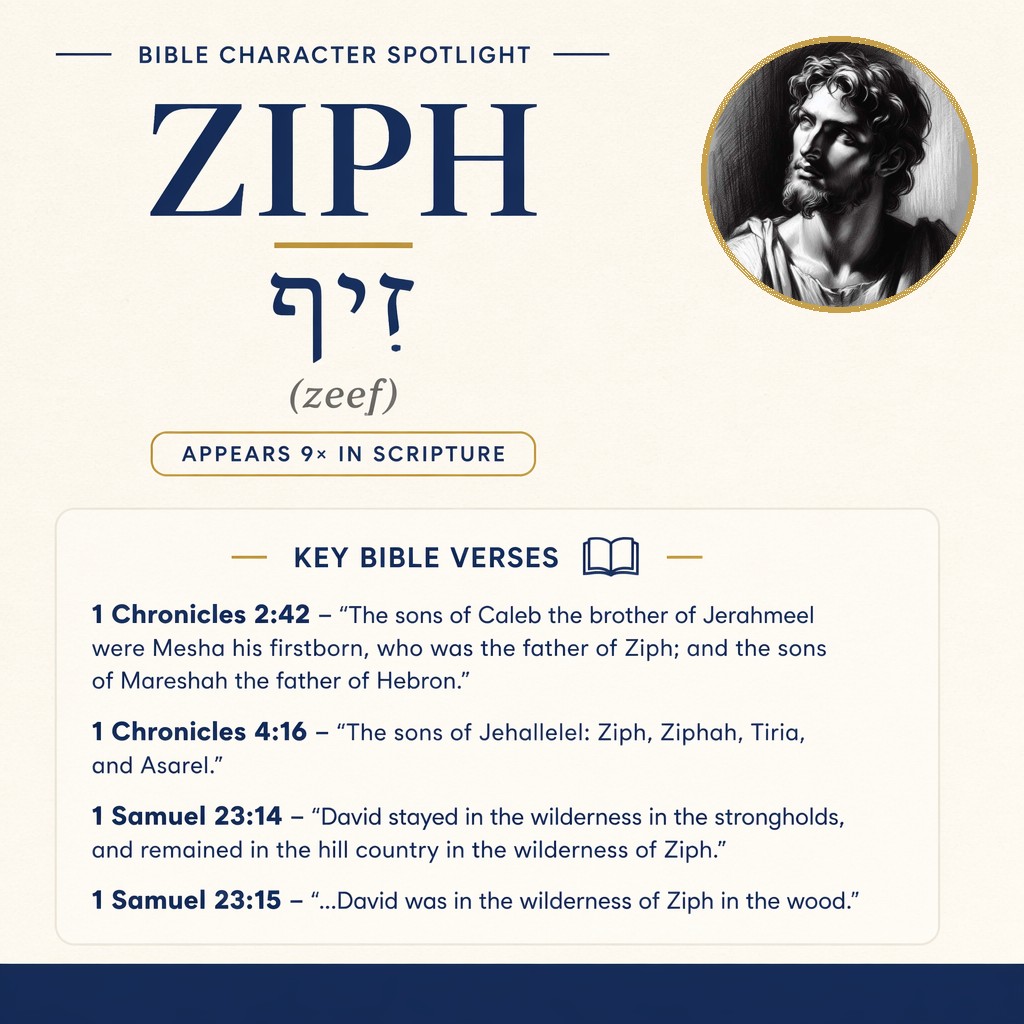
“The sons of Caleb the brother of Jerahmeel were Mesha his firstborn, who was the father of Ziph; and the sons of Mareshah the father of Hebron.” (1 Chronicles 2:42)
In another list, Ziph is named among the sons of Jehallelel:
“The sons of Jehallelel: Ziph, Ziphah, Tiria, and Asarel.” (1 Chronicles 4:16)
Ziph as a place in territorial and city lists. Ziph appears among towns listed in Judah’s territory:
“Ziph, Telem, Bealoth,” (Joshua 15:24)
“Maon, Carmel, Ziph, Jutah,” (Joshua 15:55)
It is also listed among places fortified or associated with Rehoboam’s building activity:
“Gath, Mareshah, Ziph,” (2 Chronicles 11:8)
The wilderness of Ziph in the narrative of David and Saul (1 Samuel 23). The chapter’s broader setting begins with David receiving news of conflict at Keilah, seeking Yahweh’s guidance, and going to fight:
“David was told, ‘Behold, the Philistines are fighting against Keilah, and are robbing the threshing floors.’” (1 Samuel 23:1)
“Therefore David inquired of Yahweh… Yahweh said to David, ‘Go strike the Philistines, and save Keilah.’” (1 Samuel 23:2)
“David and his men went to Keilah, and fought with the Philistines… So David saved the inhabitants of Keilah.” (1 Samuel 23:5)
As Saul heard of David’s presence, he interpreted it as an opportunity:
“Saul was told that David had come to Keilah. Saul said, ‘God has delivered him into my hand; for he is shut in by entering into a town that has gates and bars.’” (1 Samuel 23:7)
David, learning Saul’s intent, sought counsel through the ephod and asked whether Keilah would surrender him:
“David knew that Saul was devising mischief against him; and he said to Abiathar the priest, ‘Bring the ephod here.’” (1 Samuel 23:9)
“Will the men of Keilah deliver me and my men into the hand of Saul? Yahweh said, ‘They will deliver you up.’” (1 Samuel 23:12)
David then left Keilah with his men, and Saul ceased that immediate pursuit:
“Then David and his men, who were about six hundred, arose and departed out of Keilah… Saul was told that David was escaped from Keilah; and he gave up going there.” (1 Samuel 23:13)
The narrative next places David in the wilderness of Ziph, framing Ziph as a wilderness region marked by “strongholds” and “hill country,” and describing Saul’s persistent pursuit alongside divine protection:
“David stayed in the wilderness in the strongholds, and remained in the hill country in the wilderness of Ziph. Saul sought him every day, but God didn’t deliver him into his hand.” (1 Samuel 23:14)
“David saw that Saul had come out to seek his life. David was in the wilderness of Ziph in the wood.” (1 Samuel 23:15)
While David was there, Jonathan came to him “into the woods,” encouraged him in God, and spoke of David’s future kingship; they made a covenant before Yahweh:
“Jonathan, Saul’s son, arose, and went to David into the woods, and strengthened his hand in God.” (1 Samuel 23:16)
“He said to him, ‘Don’t be afraid… you will be king over Israel…’” (1 Samuel 23:17)
“They both made a covenant before Yahweh. Then David stayed in the woods…” (1 Samuel 23:18)
Immediately afterward, a group identified by their connection to Ziph appears. They went to Saul at Gibeah and described David’s hiding places in the vicinity, offering to deliver him:
“Then the Ziphites came up to Saul to Gibeah, saying, ‘Doesn’t David hide himself with us in the strongholds in the woods, in the hill of Hachilah, which is on the south of the desert?’” (1 Samuel 23:19)
“‘…and our part will be to deliver him up into the king’s hand.’” (1 Samuel 23:20)
Saul blessed them and instructed them to confirm David’s location carefully:
“Saul said, ‘You are blessed by Yahweh; for you have had compassion on me.’” (1 Samuel 23:21)
“‘Please go make yet more sure, and know and see his place where his haunt is…’” (1 Samuel 23:22)
“‘…come again to me with certainty, and I will go with you.’” (1 Samuel 23:23)
The movement of the parties is then described using Ziph as a geographic reference point. The Ziphites (or those acting on their report) went ahead of Saul, while David had moved on:
“They arose, and went to Ziph before Saul: but David and his men were in the wilderness of Maon…” (1 Samuel 23:24)
Thus, within 1 Samuel 23, Ziph functions as the named wilderness region where David occupied strongholds and wooded areas, and as the locale tied to the Ziphites’ report to Saul. A later note shows Saul also traveling to the same wilderness when continuing his search:
“Then Saul arose, and went down to the wilderness of Ziph, having three thousand chosen men of Israel with him, to seek David in the wilderness of Ziph.” (1 Samuel 26:2)
Multiple bearers
The name Ziph refers to more than one bearer. In genealogies it names individuals: one connected to Caleb’s line through Mesha (“Mesha… was the father of Ziph,” 1 Chronicles 2:42) and another as a son of Jehallelel (“Ziph,” 1 Chronicles 4:16). Separately, Ziph is also a place named in territorial and city lists (Joshua 15:24; Joshua 15:55; 2 Chronicles 11:8) and in narrative geography (“the wilderness of Ziph,” 1 Samuel 23:14–15; 1 Samuel 26:2), with “the Ziphites” appearing as people associated with that locale (1 Samuel 23:19).
Name and Meaning
Ziph is written in Hebrew as זִיף (transliterated Ziyph, pronounced “zeef”). The name is derived from a root described as meaning “flowing,” connected to a related term zepheth (זֶפֶת), “asphalt,” with the connection explained as coming from its tendency to soften.
Observation
In the account centered on David’s flight, the wilderness of Ziph is portrayed as a place of concealment and pursuit—“strongholds” and “woods”—where “Saul sought him every day,” yet “God didn’t deliver him into his hand” (1 Samuel 23:14–15).
Frequently Asked Questions
What does the name Ziph mean?
Ziph means “flowing.”
How many times does Ziph appear in the Bible?
Ziph appears 9 times.
Who was Ziph in the Bible?
Ziph is the name of a place in Palestine and also the name of an Israelite. In genealogies, Ziph is named as a son (1 Chronicles 4:16) and also appears as someone connected to Caleb’s line (1 Chronicles 2:42).
Where was David when Saul was searching for him?
David stayed in the wilderness of Ziph while Saul sought him (1 Samuel 23:14–15).
Explore Further
If you found this page about Ziph interesting and would like to discover more about other biblical characters, explore our comprehensive Encyclopedia of Biblical Characters. For those looking to delve deeper into the Greek origins of these names and terms, our Greek Lexicon is an invaluable resource.
Sources: Name and occurrence data from Strong’s Exhaustive Concordance and STEPBible reference data (CC BY). Scripture quotations from the World English Bible (public domain).