Who was Zimri in the bible?
Zimri is a name borne by multiple figures in Scripture, including a conspirator-king in 1 Kings 16 and genealogical names in 1 Chronicles 2, 8, and 9.

Death in Tirzah
When the city fell, “he… burned the king’s house over him with fire, and died” (1 Kings 16:18). His reign is described as “his treason that he committed” (1 Kings 16:20).
Learn More →Other Bearers
In genealogies, “The sons of Zerah: Zimri” appears among five names (1 Chronicles 2:6). Another Zimri is named as a son in lineage lists and “became the father of Moza” (1 Chronicles 8:36; 1 Chronicles 9:42).
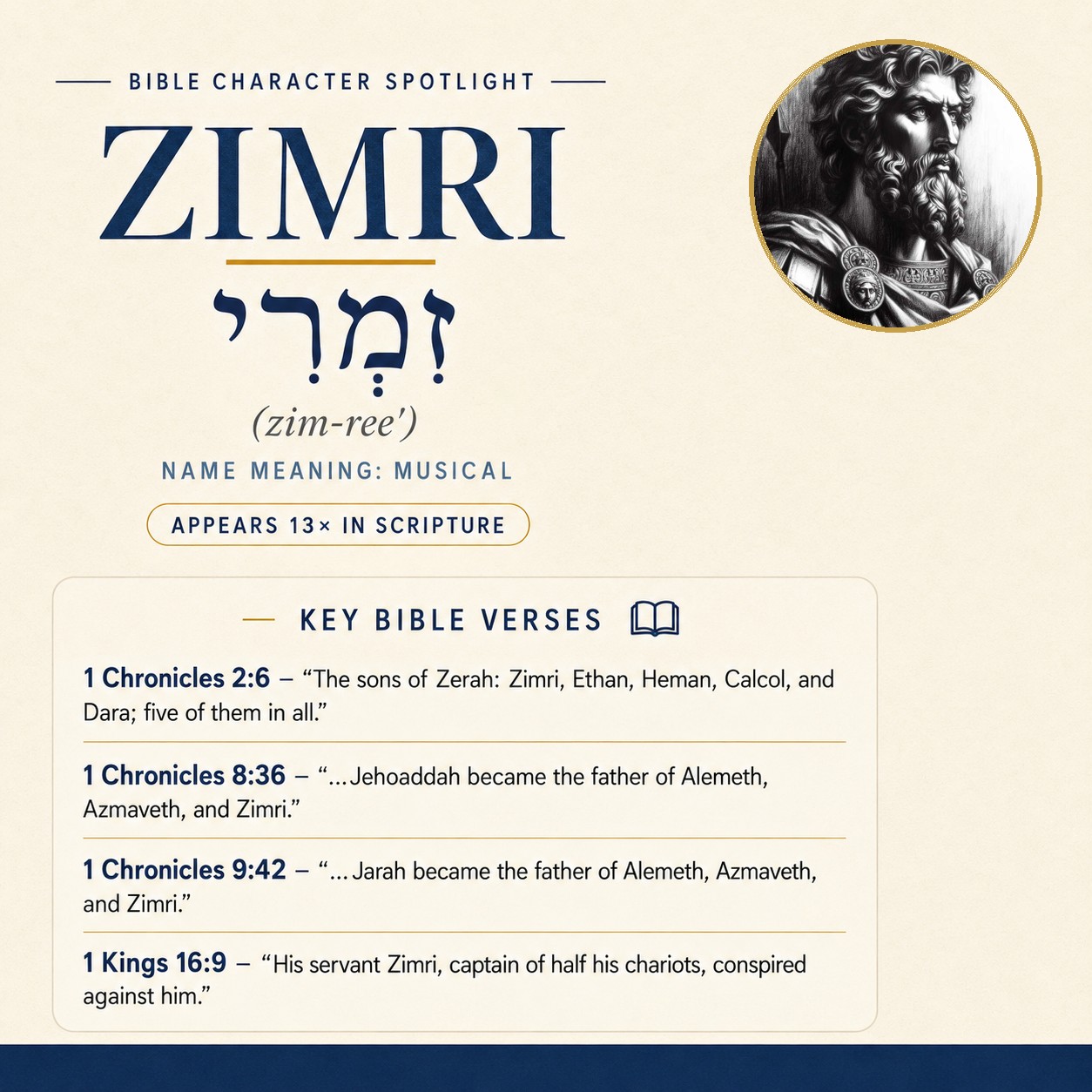
Learn More →Zimri (זִמְרִי, Zimriy; pronounced zim-ree’) is a biblical name borne by multiple figures in Israel’s records, and it is also used of a group described as having “kings.” In the biblical narratives and genealogies provided, the most detailed Zimri is a military officer who seized Israel’s throne briefly at Tirzah.
Zimri in Scripture
1) Zimri in Judah’s genealogy (son of Zerah). In a list of descendants, Zimri appears among the sons of Zerah:
“The sons of Zerah: Zimri, Ethan, Heman, Calcol, and Dara; five of them in all.” (1 Chronicles 2:6)
2) Zimri in genealogies connected with Ahaz. Two parallel genealogical notices present Zimri as one of Ahaz’s descendants and as the father of Moza:
“Ahaz became the father of Jehoaddah. Jehoaddah became the father of Alemeth, Azmaveth, and Zimri. Zimri became the father of Moza.” (1 Chronicles 8:36)
“Ahaz became the father of Jarah. Jarah became the father of Alemeth, Azmaveth, and Zimri. Zimri became the father of Moza.” (1 Chronicles 9:42)
3) Zimri the conspirator and short-lived king in Israel. The fullest account describes Zimri as a royal servant and military commander who assassinated Israel’s king Elah and ruled briefly from Tirzah. The narrative first identifies his position and action against Elah:
“His servant Zimri, captain of half his chariots, conspired against him. Now he was in Tirzah, drinking himself drunk in the house of Arza, who was over the household in Tirzah;” (1 Kings 16:9)
“and Zimri went in and struck him, and killed him, in the twenty-seventh year of Asa king of Judah, and reigned in his place.” (1 Kings 16:10)
After taking the throne, Zimri immediately moved against the entire house of Baasha. The account frames this sweeping destruction in relation to Yahweh’s word spoken earlier against Baasha:
“When he began to reign, as soon as he sat on his throne, he attacked all the house of Baasha. He didn’t leave him a single one who urinates on a wall among his relatives or his friends.” (1 Kings 16:11)
“Thus Zimri destroyed all the house of Baasha, according to Yahweh’s word, which he spoke against Baasha by Jehu the prophet,” (1 Kings 16:12)
Zimri’s reign was extremely brief, located at Tirzah while Israel’s forces were encamped elsewhere:
“In the twenty-seventh year of Asa king of Judah, Zimri reigned seven days in Tirzah. Now the people were encamped against Gibbethon, which belonged to the Philistines.” (1 Kings 16:15)
When the army and people heard of the conspiracy and royal killing, they chose another leader, Omri, as king:
“The people who were encamped heard that Zimri had conspired, and had also killed the king. Therefore all Israel made Omri, the captain of the army, king over Israel that day in the camp.” (1 Kings 16:16)
Omri marched from Gibbethon with “all Israel,” besieged Tirzah, and captured the city. Seeing defeat, Zimri died by fire in the king’s house:
“Omri went up from Gibbethon, and all Israel with him, and they besieged Tirzah.” (1 Kings 16:17)
“When Zimri saw that the city was taken, he went into the fortified part of the king’s house, and burned the king’s house over him with fire, and died,” (1 Kings 16:18)
The text then gives a moral explanation for Zimri’s end, linking it to “sins” and to “walking in the way of Jeroboam,” including the charge that he participated in making Israel sin:
“for his sins which he sinned in doing that which was evil in Yahweh’s sight, in walking in the way of Jeroboam, and in his sin which he did, to make Israel to sin.” (1 Kings 16:19)
A closing notice points to additional records of his actions and characterizes them as treason:
“Now the rest of the acts of Zimri, and his treason that he committed, aren’t they written in the book of the chronicles of the kings of Israel?” (1 Kings 16:20)
4) “Zimri” as a byword for a murderer of his master. Long after the events of 1 Kings 16, the name “Zimri” is invoked as a comparison for killing one’s master. As Jehu arrived at the gate, a woman addressed him with a question that explicitly attaches Zimri’s name to such an act:
“As Jehu entered in at the gate, she said, “Do you come in peace, Zimri, you murderer of your master?”” (2 Kings 9:31)
5) “Kings of Zimri.” In a list that includes various kings, “Zimri” appears as a collective designation:
“and all the kings of Zimri, all the kings of Elam, and all the kings of the Medes;” (Jeremiah 25:25)
Multiple Bearers
The name Zimri is borne by more than one figure in the passages cited. In Chronicles it appears in genealogical lists: one Zimri is listed among “The sons of Zerah” (1 Chronicles 2:6), and another Zimri appears as a descendant in a line associated with Ahaz and as the father of Moza (1 Chronicles 8:36; 1 Chronicles 9:42). In Kings it identifies a different Zimri, “captain of half his chariots,” who “conspired,” “killed” the king, “reigned seven days in Tirzah,” and died when he “burned the king’s house over him with fire” (1 Kings 16:9–10, 15, 18). Jeremiah also uses “Zimri” to refer to a group with “kings” (Jeremiah 25:25).
Name and Meaning
In Hebrew the name is written זִמְרִי, transliterated Zimriy, and pronounced zim-ree’. Its lexical derivation is connected with a root associated with music—described as meaning “musical”—and is related to a component word, zamar (זָמַר), explained as properly meaning to touch the strings or parts.
Observation
Within the narrative of Israel’s kings, Zimri’s seizure of power is described as “treason” and his reign is summarized with striking brevity—“Zimri reigned seven days in Tirzah” (1 Kings 16:15), ending when he “burned the king’s house over him with fire, and died” (1 Kings 16:18).
Frequently Asked Questions
What does the name Zimri mean?
Zimri is a Hebrew name that means “musical.”
How many times does Zimri appear in the Bible?
Zimri appears 13 times.
Who was Zimri in the Bible?
Zimri is the name of five Israelites, and also of an Arabian tribe. One Zimri is described as a servant and “captain of half his chariots” who conspired against the king (1 Kings 16:9).
What did Zimri do in 1 Kings 16?
Zimri conspired against the king, “struck him, and killed him,” and reigned in his place (1 Kings 16:10). He reigned seven days in Tirzah (1 Kings 16:15) and later burned the king’s house over himself and died (1 Kings 16:18).
Explore Further
If you found this page about Zimri interesting and would like to discover more about other biblical characters, explore our comprehensive Encyclopedia of Biblical Characters. For those looking to delve deeper into the Greek origins of these names and terms, our Greek Lexicon is an invaluable resource.
Sources: Name and occurrence data from Strong’s Exhaustive Concordance and STEPBible reference data (CC BY). Scripture quotations from the World English Bible (public domain).