Who was Zeeb in the bible?
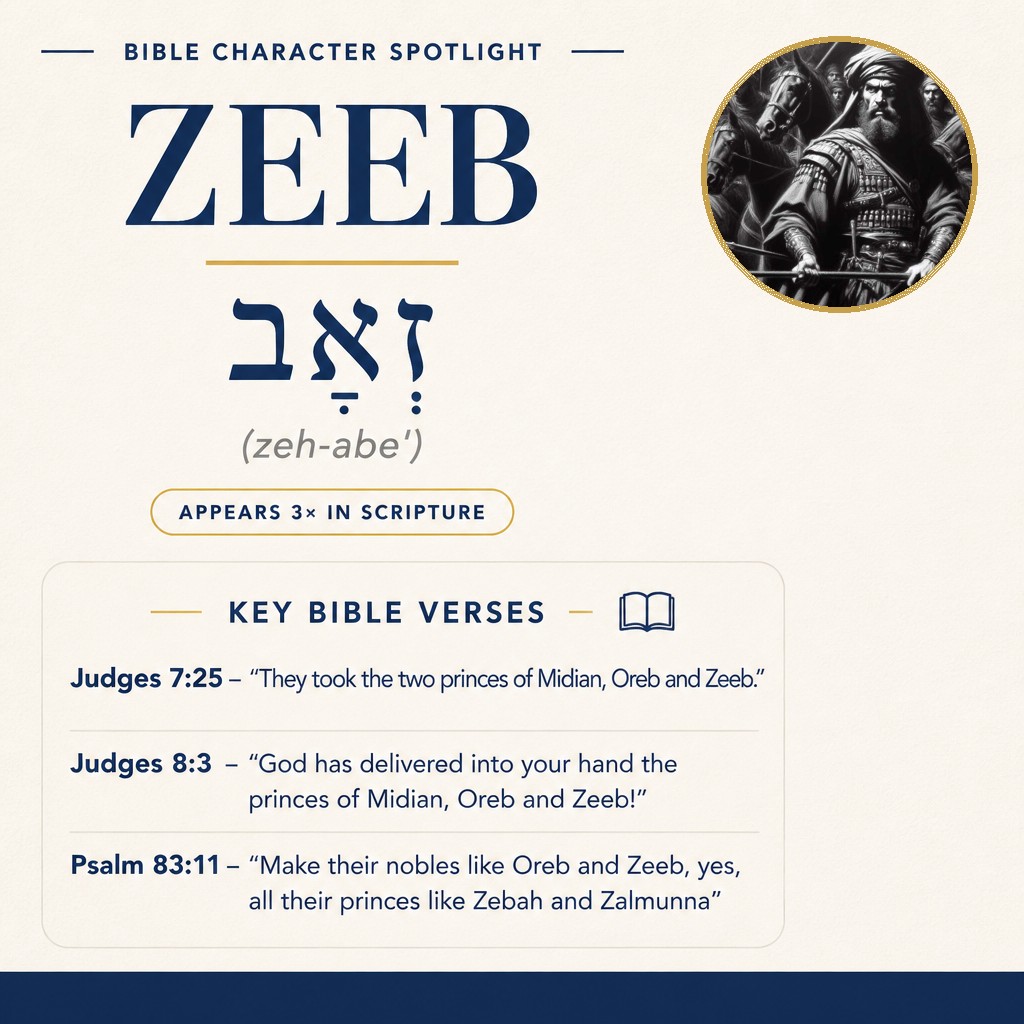
Zeeb was a prince of Midian, named in Judges 7:25; 8:3 and referenced in Psalm 83:11.

What Happened
“Zeeb they killed at Zeeb’s wine press, as they pursued Midian” (Judges 7:25), and his head was brought “to Gideon beyond the Jordan” (Judges 7:25).
Learn More →Name Meaning
Strong’s derives the name Ze'eb from a Hebrew term meaning “a wolf.” Psalm 83:11 refers to him among Midian’s nobles: “Make their nobles like Oreb and Zeeb.”
Learn More →Zeeb was a Midianitish prince whose name is derived from a Hebrew word meaning “a wolf.” In the book of Judges, he is named alongside Oreb as one of “the two princes of Midian” taken and killed during Israel’s pursuit of Midian.
Zeeb in Scripture
Zeeb appears in the narrative of Israel’s pursuit of Midian in Judges 7–8. The setting includes a mobilization of Israelites from several tribes and coordinated action under Gideon’s direction.
As Midian was pursued, the tribes involved are described in broad strokes:
“The men of Israel were gathered together out of Naphtali, out of Asher, and out of all Manasseh, and pursued Midian.” (Judges 7:23)
Gideon also called on Ephraim to take strategic positions at the waters leading to the Jordan:
“Gideon sent messengers throughout all the hill country of Ephraim, saying, ‘Come down against Midian and take the waters before them as far as Beth Barah, even the Jordan!’ So all the men of Ephraim were gathered together and took the waters as far as Beth Barah, even the Jordan.” (Judges 7:24)
Within this pursuit, Zeeb is named as one of Midian’s two princes captured and killed, with the locations of their deaths preserved in the account:
“They took the two princes of Midian, Oreb and Zeeb. They killed Oreb at Oreb’s rock, and Zeeb they killed at Zeeb’s wine press, as they pursued Midian. Then they brought the heads of Oreb and Zeeb to Gideon beyond the Jordan.” (Judges 7:25)
The narrative then records a dispute between Gideon and the men of Ephraim about their role in the conflict. Ephraim protested that they had not been called earlier:
“The men of Ephraim said to him, ‘Why have you treated us this way, that you didn’t call us when you went to fight with Midian?’ They rebuked him sharply.” (Judges 8:1)
Gideon responded by comparing his own actions with theirs and highlighting what Ephraim had already accomplished. In doing so, he explicitly credited Ephraim’s success against Midian’s leadership—including Zeeb:
“He said to them, ‘What have I now done in comparison with you? Isn’t the gleaning of the grapes of Ephraim better than the vintage of Abiezer?” (Judges 8:2)
“God has delivered into your hand the princes of Midian, Oreb and Zeeb! What was I able to do in comparison with you?’ Then their anger was abated toward him when he had said that.” (Judges 8:3)
After this tension was eased, the pursuit continued beyond the Jordan. The text notes Gideon’s movement with a reduced force, emphasizing their exhaustion yet persistence:
“Gideon came to the Jordan and passed over, he and the three hundred men who were with him, faint, yet pursuing.” (Judges 8:4)
At this stage of the account, Zeeb is no longer part of the pursuit’s objective, since Judges 7:25 has already recorded his death. Instead, Gideon’s focus is on other Midianite rulers:
“He said to the men of Succoth, ‘Please give loaves of bread to the people who follow me; for they are faint, and I am pursuing after Zebah and Zalmunna, the kings of Midian.’” (Judges 8:5)
“The princes of Succoth said, ‘Are the hands of Zebah and Zalmunna now in your hand, that we should give bread to your army?’” (Judges 8:6)
Zeeb’s name also appears in a later poetic petition in Psalm 83, where the psalmist asks God to act against hostile leaders in a way comparable to prior defeats of Midian. Zeeb is paired with Oreb and placed among other Midianite leaders as an example of nobles brought down:
“Do to them as you did to Midian, as to Sisera, as to Jabin, at the river Kishon;” (Psalm 83:9)
“who perished at Endor, who became as dung for the earth.” (Psalm 83:10)
“Make their nobles like Oreb and Zeeb, yes, all their princes like Zebah and Zalmunna,” (Psalm 83:11)
“who said, ‘Let’s take possession of God’s pasture lands.’” (Psalm 83:12)
Name and Meaning
Zeeb is written in Hebrew as זְאֵב and transliterated Ze’eb, pronounced zeh-abe’. The name is derived from a Hebrew term meaning “a wolf,” using the component word ze’eb (זְאֵב), “a wolf.”
Brief observation
In Judges, Zeeb is remembered as a “prince of Midian” whose death occurred “as they pursued Midian” (Judges 7:25), and in Psalm 83 his name remains a lasting reference point for the defeat of hostile “nobles” and “princes” (Psalm 83:11).
Frequently Asked Questions
What does the name Zeeb mean?
Zeeb is given as meaning “a Midianitish prince.”
How many times does Zeeb appear in the Bible?
Zeeb occurs 3 times.
Who was Zeeb?
Zeeb is identified as a prince of Midian. He is mentioned alongside Oreb as one of the two princes of Midian (Judges 7:25; Judges 8:3).
How did Zeeb die?
Zeeb was killed at “Zeeb’s wine press” during the pursuit of Midian (Judges 7:25).
Explore Further
If you found this page about Zeeb interesting and would like to discover more about other biblical characters, explore our comprehensive Encyclopedia of Biblical Characters. For those looking to delve deeper into the Greek origins of these names and terms, our Greek Lexicon is an invaluable resource.
Sources: Name and occurrence data from Strong’s Exhaustive Concordance and STEPBible reference data (CC BY). Scripture quotations from the World English Bible (public domain).