Who was Zebah in the bible?
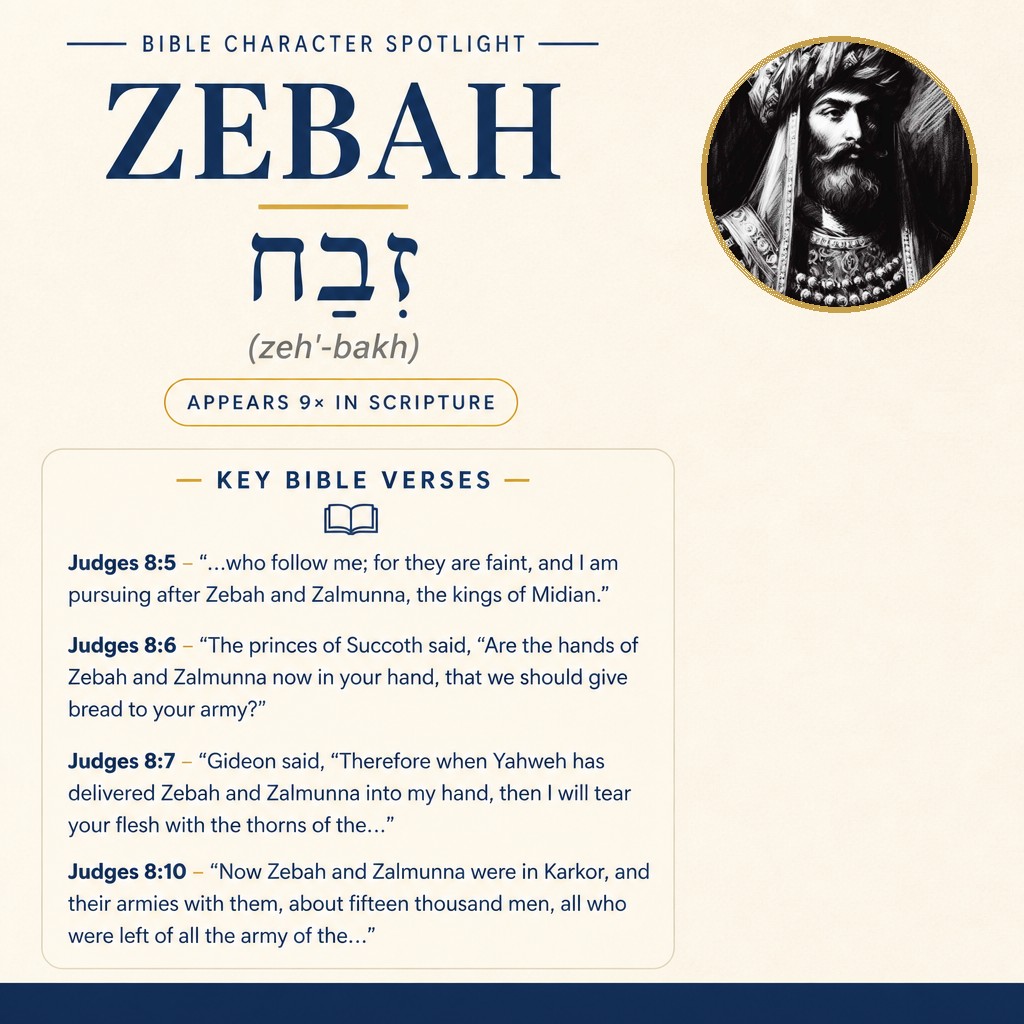
Zebah was a Midianite prince called a “king of Midian,” appearing in Judges 8 and mentioned in Psalm 83:11.

Judges Account
Gideon pursued “Zebah and Zalmunna, the kings of Midian” (Judges 8:5) and later “took the two kings of Midian, Zebah and Zalmunna” (Judges 8:12). Gideon “arose, and killed Zebah and Zalmunna” (Judges 8:21).
Learn More →Name Meaning
Strong’s derives the name Zebah from a Hebrew term meaning “sacrifice,” connected with slaughter and flesh.
Learn More →Zebah (Hebrew זֶבַח, transliterated Zebach) was a Midianite prince—described in Judges as one of “the kings of Midian”—whom Gideon pursued, captured, and killed. The name is derived from a Hebrew term connected with “sacrifice,” with a component sense of slaughtered flesh.
Zebah in Scripture
Zebah appears in the narrative of Judges 8 in connection with Gideon’s pursuit of Midian’s leadership after battle. The chapter opens with Gideon being sharply rebuked by the men of Ephraim for not calling them earlier to fight Midian (Judges 8:1). Gideon replies with conciliatory words, and “their anger was abated toward him” (Judges 8:3). Then the account turns to Gideon’s continued pursuit across the Jordan with a small, exhausted force: “Gideon came to the Jordan and passed over, he and the three hundred men who were with him, faint, yet pursuing” (Judges 8:4).
In that setting Gideon names his target: Zebah and another Midianite ruler, Zalmunna. Gideon requests food from the city of Succoth for his men, explicitly because he is pursuing the Midianite kings:
“Please give loaves of bread to the people who follow me; for they are faint, and I am pursuing after Zebah and Zalmunna, the kings of Midian.” (Judges 8:5)
The leaders of Succoth refuse, taunting Gideon about whether he has already captured these kings:
“Are the hands of Zebah and Zalmunna now in your hand, that we should give bread to your army?” (Judges 8:6)
Gideon answers with a conditional threat directed at Succoth, tied to Zebah’s capture:
“Therefore when Yahweh has delivered Zebah and Zalmunna into my hand, then I will tear your flesh with the thorns of the wilderness and with briers.” (Judges 8:7)
Gideon then goes to Penuel and “spoke to them in the same way,” receiving the same kind of answer (Judges 8:8). He warns Penuel, “When I come again in peace, I will break down this tower” (Judges 8:9). The narrative next gives Zebah’s location and the condition of the Midianite forces:
“Now Zebah and Zalmunna were in Karkor, and their armies with them, about fifteen thousand men, all who were left of all the army of the children of the east; for there fell one hundred twenty thousand men who drew sword.” (Judges 8:10)
Gideon advances by a route “on the east of Nobah and Jogbehah,” striking an army that “felt secure” (Judges 8:11). Zebah’s reaction is described along with his capture: “Zebah and Zalmunna fled and he pursued them. He took the two kings of Midian, Zebah and Zalmunna, and confused all the army” (Judges 8:12). In the flow of Judges 8, Zebah is consistently paired with Zalmunna as one of the two Midianite kings being hunted down.
After Gideon’s return “from the battle” (Judges 8:13), the story circles back to the earlier refusals. Gideon gathers information about Succoth’s leadership (Judges 8:14) and confronts the men of Succoth with the captured kings, quoting their earlier taunt:
“See Zebah and Zalmunna, concerning whom you taunted me, saying, ‘Are the hands of Zebah and Zalmunna now in your hand, that we should give bread to your men who are weary?’ ” (Judges 8:15)
Gideon then punishes Succoth using “thorns of the wilderness and briers” (Judges 8:16), and he fulfills his warning to Penuel by breaking down the tower and killing men of the city (Judges 8:17). With that local reckoning complete, Gideon turns again to Zebah and Zalmunna for an interrogation related to killings at Tabor:
“Then he said to Zebah and Zalmunna, ‘What kind of men were they whom you killed at Tabor?’ They answered, ‘They were like you. They all resembled the children of a king.’ ” (Judges 8:18)
Gideon responds by identifying the slain men as his own relatives: “They were my brothers, the sons of my mother” (Judges 8:19). He swears an oath and declares that their survival would have spared Zebah and Zalmunna: “As Yahweh lives, if you had saved them alive, I would not kill you” (Judges 8:19). Gideon then commands his firstborn son to execute them, but the young man refuses out of fear (Judges 8:20). Zebah speaks again alongside Zalmunna, urging Gideon himself to carry out the act:
“Then Zebah and Zalmunna said, ‘You rise and fall on us; for as the man is, so is his strength.’ Gideon arose, and killed Zebah and Zalmunna, and took the crescents that were on their camels’ necks.” (Judges 8:21)
In Judges 8, this is the end of Zebah’s role: he is captured as a king of Midian, questioned by Gideon about killings at Tabor, and then killed by Gideon. The immediate narrative then moves on to Israel’s response to Gideon—“Rule over us” (Judges 8:22)—and Gideon’s refusal: “Yahweh shall rule over you” (Judges 8:23). Those later verses provide the broader setting of the chapter but do not add further biographical detail about Zebah beyond his identity as a Midianite king/prince and his fate.
Outside Judges, Zebah’s name appears as a remembered example in a prayer from the Psalms. Psalm 83 petitions God concerning enemies and asks that their leaders be made like earlier defeated leaders, naming Zebah and Zalmunna among them:
“Make their nobles like Oreb and Zeeb, yes, all their princes like Zebah and Zalmunna,” (Psalm 83:11)
This reference treats Zebah as a representative “prince” whose downfall is invoked as a precedent.
Name and Meaning
The name is written in Hebrew as זֶבַח, transliterated Zebach, and pronounced zeh’-bakh. Its derivation is connected with a Hebrew word for “sacrifice,” and one component sense is “a slaughter,” understood as the flesh of what is slaughtered.
Observation
Across the quoted passages, Zebah is consistently paired with Zalmunna as a Midianite leader targeted in Gideon’s pursuit—named as “the kings of Midian” (Judges 8:5) and later remembered as exemplary “princes” (Psalm 83:11).
Frequently Asked Questions
What does the name Zebah mean?
Zebah means “sacrifice.”
How many times does Zebah appear in the Bible?
Zebah appears 9 times.
Who was Zebah?
Zebah was a Midianitish prince. In Judges 8 he is mentioned alongside Zalmunna as one of the kings of Midian (Judges 8:12).
What happened to Zebah in Gideon’s pursuit?
Gideon pursued Zebah and Zalmunna, took them, and later killed them (Judges 8:12, Judges 8:21).
Explore Further
If you found this page about Zebah interesting and would like to discover more about other biblical characters, explore our comprehensive Encyclopedia of Biblical Characters. For those looking to delve deeper into the Greek origins of these names and terms, our Greek Lexicon is an invaluable resource.
Sources: Name and occurrence data from Strong’s Exhaustive Concordance and STEPBible reference data (CC BY). Scripture quotations from the World English Bible (public domain).