
Who was Zalmunna in the bible?
Zalmunna was a king of Midian pursued and killed by Gideon, appearing chiefly in Judges 8 and referenced in Psalm 83:11.
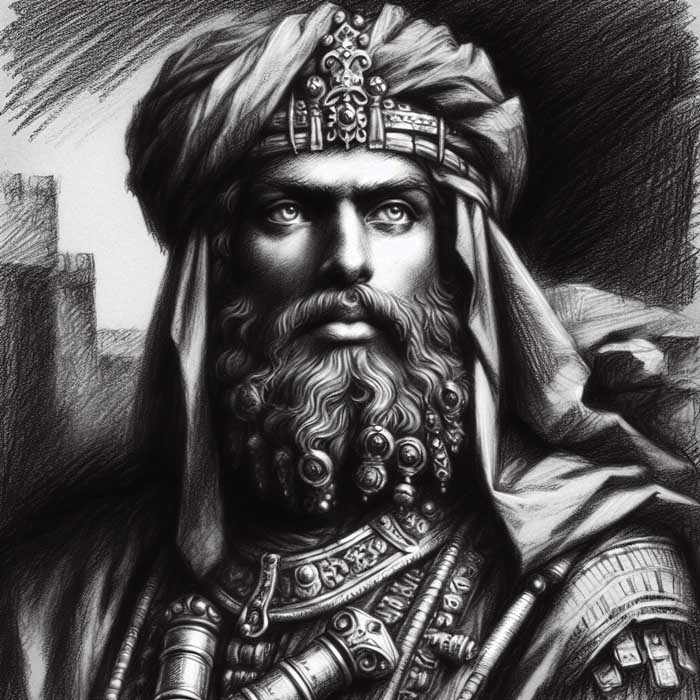
His Story
Zebah and Zalmunna “were in Karkor, and their armies with them” (Judges 8:10), then “fled and he pursued them” (Judges 8:12). Later, “Gideon arose, and killed Zebah and Zalmunna” (Judges 8:21).
Learn More →Name Meaning
The name Tsalmunna is glossed in a lexicon as a Midianite. Its Strong’s derivation is given as “shade has been denied.”
Learn More →Zalmunna was a Midianite king mentioned in Judges 8, pursued, captured, questioned, and killed by Gideon. The name (צַלְמֻנָּע, Tsalmunna’, pronounced tsal-moon-naw’) is glossed in lexicon material as meaning “shade has been denied.”

Zalmunna in Scripture
In the narrative of Gideon’s pursuit after Midian, Zalmunna appears alongside Zebah as one of “the kings of Midian.” Gideon, crossing the Jordan with his small force, sought provisions while continuing the chase.
“He said to the men of Succoth, ‘Please give loaves of bread to the people who follow me; for they are faint, and I am pursuing after Zebah and Zalmunna, the kings of Midian.’” (Judges 8:5, WEB)
The leaders of Succoth refused, challenging Gideon’s request by questioning whether the kings had already been subdued.
“The princes of Succoth said, ‘Are the hands of Zebah and Zalmunna now in your hand, that we should give bread to your army?’” (Judges 8:6, WEB)
Gideon answered by declaring that their refusal would be repaid once the pursuit succeeded.
“Gideon said, ‘Therefore when Yahweh has delivered Zebah and Zalmunna into my hand, then I will tear your flesh with the thorns of the wilderness and with briers.’” (Judges 8:7, WEB)
After similar interactions with Penuel (where Gideon said, “When I come again in peace, I will break down this tower.”; Judges 8:9), the text places the Midianite kings at Karkor with the remnants of their force.
“Now Zebah and Zalmunna were in Karkor, and their armies with them, about fifteen thousand men, all who were left of all the army of the children of the east; for there fell one hundred twenty thousand men who drew sword.” (Judges 8:10, WEB)
Gideon attacked the camp unexpectedly. The two kings attempted to escape, but Gideon captured them, and their army was thrown into confusion.
“Zebah and Zalmunna fled and he pursued them. He took the two kings of Midian, Zebah and Zalmunna, and confused all the army.” (Judges 8:12, WEB)
With the captured kings in view, Gideon returned to Succoth and confronted its leaders with their earlier taunt.
“He came to the men of Succoth, and said, ‘See Zebah and Zalmunna, concerning whom you taunted me, saying, “Are the hands of Zebah and Zalmunna now in your hand, that we should give bread to your men who are weary?” ’” (Judges 8:15, WEB)
The account then turns to Gideon’s direct questioning of the kings, focusing on a prior killing at Tabor. Gideon asks them what the men were like; the kings describe them with language of resemblance and royal bearing.
“Then he said to Zebah and Zalmunna, ‘What kind of men were they whom you killed at Tabor?’ They answered, ‘They were like you. They all resembled the children of a king.’” (Judges 8:18, WEB)
Gideon identifies the slain as closely related to him and frames his decision to execute the kings in terms of what would have happened “if you had saved them alive.”
“He said, ‘They were my brothers, the sons of my mother. As Yahweh lives, if you had saved them alive, I would not kill you.’” (Judges 8:19, WEB)
Gideon first instructed his firstborn, Jether, to kill the kings, but Jether did not act because of fear and youth (Judges 8:20). In response, Zebah and Zalmunna addressed Gideon directly, asking him to carry out the execution himself.
“Then Zebah and Zalmunna said, ‘You rise and fall on us; for as the man is, so is his strength.’ Gideon arose, and killed Zebah and Zalmunna, and took the crescents that were on their camels’ necks.” (Judges 8:21, WEB)
Later in Judges 8, the narrative continues with Gideon’s interactions with Israel and matters of plunder, including mention of items associated with “the kings of Midian.” While Zalmunna is not named in those later verses, the earlier identification of him as one of the kings provides the setting for the reference.
“The weight of the golden earrings that he requested was one thousand and seven hundred shekels of gold, in addition to the crescents, and the pendants, and the purple clothing that was on the kings of Midian, and in addition to the chains that were about their camels’ necks.” (Judges 8:26, WEB)
Outside Judges, Zalmunna appears in a prayer in Psalms, where the psalmist calls for the enemies’ leaders to be made like earlier defeated figures, naming Zebah and Zalmunna among them.
“Make their nobles like Oreb and Zeeb, yes, all their princes like Zebah and Zalmunna,” (Psalm 83:11, WEB)
Multiple bearers
The provided references present Zalmunna as a single figure: a Midianite king paired with Zebah, pursued by Gideon and killed (Judges 8:5–21), and later invoked as a representative example of defeated leadership (Psalm 83:11).
Name and Meaning
Zalmunna is written in Hebrew as צַלְמֻנָּע and transliterated Tsalmunna’, pronounced tsal-moon-naw’. Lexicon material derives the name from a combination of terms associated with “shade” (tsel, צֵל) and “to debar” (mana’, מָנַע), yielding the sense “shade has been denied.”
Observation
Within Judges 8, Zalmunna is consistently presented as a king whose fate is tied to Gideon’s pursuit and victory: “He took the two kings of Midian, Zebah and Zalmunna” (Judges 8:12, WEB), and “Gideon arose, and killed Zebah and Zalmunna” (Judges 8:21, WEB).
Frequently Asked Questions
What does the name Zalmunna mean?
The name Zalmunna is given the meaning “shade has been denied.”
How many times does Zalmunna appear in the Bible?
Zalmunna appears 9 times.
Who was Zalmunna?
Zalmunna (Tsalmunna) is identified as a Midianite. In Judges 8 he is mentioned along with Zebah as one of the “two kings of Midian” (Judges 8:12).
What happened to Zalmunna in Gideon’s pursuit?
Gideon pursued Zebah and Zalmunna, took them, and later killed them (Judges 8:12; Judges 8:21).
Explore Further
If you found this page about Zalmunna interesting and would like to discover more about other biblical characters, explore our comprehensive Encyclopedia of Biblical Characters. For those looking to delve deeper into the Greek origins of these names and terms, our Greek Lexicon is an invaluable resource.
Sources: Name and occurrence data from Strong’s Exhaustive Concordance and STEPBible reference data (CC BY). Scripture quotations from the World English Bible (public domain).





